

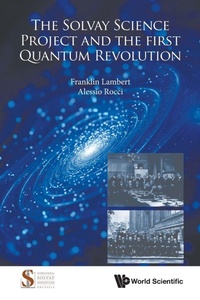
The Solvay Science Project And The First Quantum Revolution
Published on 15. August 2025
Book
Paperback/Softback
268 pages
978-981-98-1868-6 (ISBN)
Description
This book presents a historical reconstruction of the first quantum revolution, from the first Solvay meeting (1911) to the fifth Physics Council (1927). The reader is guided through a journey to discover how a project envisioned by Ernest Solvay - the Solvay Science Project - contributed to this process. The authors investigate two of its main aspects: the five Physics Councils chaired by H A Lorentz and the subsidy programme of the International Solvay Institute of Physics (ISIP). Special attention is given to a point that escaped the attention of most science historians: how Solvay subsidies, granted by an International Committee, contributed to the validation of Bohr's atomic theory, one of the most significant steps in the quantum revolution. More than ten beneficiaries of Solvay grants were named by Bohr in his Rutherford Memorial Lecture; six were awarded a Nobel Prize.The book contains a detailed analysis of the steps taken by ISIP's Scientific Committee to prepare the Councils that marked the transition from classical to quantum physics. Emphasis is placed on the information provided by X-ray research and by C T R Wilson's cloud chamber, two elements that paved the way to a recognition of the dual nature of light and matter, a fundamental characteristic of the quantum world.
More details
Language
English
Place of publication
Singapore
Singapore
Target group
College/higher education
Professional and scholarly
Dimensions
Height: 229 mm
Width: 152 mm
Thickness: 15 mm
Weight
396 gr
ISBN-13
978-981-98-1868-6 (9789819818686)
Copyright in bibliographic data and cover images is held by Nielsen Book Services Limited or by the publishers or by their respective licensors: all rights reserved.
Schweitzer Classification