

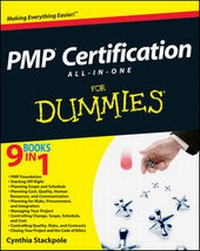
PMP Certification All-In-One Desk Reference For Dummies
1st Edition
Published on 30. September 2011
Book
Paperback/Softback
864 pages
978-0-470-08715-2 (ISBN)
Description
* Nine minibooks filling more than 700 pages give project managers the information and practice they need to pass the Project Management Professional (PMP) exam-and watch their salaries grow by an average of 8 percent!
* Each minibook covers one domain of the Project Management Common Body of Knowledge: communications management, cost management, human resources management, integration management, procurement management, quality management, risk management, scope management, and time management
* Offers complete coverage of the challenging PMP certification requirements, lots of practice questions, and a CD-ROM with exclusive, fully customizable test-prep software
* Over 200,000 people currently hold the PMP certification, and the Project Management Institute (PMI) administers 13,000 PMP exams a month, on average; PMI membership has grown by over 19 percent in each of the last two years
More details
Edition
1., Auflage
Language
English
Place of publication
Chichester
United Kingdom
Publishing group
John Wiley and Sons Ltd
Target group
Professional and scholarly
Dimensions
Height: 25.1 cm
Width: 25.1 cm
Thickness: 22 mm
Weight
408 gr
ISBN-13
978-0-470-08715-2 (9780470087152)
Schweitzer Classification
Other editions
New editions
Cynthia Snyder
PMP Certification All-in-One For Dummies
Book
10/2013
2nd Edition
Wiley
€38.90
Article exhausted; check different version
Person
Cynthia Stackpole is a professional project management consultant, instructor, and author. She provides consulting and training services for government and private industry as well as corporate, public sector, and academic environments. She was Project Manager for the PMBOK Guide, Fourth Edition.
Content
Introduction 1
Book I: PMP Foundation 7
Chapter 1: The PMP Exam 9
Chapter 2: Foundations of Project Management 23
Chapter 3: Project Life Cycles, Organizational Structures, and Organizational Process Assets 39
Chapter 4: It's All about the Process 57
Book II: Starting Off Right 87
Chapter 1: OMG! It's a Project! 89
Chapter 2: Chartering Your Project 109
Chapter 3: Identifying Project Stakeholders 129
Book III: Planning Scope and Schedule 149
Chapter 1: Defi ning Project Scope 151
Chapter 2: Creating Your Schedule 183
Book IV: Planning Cost, Quality, Human Resources, and Communication 227
Chapter 1: Estimating the Price Tag 229
Chapter 2: Planning for Quality 255
Chapter 3: Identifying Your Team Members 277
Chapter 4: 90 Percent of Your Job Is Communication 293
Book V: Planning for Risks, Procurement, and Integration 311
Chapter 1: Identifying What Could Go Wrong 313
Chapter 2: Getting Help -- Procuring Project Scope 359
Chapter 3: Constructing the Project Management Plan 381
Book VI: Managing Your Project 401
Chapter 1: Executing Your Project and Assuring Quality 403
Chapter 2: Managing the People Side of Your Project 425
Chapter 3: Getting the Word Out to Stakeholders and Contractors 457
Book VII: Controlling Change, Scope, Schedule, and Cost 481
Chapter 1: Monitoring, Controlling, and Managing Change 483
Chapter 2: Controlling Project Scope 505
Chapter 3: Controlling Your Schedule 525
Chapter 4: Controlling Cost and Using Earned Value 543
Book VIII: Controlling Quality, Risks, and Contracts 571
Chapter 1: Controlling Quality 573
Chapter 2: Reporting--The Good, the Bad, and the Ugly 597
Chapter 3: Managing Your Risks and Procurements 621
Book IX: Closing Your Project and the Code of Ethics 645
Chapter 1: Closing Your Contracts and Your Project 647
Chapter 2: The PMI Code of Ethics and Professional Conduct 671
Appendix A: What's on the CD 691
Appendix B: Practice Test 695
Appendix C: Lab Work 723
Appendix D: Exam Objective Cross Walk 749
Glossary 763
Index 801