

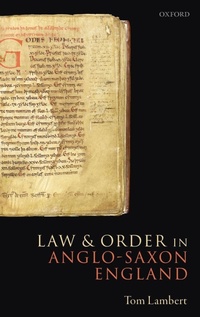
Law and Order in Anglo-Saxon England
Published on 16. February 2017
Book
Hardback
416 pages
978-0-19-878631-3 (ISBN)
Description
Law and Order in Anglo-Saxon England explores English legal culture and practice across the Anglo-Saxon period, beginning with the essentially pre-Christian laws enshrined in writing by King AEthelberht of Kent in c. 600 and working forward to the Norman Conquest of 1066. It attempts to escape the traditional retrospective assumptions of legal history, focused on the late twelfth-century Common Law, and to establish a new interpretative framework for the subject, more sensitive to contemporary cultural assumptions and practical realities.
The focus of the volume is on the maintenance of order: what constituted good order; what forms of wrongdoing were threatening to it; what roles kings, lords, communities, and individuals were expected to play in maintaining it; and how that worked in practice. Its core argument is that the Anglo-Saxons had a coherent, stable, and enduring legal order that lacks modern analogies: it was neither state-like nor stateless, and needs to be understood on its own terms rather than as a variant or hybrid of these models. Tom Lambert elucidates a distinctively early medieval understanding of the tension between the interests of individuals and communities, and a vision of how that tension ought to be managed that, strikingly, treats strongly libertarian and communitarian features as complementary. Potentially violent, honour-focused feuding was an integral aspect of legitimate legal practice throughout the period, but so too was fearsome punishment for forms of wrongdoing judged socially threatening. Law and Order in Anglo-Saxon England charts the development of kings' involvement in law, in terms both of their authority to legislate and their ability to influence local practice, presenting a picture of increasingly ambitious and effective royal legal innovation that relied more on the cooperation of local communal assemblies than kings' sparse and patchy network of administrative officials.
The focus of the volume is on the maintenance of order: what constituted good order; what forms of wrongdoing were threatening to it; what roles kings, lords, communities, and individuals were expected to play in maintaining it; and how that worked in practice. Its core argument is that the Anglo-Saxons had a coherent, stable, and enduring legal order that lacks modern analogies: it was neither state-like nor stateless, and needs to be understood on its own terms rather than as a variant or hybrid of these models. Tom Lambert elucidates a distinctively early medieval understanding of the tension between the interests of individuals and communities, and a vision of how that tension ought to be managed that, strikingly, treats strongly libertarian and communitarian features as complementary. Potentially violent, honour-focused feuding was an integral aspect of legitimate legal practice throughout the period, but so too was fearsome punishment for forms of wrongdoing judged socially threatening. Law and Order in Anglo-Saxon England charts the development of kings' involvement in law, in terms both of their authority to legislate and their ability to influence local practice, presenting a picture of increasingly ambitious and effective royal legal innovation that relied more on the cooperation of local communal assemblies than kings' sparse and patchy network of administrative officials.
Reviews / Votes
This is an important book. Representing the most significant rethinking of Anglo-Saxon law and order ... its arguments will be rehearsed and revisited for years to come ... This is a truly superb first monograph, which will not only change the way we approach Anglo-Saxon law and order, but how we think about legislation and society in the early medieval West more generally. I cannot recommend it strongly enough. * Levi Roach, History * Tom Lambert has written an immensely stimulating book, which carefully attempts to piece together the ideal vision of social order lying behind the laws of Anglo-Saxon England. It deserves attention from a wide audience. * Conor O'Brien, Churchill College, Cambridge, Early Medieval Europe * Tom Lambert has produced an enormously rich book - essential reading for anyone interested not just in the law, but in the society and rule of early England. * Pauline Stafford, Times Literary Supplement * Law and Order in Anglo-Saxon England makes good on its promises, persuasively demonstrating the role of Anglo-Saxon communities in enforcing law, and the role of legal assemblies in constituting communities, over the course of four centuries. It is precisely because it able to draw these imaginative connections, engaging with matters of identity and community as much as it does legal and social order, that this book deserves a wide audience. * Philippa Byrne, Reviews in History * this book is an important contribution to the scholarship on Anglo-Saxon law and legal culture, one that deserves a place in bibliographies and classrooms, and will certainly have a place in my own. * Jay Gates, H-Law *More details
Language
English
Place of publication
Oxford
United Kingdom
Target group
College/higher education
Professional and scholarly
Dimensions
Height: 240 mm
Width: 161 mm
Thickness: 27 mm
Weight
787 gr
ISBN-13
978-0-19-878631-3 (9780198786313)
Copyright in bibliographic data and cover images is held by Nielsen Book Services Limited or by the publishers or by their respective licensors: all rights reserved.
Schweitzer Classification
Other editions
Additional editions
Tom Lambert
Law and Order in Anglo-Saxon England
E-Book
02/2017
1st Edition
OUP eBook
€70.99
Available for download
Tom Lambert
Law and Order in Anglo-Saxon England
E-Book
02/2017
1st Edition
OUP eBook
€81.49
Available for download
Person
Tom Lambert was born and grew up in York. He spent nearly a decade based at the University of Durham, as an undergraduate, postgraduate, and seminar tutor. Since gaining his doctorate in 2009, he has held a Past and Present Postdoctoral Fellowship at the Institute of Historical Research in London, and spent five very happy years teaching and researching in Oxford. Much of the work for Law and Order in Anglo-Saxon England was carried out between 2012 and 2015, when he was the Bennett Boskey Fellow in History at Exeter College, Oxford. He is now a Fellow of Sidney Sussex College, Cambridge.
Content
PART I: THE FOUNDATIONS OF THE ANGLO-SAXON LEGAL ORDER; PART II: ORDER AND "THE STATE" IN LATE ANGLO-SAXON ENGLAND