

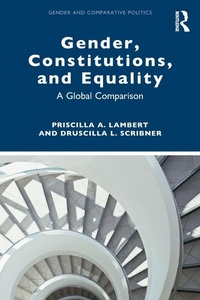
Gender, Constitutions, and Equality
A Global Comparison
1st Edition
Published on 15. June 2023
Book
Paperback/Softback
154 pages
978-1-032-30161-7 (ISBN)
Description
This book addresses whether the "gendering" of constitutions promotes women's equality.
The authors use a mixed-methods approach to explore how constitutional gender rights affect political processes and strategies, legislative and judicial outcomes, and ultimately women's equality. They employ a cross-national study by constructing a unique database of gender provisions in over 100 countries at three points in time: 1995, 2005, and 2015. Four in-depth comparative case studies on Argentina, Chile, South Africa, and Botswana trace the complex relationship between constitutional law, strategies, and policy change in four policy areas: family law, gender-based violence, reproductive rights, and employment rights. They argue that where egalitarian constitutional provisions are present, women's rights advocates can use them as a tool to fight gender discrimination and pursue policy changes that address gender-based power disparities.
At a time when gender equality provisions are increasingly common in constitutional design, this book clarifies the mechanisms that link constitutional provisions to changes in process and outcomes while also systematically describing and analyzing the effect of gender provisions across countries and over time. Gender, Constitutions, and Equality will inform theoretical debates on gender and politics, law and social change, feminist institutionalism, and constitutional design and its effect on legislation and political strategies.
The authors use a mixed-methods approach to explore how constitutional gender rights affect political processes and strategies, legislative and judicial outcomes, and ultimately women's equality. They employ a cross-national study by constructing a unique database of gender provisions in over 100 countries at three points in time: 1995, 2005, and 2015. Four in-depth comparative case studies on Argentina, Chile, South Africa, and Botswana trace the complex relationship between constitutional law, strategies, and policy change in four policy areas: family law, gender-based violence, reproductive rights, and employment rights. They argue that where egalitarian constitutional provisions are present, women's rights advocates can use them as a tool to fight gender discrimination and pursue policy changes that address gender-based power disparities.
At a time when gender equality provisions are increasingly common in constitutional design, this book clarifies the mechanisms that link constitutional provisions to changes in process and outcomes while also systematically describing and analyzing the effect of gender provisions across countries and over time. Gender, Constitutions, and Equality will inform theoretical debates on gender and politics, law and social change, feminist institutionalism, and constitutional design and its effect on legislation and political strategies.
More details
Series
Language
English
Place of publication
London
United Kingdom
Publishing group
Taylor & Francis Ltd
Target group
College/higher education
Postgraduate and Undergraduate
Illustrations
9 s/w Abbildungen, 9 s/w Zeichnungen, 9 s/w Tabellen
9 Tables, black and white; 9 Line drawings, black and white; 9 Illustrations, black and white
Dimensions
Height: 229 mm
Width: 152 mm
Thickness: 9 mm
Weight
256 gr
ISBN-13
978-1-032-30161-7 (9781032301617)
Copyright in bibliographic data and cover images is held by Nielsen Book Services Limited or by the publishers or by their respective licensors: all rights reserved.
Schweitzer Classification
Other editions
Additional editions
E-Book
06/2023
1st Edition
Routledge
€53.99
Available for download
Book
06/2023
1st Edition
Routledge
€195.70
Shipment within 10-20 days
E-Book
06/2023
1st Edition
Routledge
€53.99
Available for download
Persons
Priscilla A. Lambert is Associate Professor of Political Science at Western Michigan University. She received her Ph.D. from the University of California San Diego in 2004 and specializes in comparative politics, Japanese politics, welfare state politics, and women and politics. She has published articles on these topics in Comparative Politics, Gender and Politics, the Journal of Japanese Studies, Social Politics, Politics, Groups and Identities, and the Journal of Politics in Latin America.
Druscilla L. Scribner is Professor of Political Science at the University of Wisconsin Oshkosh. She received her Ph.D. from the University of California San Diego in 2004 and specializes in comparative politics, Latin American judicial politics, and women and politics. She has published articles on these topics in Comparative Politics, Gender and Politics, Global Policy, Politics, Groups and Identities, and the Journal of Politics in Latin America.
Druscilla L. Scribner is Professor of Political Science at the University of Wisconsin Oshkosh. She received her Ph.D. from the University of California San Diego in 2004 and specializes in comparative politics, Latin American judicial politics, and women and politics. She has published articles on these topics in Comparative Politics, Gender and Politics, Global Policy, Politics, Groups and Identities, and the Journal of Politics in Latin America.
Content
1. Gendering Constitutions 2. Why Constitutions Matter for Gender Equality 3. Constitutional Gender Provisions and Equality: Cross-national Evidence 4. Gender Provisions, Rights Advocacy, and Policy Outcomes in Chile and Argentina 5. Gender Provisions, Rights Advocacy, and Policy Outcomes in Botswana and South Africa 6. Conclusion Appendix A: Coding constitutions and construction of egalitarian and maternal provisions scores Appendix B: Egalitarian and maternal constitutional provision scores, 1995-2015