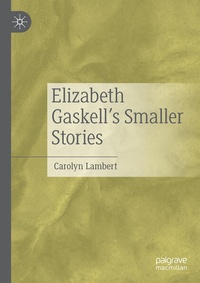
This book re-locates Elizabeth Gaskell's 'smaller stories' in the literary and cultural context of the nineteenth century. While Gaskell is recognised as one of the major novelists of her time, the short stories that make up a large proportion of her published work have not yet received the critical attention they deserve. This study re-claims them as an indispensable part of her literary output that enables us to better contextualize and assess her achievement holistically as a highly-skilled woman of letters. The periodicals in which Gaskell's shorter pieces were published offer a microcosm of nineteenth-century society, and Gaskell took full advantage of the medium to apply a consistent and barbed challenge to cultural and gendered constructs of roles and social behaviour. Although her eminently readable prose still flows easily in her short stories, it is less likely to elide the sharp corners of domestic violence, the disabling experiences of women, the pain of death and loss, andthe complications of family life.
Reviews / Votes
"Though this book does not break new ground in Gaskell criticism, it does assemble in one place solid readings of a large body of her short fiction; scholars of Gaskell will also appreciate that the introduction and appendix provide a readable and succinct guide to her dealings with the publishing world." (Melissa Schaub, Victorian Studies, Vol. 65 (4), 2023)
Edition
Language
Place of publication
Publishing group
Springer International Publishing
Target group
Professional and scholarly
Illustrations
Dimensions
Height: 210 mm
Width: 148 mm
Thickness: 12 mm
Weight
ISBN-13
978-3-030-79707-2 (9783030797072)
DOI
10.1007/978-3-030-79705-8
Schweitzer Classification
Carolyn Lambert
is the author of
The Meanings of Home in Elizabeth Gaskell's Fiction
(2013), co-editor with Marion Shaw of
For Better, For Worse: Marriage in Victorian Novels by Women
(2018) and the author of
Frances Trollope
(2020).
1 Introduction.- 2 The Gothic and the Ghostly.- 3 Fairy Tales.- 4 Narrating Sexuality.- 5 Narrative Architecture.- 6 Conclusion.