

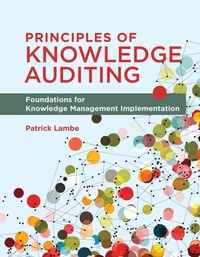
Principles of Knowledge Auditing
Foundations for Knowledge Management Implementation
Published on 2. May 2023
Book
Paperback/Softback
392 pages
978-0-262-54503-7 (ISBN)
Description
"An expert on the topic of knowledge managment argues how the process of KM implementation can be improved"--
More details
Language
English
Place of publication
Cambridge (Massachusetts)
United States
Publishing group
MIT Press Ltd
Dimensions
Height: 229 mm
Width: 182 mm
Thickness: 35 mm
Weight
588 gr
ISBN-13
978-0-262-54503-7 (9780262545037)
Copyright in bibliographic data and cover images is held by Nielsen Book Services Limited or by the publishers or by their respective licensors: all rights reserved.
Schweitzer Classification
Other editions
Additional editions
E-Book
05/2023
MIT Press
€48.99
Available for download
Person
Patrick Lambe
Content
Introduction 1
I Recovering Our Past
1 Seeking to Understand Knowledge in Organizations 15
2 The History of Knowledge Audits 23
II Speaking Clearly about Audits
3 What is an Audit? A Definitional Approach 31
4 What Kind of Audit Is a Knowledge Audit? A Naturalistic Approach 43
5 What Are We Auditing? 63
III Drivers and Motivations
6 What Stimulated the Emergence of Knowledge-Related Audits? 77
7 Beginnings and Improvisations: Discovery Review, Inventory, and Participative Goal-Setting Audits 101
8 Authority Envy: Assessment Audits and Standards in Communication and Information Audits 127
9 The Battle for Standards in Knowledge Management 145
IV Speaking Clearly about Knowledge
10 Risky Metaphors 185
11 The Syllepsis Trap: When Choice of Language Becomes Problematic 191
12 The Language of Value: Assets and Capital 203
13 The Language of Value: Resources 227
14 Ascribing Value to Knowledge and the Implications for Influence and Control 245
15 The Inventory Audit: Auditing Knowledge Stocks 253
16 Unhelpful Dualisms: The Personal-Collective Dualism 261
17 Unhelpful Dualisms: The Tacit-Explicit Dualism 283
18 Typologies of Personal Knowledge 293
19 Typologies of Organizational Knowledge 301
20 Toward Integration: Typologies of Functional Knowledge 331
21 Conclusion: Possibilities 347
References 355
Index 393
I Recovering Our Past
1 Seeking to Understand Knowledge in Organizations 15
2 The History of Knowledge Audits 23
II Speaking Clearly about Audits
3 What is an Audit? A Definitional Approach 31
4 What Kind of Audit Is a Knowledge Audit? A Naturalistic Approach 43
5 What Are We Auditing? 63
III Drivers and Motivations
6 What Stimulated the Emergence of Knowledge-Related Audits? 77
7 Beginnings and Improvisations: Discovery Review, Inventory, and Participative Goal-Setting Audits 101
8 Authority Envy: Assessment Audits and Standards in Communication and Information Audits 127
9 The Battle for Standards in Knowledge Management 145
IV Speaking Clearly about Knowledge
10 Risky Metaphors 185
11 The Syllepsis Trap: When Choice of Language Becomes Problematic 191
12 The Language of Value: Assets and Capital 203
13 The Language of Value: Resources 227
14 Ascribing Value to Knowledge and the Implications for Influence and Control 245
15 The Inventory Audit: Auditing Knowledge Stocks 253
16 Unhelpful Dualisms: The Personal-Collective Dualism 261
17 Unhelpful Dualisms: The Tacit-Explicit Dualism 283
18 Typologies of Personal Knowledge 293
19 Typologies of Organizational Knowledge 301
20 Toward Integration: Typologies of Functional Knowledge 331
21 Conclusion: Possibilities 347
References 355
Index 393