

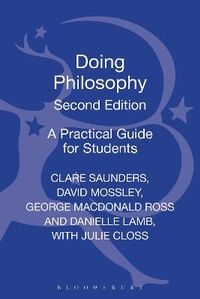
Doing Philosophy
A Practical Guide for Students
2nd Edition
Published on 1. November 2012
Book
Hardback
256 pages
978-1-4411-0897-5 (ISBN)
Description
Doing Philosophy provides a practical guide to studying philosophy for undergraduate students. The book presents strategies for developing the necessary skills that will allow students to get the most out of this fascinating subject. It examines what it means to think, read, discuss and write philosophically, giving advice on:
Reading and analysing philosophical texts
Preparing for and participating in seminars
Choosing essay topics
Constructing arguments and avoiding plagiarism
Using libraries, the internet and other resources
Technical terms, forms of expression and logical notation The second edition is fully revised and expanded throughout, packed with practical exercises, useful examples and fully up-to-date resources. It also features for the first time a full companion website with additional resources and a range of pedagogical tools and activities designed for students and lecturers to use both in the classroom and in seminar preparation.
Concise and accessible, Doing Philosophy equips the student with the tools needed to successfully engage in discussing, reading and writing philosophy.
Reading and analysing philosophical texts
Preparing for and participating in seminars
Choosing essay topics
Constructing arguments and avoiding plagiarism
Using libraries, the internet and other resources
Technical terms, forms of expression and logical notation The second edition is fully revised and expanded throughout, packed with practical exercises, useful examples and fully up-to-date resources. It also features for the first time a full companion website with additional resources and a range of pedagogical tools and activities designed for students and lecturers to use both in the classroom and in seminar preparation.
Concise and accessible, Doing Philosophy equips the student with the tools needed to successfully engage in discussing, reading and writing philosophy.
Reviews / Votes
'Anyone coming to the study of philosophy at university for the first time will find help here, and some more advanced students might gain from reading it, too...by offering a clear account of some of the barriers to successful engagement with philosophical texts and questions, and helping to overcome them, [the authors] have done a real service.' Dr Dave Leal, Brasenose College, University of Oxford, UK 'This is an excellent book, and I'll definitely be advising my first-year Philosophy students to buy it. Doing Philosophy basically tells the student beginning philosophy at university everything they need to know. The topics include finding resources, reading philosophy, plagiarism, referencing, taking notes, seminar discussions, and more. In particular, I think the chapter on writing philosophy - and especially the examples of essay questions, together with advice on how to tackle them - will be hugely useful. It's easy to forget just how different writing a philosophy essay is to anything else most beginning philosophy students have done; even (perhaps especially) those who have studied philosophy at A-level. The authors guide the student through each question, showing them how to find and filter relevant information, how to make sure they stick to the question, and how to maintain a properly philosophical approach to the topic. I'm sure beginning students - and their teachers - will be very grateful. Professor Helen Beebee, University of Birmingham, UK. "...well worth a read for those either preparing to or currently studying philosophy for the first time. Indeed, it will help many students to understand that, as the authors recognise, 'the focus of your philosophical study will be to learn not what to believe, but how to think.'" Emma L Williams, Philosopher in Residence, Rugby School, UKMore details
Edition
2nd edition
Language
English
Place of publication
New York
United States
Publishing group
Bloomsbury Publishing Plc
Target group
Professional and scholarly
Dimensions
Height: 216 mm
Width: 138 mm
Weight
465 gr
ISBN-13
978-1-4411-0897-5 (9781441108975)
DOI
CBID167314
Copyright in bibliographic data and cover images is held by Nielsen Book Services Limited or by the publishers or by their respective licensors: all rights reserved.
Schweitzer Classification
Other editions
Additional editions
Danielle Lamb | David Mossley | George MacDonald Ross
Doing Philosophy
A Practical Guide for Students
E-Book
03/2013
2nd Edition
Bloomsbury Academic USA
€29.99
Available for download
Danielle Lamb | David Mossley | George MacDonald Ross
Doing Philosophy
A Practical Guide for Students
E-Book
03/2013
2nd Edition
Bloomsbury Academic USA
€29.99
Available for download
Previous edition
George MacDonald Ross | Clare Saunders | David Mossley
Doing Philosophy
A Practical Guide for Students
Book
04/2008
Continuum International Publishing Group Ltd.
€88.20
Article exhausted; check for reprint
Persons
George MacDonald Ross is former Director of the Subject Centre for Philosophical and Religious Studies, and Visiting Senior Lecturer in Philosophy at the University of Leeds, UK. In 2006 he was awarded a National Teaching Fellowship for his contribution to the improvement of learning and teaching in higher education in the UK.
Content
Introduction \ 1. Studying Philosophy
\ 1.1 What is philosophy? \ 1.2 Why study philosophy? \ 1.3 What does studying
philosophy involve? \ 1.4 Summary \ 2. Reading Philosophy \ 2.1 What to
read \ 2.2 How to read \ 2.3 Summary \ 3. Taking Notes \ 3.1 Why is
note-taking important? \ 3.2 Content- what should I write down? \ 3.3 Method-
how should I go about taking notes? \ 3.4 An example of effective note taking 3.5 Tailoring your methods to your context \ 3.6 Making best use of your notes
\ 3.7 Summary \ 4. Discussion \ 4.1 The value of discussion \ 4.2
Discussion seminars \ 4.3 Other forms of discussion \ 4.4 Summary \ 5.
Writing Philosophy \ 5.1 What to write \ 5.2 How to Write 5.3 Example assignments \ 5.4 Assessment and feedback \ 5.5 Summary \ 6.
Resources \ 6.1 Library resources \ 6.2 Internet resources \ 6.3 Support
systems \ 6.4 Some useful philosophical terms \ Index
\ 1.1 What is philosophy? \ 1.2 Why study philosophy? \ 1.3 What does studying
philosophy involve? \ 1.4 Summary \ 2. Reading Philosophy \ 2.1 What to
read \ 2.2 How to read \ 2.3 Summary \ 3. Taking Notes \ 3.1 Why is
note-taking important? \ 3.2 Content- what should I write down? \ 3.3 Method-
how should I go about taking notes? \ 3.4 An example of effective note taking 3.5 Tailoring your methods to your context \ 3.6 Making best use of your notes
\ 3.7 Summary \ 4. Discussion \ 4.1 The value of discussion \ 4.2
Discussion seminars \ 4.3 Other forms of discussion \ 4.4 Summary \ 5.
Writing Philosophy \ 5.1 What to write \ 5.2 How to Write 5.3 Example assignments \ 5.4 Assessment and feedback \ 5.5 Summary \ 6.
Resources \ 6.1 Library resources \ 6.2 Internet resources \ 6.3 Support
systems \ 6.4 Some useful philosophical terms \ Index