

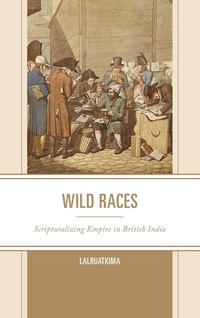
Wild Races
Scripturalizing Empire in British India
Published on 5. January 2024
Book
Hardback
220 pages
978-1-9787-1644-5 (ISBN)
Description
This book analyzes the narrative dynamics of social formations in British India, using statistical and ethnographic records, visual cultures, and linguistic exercises to describe the British Empire's production of knowledge about so-called "strange new worlds." Lalruatkima then labels these narrative dynamics as "scripturalizing" to account for the creation, or writing, of these worlds into existence. This focus underscores empire as one of many such formations imagined against the backdrop of contested conversations about what it is and what it could be. When reverse engineered, empire throws into sharp relief its constituent narrative placeholders, and the sequences of meaning-making that connect them. Power differentials between the imperial center and frontier determine the placeholders and how they fit into the larger narrative. These discursive components in turn engender the politically charged attitudes and relations within the imperial domain. Lalruatkima excavates the imperial archive for material that accounts for these narrative dynamics.
Reviews / Votes
Wild Races exemplifies the rich, layered research called for-or better said-demanded by the Signifying (on) Scriptures project. It transgresses the disciplinary boundaries and canonical data sets that undergird the conventions that make regimes like racial empire possible. Lalruatkima presses us to re-examine the postures, practices, and politics of reading so that make we might more honestly account for the violence and creativity of scripturalization. -- Richard Newton, University of Alabama Tracing how British imperial reports, maps, photos, dictionaries, and churches worked their magic to conjure up the "reality" of ethnic identity, history, cartography, and even the modern Indian state of Mizoram, Lalruatkima shows how colonial politics are shot through normalized objects of postcolonial inquiry. Exploring the persistent eruptions of agency by what are known in India as scheduled tribes, this critique contributes to global Indigenous studies by untying the binaries of difference that attempt (and fail) to found the nation-state and to enforce power inequalities. -- Joe Parker, Pitzer College Wild Races: Scripturalizing Empire in British India by Lalruatkima presents a refreshing post-colonial reading of the history of the Mizos in the Northeastern part of India. For a non-literate tribe like the Mizos, the colonial scripturalizing enterprise formed the very foundation of colonial hegemony that left a strong legacy even after colonial departure. Framed as 'wild races', the Mizos were locked in a mental cell that circumscribed their thought process and behaviors. Navigating through the historical development in the Mizo Hills, this book illuminates those dark cells and offers new light to the life and history of the Mizos. -- Rohmingmawii, Pachhunga University CollegeMore details
Series
Language
English
Place of publication
United States
Publishing group
Bloomsbury Publishing Plc
Target group
Professional and scholarly
Dimensions
Height: 235 mm
Width: 157 mm
Thickness: 18 mm
Weight
515 gr
ISBN-13
978-1-9787-1644-5 (9781978716445)
Copyright in bibliographic data and cover images is held by Nielsen Book Services Limited or by the publishers or by their respective licensors: all rights reserved.
Schweitzer Classification
Other editions
Additional editions
E-Book
01/2024
1st Edition
Lexington Books/Fortress Academic
€90.99
Available for download
E-Book
01/2024
1st Edition
Bloomsbury eBooks US
€90.99
Available for download
Person
Lalruatkima teaches religion at the Academy of Integrated Christian Studies (AICS) in Aizawl, India.
Content
Introduction
1. Textures and Tensions of Imperial Imaginations
2. Civilizing the Wild Races
3. Framing Wildness
4. Translations and Translingual Exchanges
Conclusion
1. Textures and Tensions of Imperial Imaginations
2. Civilizing the Wild Races
3. Framing Wildness
4. Translations and Translingual Exchanges
Conclusion