

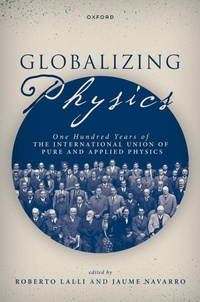
Globalizing Physics
One Hundred Years of the International Union of Pure and Applied Physics
Published on 9. July 2024
Book
Hardback
336 pages
978-0-19-887868-1 (ISBN)
Description
This is an open access book available under the terms of a CC BY-NC-ND 4.0 International licence. It is free to read on the Oxford Academic platform and offered as a free PDF download from OUP and selected open access locations.
Following the centenary of the International Union of Pure and Applied Physics, this volume features contributions from leading science historians from around the world on the changing roles of the institution in international affairs from its foundation in 1922 to the present. The case studies presented in this volume show the multitude of functions that IUPAP had and how these were related to the changing international political contexts.
The book is divided into three parts. The first discusses the interwar period demonstrating how the exclusion of communities of the Central Powers from international scientific institutions imposed by victorious allied countries made IUPAP ineffective until the end of World War II. The second part analyzes the changing roles assumed by IUPAP starting from its complete renovation after World War II. Case studies covering the role of IUPAP in physics education, in metrology, in joint commissions with other unions and in defining the complex relations between pure and applied physics provide examples of IUPAP's impact on the world of science. Part III squarely addresses the science diplomacy aspects of IUPAP during the Cold War highlighting the importance of IUPAP in furthering diplomatic goals and explaining the origin of the pursuit of the free circulation of scientists as the activity that characterized the main function of international unions during the Cold War.
Highlighting how often scientific agendas and political imperatives were entangled in the activities of IUPAP, the book analyzes the work of the Union as exercises of science diplomacy, thus contributing to the current debate on the use of science and technology in international relations.
Following the centenary of the International Union of Pure and Applied Physics, this volume features contributions from leading science historians from around the world on the changing roles of the institution in international affairs from its foundation in 1922 to the present. The case studies presented in this volume show the multitude of functions that IUPAP had and how these were related to the changing international political contexts.
The book is divided into three parts. The first discusses the interwar period demonstrating how the exclusion of communities of the Central Powers from international scientific institutions imposed by victorious allied countries made IUPAP ineffective until the end of World War II. The second part analyzes the changing roles assumed by IUPAP starting from its complete renovation after World War II. Case studies covering the role of IUPAP in physics education, in metrology, in joint commissions with other unions and in defining the complex relations between pure and applied physics provide examples of IUPAP's impact on the world of science. Part III squarely addresses the science diplomacy aspects of IUPAP during the Cold War highlighting the importance of IUPAP in furthering diplomatic goals and explaining the origin of the pursuit of the free circulation of scientists as the activity that characterized the main function of international unions during the Cold War.
Highlighting how often scientific agendas and political imperatives were entangled in the activities of IUPAP, the book analyzes the work of the Union as exercises of science diplomacy, thus contributing to the current debate on the use of science and technology in international relations.
Reviews / Votes
An important piece of heritage that also offers some cutting-edge history of science, written by leading figures in the field. * Cyrus Mody, Maastricht University * Well-conceived, important, unique, and valuable not only for the field of history of science and technology, but also for physics and readers beyond academia. * Zuoyue Wang, California State Polytechnic University, Pomona * The innovation inherent in this volume comes from the novelty of the subject matter and the historical sources. It represents an opportunity for a new analysis of physics in the framework of twentieth century geopolitics and international affairs. * Matthew Adamson, McDaniel College, Budapest *More details
Language
English
Place of publication
Oxford
United Kingdom
Target group
Professional and scholarly
Product notice
sewn/stitched
Cloth over boards
Illustrations
24 B&W figures
Dimensions
Height: 226 mm
Width: 155 mm
Thickness: 28 mm
Weight
726 gr
ISBN-13
978-0-19-887868-1 (9780198878681)
Copyright in bibliographic data and cover images is held by Nielsen Book Services Limited or by the publishers or by their respective licensors: all rights reserved.
Schweitzer Classification
Other editions
Additional editions
Roberto Lalli | Jaume Navarro
Globalizing Physics
One Hundred Years of the International Union of Pure and Applied Physics
E-Book
06/2024
1st Edition
OUP eBook
€49.49
Available for download
Persons
Roberto Lalli is an Assistant Professor in the History of Science and Technology at the Polytechnic University of Turin. He specializes in the history of physics from the second half of the nineteenth century to the present. After a MSc degree in physics, he earned a PhD in International History at the University of Milan in 2011. From 2011 to 2013, he was a post-doctoral fellowship at MIT, and from 2013 to 2022, he was a Research Scholar at the Max Planck Institute for the History of Science in Berlin. He has been developing quantitative methodologies for the investigation of historical developments of scientific fields and has published extensively on the interplay between science and diplomacy in the history of international scientific organizations during the Cold War.
Jaume Navarro is Ikerbasque Research Professor at the University of the Basque Country. A historian of science, he has previously held research positions at the University of Cambridge, Imperial College, the University of Exeter and the Max Planck Institute for the History of Science. His research interests lie in the history of physics and in the historiography of science and religion. He is the author of, among others, A History of the Electron. J.J. and G.P. Thomson (CUP 2012) and the editor of Ether and Modernity (OUP 2018).
Jaume Navarro is Ikerbasque Research Professor at the University of the Basque Country. A historian of science, he has previously held research positions at the University of Cambridge, Imperial College, the University of Exeter and the Max Planck Institute for the History of Science. His research interests lie in the history of physics and in the historiography of science and religion. He is the author of, among others, A History of the Electron. J.J. and G.P. Thomson (CUP 2012) and the editor of Ether and Modernity (OUP 2018).
Content
Monica Pepe-Altarelli and Silvina Ponce Dawson: Preface
Roberto Lalli and Jaume Navarro: Introduction
PART I: IUPAP Between the Two World Wars
1: Danielle Fauque and Robert Fox: IUPAP and the Interwar World of Science
2: Jaume Navarro: The "Happy Thirties"? Millikan's Troubled Presidency of IUPAP
PART II: Reshaping IUPAP after World War II
3: Roberto Lalli: From Diplomacy to Physics and Back Again: The Changing Roles of IUPAP in the Second Half of the 20th Century
4: Joseph D. Martin: Drawing the Line between Pure and Applied Physics
5: Danielle Fauque and Brigitte Van Tiggelen: Under the ICSU Umbrella: The Joint Commission on Radioactivity (1947-1955) Between IUPAP and IUPAC
6: Josep Simon: Restoring Physics: IUPAP's Commission on Education, Signature Pedagogies, and the Inter-National Politics of Science in the 1960s
7: Connemara Doran: The Role of IUPAP in Shaping Metrological Practice: International Negotiation and Collaboration
8: Kenji Ito: Repairing a Scientific Network: The International Conference of Theoretical Physics in 1953 and the Rehabilitation of the Japanese Physics Community
Part III: Physics, Diplomacy, and the Cold War
9: Climerio Paulo da Silva Neto and Alexei Kojevnikov: Socialist Internationalism and Science Diplomacy Across the Iron Curtain: Geneva, Dubna, IUPAP
10: Barbara Hof: Particles, Purity, Politics: Expanding International Exchange in High Energy Physics during the Cold War
11: Danian Hu, Jinyan Liu, and Xiaodong Yin: China's Tortuous Path to IUPAP: An Enlightening Case of Chinese Science Diplomacy during the Cold War
12: Doubravka Ol%sakova: IUPAP, Cooperative Antagonism and the GDR
13: Daniele Cozzoli: Edoardo Amaldi and the Scientific Collaboration with the USSR
14: Luciana Vieira Souza da Silva: National Individuals and International Unions: Gleb Wataghin's Experience with IUPAP (1951-1959)
15: Simone Turchetti: The Only (Tense) Encounter of a Non-existent Relationship? NATO, IUPAP and the 1963 Travel Ban Controversy
Appendix: National Membership and Fees, 1919-1947Danielle Fauque and Robert Fox:
Roberto Lalli and Jaume Navarro: Introduction
PART I: IUPAP Between the Two World Wars
1: Danielle Fauque and Robert Fox: IUPAP and the Interwar World of Science
2: Jaume Navarro: The "Happy Thirties"? Millikan's Troubled Presidency of IUPAP
PART II: Reshaping IUPAP after World War II
3: Roberto Lalli: From Diplomacy to Physics and Back Again: The Changing Roles of IUPAP in the Second Half of the 20th Century
4: Joseph D. Martin: Drawing the Line between Pure and Applied Physics
5: Danielle Fauque and Brigitte Van Tiggelen: Under the ICSU Umbrella: The Joint Commission on Radioactivity (1947-1955) Between IUPAP and IUPAC
6: Josep Simon: Restoring Physics: IUPAP's Commission on Education, Signature Pedagogies, and the Inter-National Politics of Science in the 1960s
7: Connemara Doran: The Role of IUPAP in Shaping Metrological Practice: International Negotiation and Collaboration
8: Kenji Ito: Repairing a Scientific Network: The International Conference of Theoretical Physics in 1953 and the Rehabilitation of the Japanese Physics Community
Part III: Physics, Diplomacy, and the Cold War
9: Climerio Paulo da Silva Neto and Alexei Kojevnikov: Socialist Internationalism and Science Diplomacy Across the Iron Curtain: Geneva, Dubna, IUPAP
10: Barbara Hof: Particles, Purity, Politics: Expanding International Exchange in High Energy Physics during the Cold War
11: Danian Hu, Jinyan Liu, and Xiaodong Yin: China's Tortuous Path to IUPAP: An Enlightening Case of Chinese Science Diplomacy during the Cold War
12: Doubravka Ol%sakova: IUPAP, Cooperative Antagonism and the GDR
13: Daniele Cozzoli: Edoardo Amaldi and the Scientific Collaboration with the USSR
14: Luciana Vieira Souza da Silva: National Individuals and International Unions: Gleb Wataghin's Experience with IUPAP (1951-1959)
15: Simone Turchetti: The Only (Tense) Encounter of a Non-existent Relationship? NATO, IUPAP and the 1963 Travel Ban Controversy
Appendix: National Membership and Fees, 1919-1947Danielle Fauque and Robert Fox: