

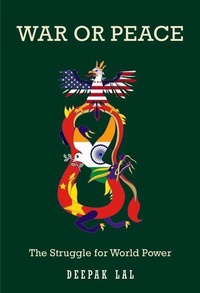
War or Peace
The Struggle for World Power
Published on 4. October 2018
Book
Hardback
464 pages
978-0-19-948212-2 (ISBN)
Description
The Pax Americana---the global order established after the collapse of the Soviet Empire---is increasingly being challenged especially by former imperial behemoths China and Russia. There is a growing chorus questioning the so-called 'Washington Consensus' in favour of a 'Beijing Consensus' in economic policy. As the US ceases to be the sole superpower willing and able to maintain a global PAX, today there is an increasing global 'disorder'. This book is a study of the causes and consequences for this disorder, examining alternative claims for a desirable future economic policy.
The book argues that the origin of this increasing disorder lie, in part, in the great economic recession of 2008 in the US, which has tarnished the free market based capitalism of the West. It goes on to debate that there are four major imperial systems which are and will be involved in the new 'Great Game' in Eurasia---the US and its European outpost---the EU, China, Russia and India and, potentially, Japan as it seeks to alter its post-war pacifist constitution to act like Britain did for many centuries, as the offshore balancer in the struggle for the mastery of Asia, either as a partner or independent of the US. Their strategic decisions will determine whether we will see a repeat of the past, with another completely unnecessary world war like the First World War, or if they will succeed in eschewing this atavism.
The book argues that the origin of this increasing disorder lie, in part, in the great economic recession of 2008 in the US, which has tarnished the free market based capitalism of the West. It goes on to debate that there are four major imperial systems which are and will be involved in the new 'Great Game' in Eurasia---the US and its European outpost---the EU, China, Russia and India and, potentially, Japan as it seeks to alter its post-war pacifist constitution to act like Britain did for many centuries, as the offshore balancer in the struggle for the mastery of Asia, either as a partner or independent of the US. Their strategic decisions will determine whether we will see a repeat of the past, with another completely unnecessary world war like the First World War, or if they will succeed in eschewing this atavism.
More details
Language
English
Place of publication
Oxford
United Kingdom
Target group
Professional and scholarly
Product notice
sewn/stitched
Cloth over boards
Illustrations
Various
Dimensions
Height: 223 mm
Width: 148 mm
Thickness: 32 mm
Weight
724 gr
ISBN-13
978-0-19-948212-2 (9780199482122)
Copyright in bibliographic data and cover images is held by Nielsen Book Services Limited or by the publishers or by their respective licensors: all rights reserved.
Schweitzer Classification
Other editions
Additional editions
E-Book
05/2018
1st Edition
OUP
€39.59
Available for download
Person
Deepak Lal is the James S. Coleman Professor Emeritus of International Development Studies at the University of California at Los Angeles, professor emeritus of political economy at University College London, and a senior fellow at the Cato Institute. He was a member of the Indian Foreign Service (1963?-66) and has served as a consultant to the Indian Planning Commission, the World Bank, the Organization for Economic Cooperation and Development, various UN
agencies, South Korea, and Sri Lanka. From 1984 to 1987, he was research administrator at the World Bank. He is the author of a number of books, including 'The Poverty of Development Economics'; 'The Hindu
Equilibrium'; 'Against Dirigisme'; 'The Political Economy of Poverty', 'Equity and Growth'; 'Unintended Consequences: The Impact of Factor Endowments', 'Culture, and Politics on Long-Run Economic Performance'; and 'Reviving the Invisible Hand: The Case for Classical Liberalism in the 21st Century'.
agencies, South Korea, and Sri Lanka. From 1984 to 1987, he was research administrator at the World Bank. He is the author of a number of books, including 'The Poverty of Development Economics'; 'The Hindu
Equilibrium'; 'Against Dirigisme'; 'The Political Economy of Poverty', 'Equity and Growth'; 'Unintended Consequences: The Impact of Factor Endowments', 'Culture, and Politics on Long-Run Economic Performance'; and 'Reviving the Invisible Hand: The Case for Classical Liberalism in the 21st Century'.
Content
Preface Acknowledgements Introduction PART I: GEOPOLITICS Chapter 1: War and Peace Chapter 2: Geography Chapter 3: Ideologies PART II: GEOECONOMICS Chapter 4: The Great Recession and After Chapter 5: Growth and Global Structural Change Chapter 6: The United States Chapter 7: China and India Chapter 8: Japan, Russia PART III: A THIRD WORLD WAR? Chapter 9: The American Imperium Chapter 10: Towards Global Disorder Chapter 11: Flashpoints Chapter 12: India Midst Global Disorder ConclusionsNotes Appendix Bibliography Index About the Author