

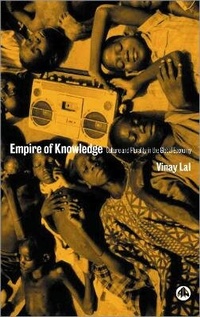
Empire of Knowledge
Culture and Plurality in the Global Economy
Published on 20. October 2002
Book
Paperback/Softback
264 pages
978-0-7453-1736-6 (ISBN)
Description
During the media frenzy over the Millennium celebrations, there was hardly any mention of the fact that, for the majority of the world, there was no Millennium at all. This linear understanding of time is a specifically Western - and Christian - concept.
This is just one of many examples that Vinay Lal uses to demonstrate that nearly every idea which we take for granted in the west is part of a politics of ideas. Oppression is usually associated with class struggle and other forms of economic monopoly. Lal looks beyond this, deconstructing the cultural assumptions that have emerged alongside capitalism to offer a devastating critique of the politics of knowledge at the heart of all powerbroking.
Other topics examined are the concept of 'development', which has provided a mandate for surreptitious colonisation; and the idea of the 'nation state', something we have lived with for no more than two centuries, yet is accepted without question. Linking this to the emergence of 'international governance' through the United Nations, the US, and imperial economic bodies (such as the IMF and WTO), Lal explains how such universalism came to dominate the trajectory of Western thought.
This is just one of many examples that Vinay Lal uses to demonstrate that nearly every idea which we take for granted in the west is part of a politics of ideas. Oppression is usually associated with class struggle and other forms of economic monopoly. Lal looks beyond this, deconstructing the cultural assumptions that have emerged alongside capitalism to offer a devastating critique of the politics of knowledge at the heart of all powerbroking.
Other topics examined are the concept of 'development', which has provided a mandate for surreptitious colonisation; and the idea of the 'nation state', something we have lived with for no more than two centuries, yet is accepted without question. Linking this to the emergence of 'international governance' through the United Nations, the US, and imperial economic bodies (such as the IMF and WTO), Lal explains how such universalism came to dominate the trajectory of Western thought.
Reviews / Votes
'Vinay Lal is a new and important presence in the world of scholars who question the intellectual and cultural assumptions that accompany the processes of modernisation, development and globalization.' Dipesh Chakrabarty, The University of ChicagoMore details
Language
English
Place of publication
London
United Kingdom
Target group
Professional and scholarly
Product notice
Paperback (UK-trade)
Dimensions
Height: 215 mm
Width: 135 mm
Weight
414 gr
ISBN-13
978-0-7453-1736-6 (9780745317366)
Copyright in bibliographic data and cover images is held by Nielsen Book Services Limited or by the publishers or by their respective licensors: all rights reserved.
Schweitzer Classification
Other editions
Additional editions
E-Book
10/2002
1st Edition
Pluto Press
€122.99
Available for download
Person
Vinay Lal is Professor of History and Asian American Studies at the University of California, Los Angeles. He has written widely on contemporary South Asian politics, Indian and American cultural politics and the global politics of knowledge. He is the author of Empire of Knowledge: Culture and Plurality in the Global Economy (Pluto, 2002).
Content
Acknowledgments
Introduction
1. Reckoning with the Millennium
2. Politics in Our Times
3. Governance in the Twenty-First Century
4. Modern Knowledge and Its Categories
5. Ecology, Economy, Equality
6. Dissenting Futures
Postscript: 911, or the Terrorism That Has No Name
Notes
Suggestions for Further Reading
Index
Introduction
1. Reckoning with the Millennium
2. Politics in Our Times
3. Governance in the Twenty-First Century
4. Modern Knowledge and Its Categories
5. Ecology, Economy, Equality
6. Dissenting Futures
Postscript: 911, or the Terrorism That Has No Name
Notes
Suggestions for Further Reading
Index