

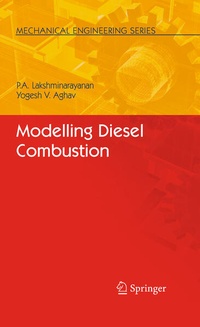
Modelling Diesel Combustion
Published on 5. May 2012
Book
Paperback/Softback
XIII, 305 pages
978-94-007-3186-8 (ISBN)
Description
Phenomenology of Diesel Combustion and Modeling Diesel is the most efficient combustion engine today and it plays an important role in transport of goods and passengers on land and on high seas. The emissions must be controlled as stipulated by the society without sacrificing the legendary fuel economy of the diesel engines. These important drivers caused innovations in diesel engineering like re-entrant combustion chambers in the piston, lower swirl support and high pressure injection, in turn reducing the ignition delay and hence the nitric oxides. The limits on emissions are being continually reduced. The- fore, the required accuracy of the models to predict the emissions and efficiency of the engines is high. The phenomenological combustion models based on physical and chemical description of the processes in the engine are practical to describe diesel engine combustion and to carry out parametric studies. This is because the injection process, which can be relatively well predicted, has the dominant effect on mixture formation and subsequent course of combustion. The need for improving these models by incorporating new developments in engine designs is explained in Chapter 2. With "model based control programs" used in the Electronic Control Units of the engines, phenomenological models are assuming more importance now because the detailed CFD based models are too slow to be handled by the Electronic Control Units. Experimental work is necessary to develop the basic understanding of the pr- esses.
More details
Series
Edition
2010 ed.
Language
English
Place of publication
Dordrecht
Netherlands
Target group
Professional and scholarly
Research
Illustrations
XIII, 305 p.
Dimensions
Height: 235 mm
Width: 155 mm
Thickness: 18 mm
Weight
487 gr
ISBN-13
978-94-007-3186-8 (9789400731868)
DOI
10.1007/978-90-481-3885-2
Schweitzer Classification
Other editions
Additional editions
P. A. Lakshminarayanan | Yoghesh V. Aghav
Modelling Diesel Combustion
Book
03/2010
Springer
€160.49
Shipment within 15-20 days
Persons
Dr. P. A. Lakshminarayanan (born 1950) studied at Indian Institute of Technology Madras for his B. Tech, M.S. and Ph.D. degrees. He worked at Loughborough University of Technology and Kirloskar Oil Engines Ltd. for about five and twenty years, respectively, before moving to Ashok Leyland in 2002 to head the Engine R&D. From 2011 till 2019, he was the CTO, and the Technical Adviser at Simpson and Co. Ltd. Now, he is an adjunct professor at IIT Kanpur.
With his teams, he has developed more than eight diesel and CNG engine platforms and 150 engine types commercially successful for efficiency and cost effectiveness. Two engine designs received prizes from the Institute of Directors (India). Twelve ideas were patented during the development of engines over 40 years. He has authored 54 research papers in journals and conferences of international repute. Four of them received the prizes for integrity and quality of contents from the SAE (Arch Colwell Award), Combustion Society (India), AVL (Graz) and AVL (India) in 1983, 1993, 2005 and 2011, respectively. He has coauthored two books titled "Modeling Diesel Combustion" (Springer 2010) and "Critical Component Wear of Parts in heavy Duty Engines" (John Wiley 2011). He has coedited a handbook "Design and Development of Heavy Duty Diesel Engines" (Springer, 2020). Now, he is editing his fourth book "Thermal Management of Engines for Performance and Emissions" which is due in 2021. He is elected to the fellowships of SAE (2009), INAE (2013) and ISEES (2018).Dr. Yogesh V. Aghav received B. E. and M. Tech. degrees from VIT Pune and IIT Madras, respectively. His Doctoral degree is from IIT Delhi for his research work on heat release in diesel engines. Currently, he is the associate vice president of the corporate Research and Engineering, Kirloskar Oil Engines Ltd., Pune, with responsibilities for the performance, emissions, NVH, and development of internal combustion engines running on diesel and alternative fuels like natural gas and biodiesel. For two years, he served FEV, Pune, and helped to found the organization. For the last 25 years, he has lead teams to develop many engines of swept volumes ranging from 300 c.c. to 32-liter applied to agriculture, off-highway, power generation, construction equipment, marine, and defense.
He has published more than 50 research papers in ASME, SAE, and IMechE journals. He is associated with the boards of studies of VIT and MITADT, Pune. He advises the Universities and takes part in faculty development. He is a member of the SAE India.
Prof. Rolf Reitz's research interests include internal combustion engines and sprays. He is former director of the Engine Research Center and is Emeritus Wisconsin Distinguished Professor of Mechanical Engineering at the University of Wisconsin-Madison. Before joining UW-Madison he spent six years at the GM Research Laboratories, three years as a research staff member at PrincetonUniversity, and two years as a research scientist at the Courant Institute of Mathematical Sciences, New York University. He received his Ph.D. in Mechanical and Aerospace Engineering from Princeton University in 1978. Professor Reitz is a Fellow member of SAE and ASME and he serves as a consultant to many industries through his consulting company, Wisconsin Engine Research Consultants. He is Editor (Americas) and co-founder of the International Journal of Engine Research and is past-Chairman of the Institute of Liquid Atomization and Spraying Systems - North and South America. He and his group have won major research awards, and he has co-authored over 550 technical papers on engine research.
Yu Shi received his Ph.D. in Mechanical Engineering from the Engine Research Center at the University of Wisconsin-Madison, where he specialized in computational optimization of internal combustion engines. After finishing his Ph.D. in 2009,he worked as a postdoctoral ass
Content
Phenomenology of Diesel Combustion and Modelling.- Experiments.- Turbulent Structure of the Diesel Spray.- Ignition Delay in a Diesel Engine.- Heat Transfer.- Heat Release in Indirect Injection Engines.- Mixing Correlations for Smoke and Fuel Consumption of Direct Injection Engines.- Heat Release in Direct Injection Engines.- Hydrocarbons from DI Diesel Engines.- Hydrocarbon Emissions from Spark Ignition Engines.- Smoke from DI Diesel Engines.- Oxides of Nitrogen from Direct Injection Diesel Engines.- Particulate Matter from Direct Injection Diesel Engines.- Multi-dimensional Modelling of Diesel Combustion: Review.- Multi-dimensional Modelling of Diesel Combustion: Applications.