

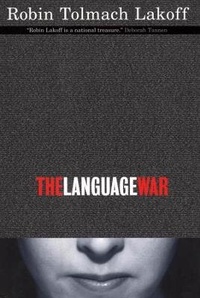
The Language War
1st Edition
Published on 17. August 2001
Book
Paperback/Softback
332 pages
978-0-520-23207-5 (ISBN)
Description
Robin Lakoff gets to the heart of one of the most fascinating and pressing issues in American society today: who holds power and how they use it, keep it, or lose it. In a brilliant and vastly entertaining discussion of news events that have occupied an enormous amount of media space - political correctness, the Anita Hill/Clarence Thomas hearings, Hillary Rodham Clinton as First Lady, O. J. Simpson's murder trial, the Ebonics controversy, and the Clinton sex scandal - Lakoff shows that the struggle for power and status at the end of the century is being played out as a war over language. Controlling language is a basis for all power, she says, and therefore it is worth fighting for. As a result, newly emergent groups, especially blacks and women, are contending with middle- to upper-class white men for a share in 'language rights.' Lakoff's introduction to linguistic theories and the philosophy of language lays the groundwork for an exploration of news stories that meet what she calls the UAT (Undue Attention Test).
As the stories became the subject of talk-show debates, late-night comedy routines, Web sites, and magazine articles, they were embroidered with additional meanings, depending on who was telling the story. Race, gender, or both are at the heart of these stories, and each one is about the right to construct meanings from languagein short, to possess power. Because language tells us how we are connected to one another, who has power and who does not, the stories reflect the language war. We use language to analyze what we call 'reality,' the author argues, but we mistrust how language is used today - witness the 'politics of personal destruction' following the Clinton impeachment. Yet Lakoff sees in the struggle over language a positive goal: equality in the creation of our national discourse. Her writing is accessible and witty, and her excerpts from the media are used to great effect.
As the stories became the subject of talk-show debates, late-night comedy routines, Web sites, and magazine articles, they were embroidered with additional meanings, depending on who was telling the story. Race, gender, or both are at the heart of these stories, and each one is about the right to construct meanings from languagein short, to possess power. Because language tells us how we are connected to one another, who has power and who does not, the stories reflect the language war. We use language to analyze what we call 'reality,' the author argues, but we mistrust how language is used today - witness the 'politics of personal destruction' following the Clinton impeachment. Yet Lakoff sees in the struggle over language a positive goal: equality in the creation of our national discourse. Her writing is accessible and witty, and her excerpts from the media are used to great effect.
Reviews / Votes
"To say simply that Lakoff is a linguist is like calling the Alps just another mountain range. In The Language War, she brilliantly applies her understanding of how language works to the major political battles of the past decade." - San Francisco Chronicle Book Review "An intellectually stimulating probe of the nuances of social, cultural and political infighting among people who think they speak the same language." - Meta G. Carstarphen, Dallas Morning News "Provocative analysis." - Mary Carroll, Booklist "A provocative collection of essays." - Paula Friedman, San Diego Union-Tribune "Lakoff is excellent on sexism in the job market." - Raphael Salkie, The Times Higher Education Supplement "Robin Lakoff is a national treasure. She is one of the most astute and knowledgeable linguists in the country (indeed, in the world), and one of the few who turns her analytic eye to the role of language in popular and political culture. It was she who pioneered the field of gender and language. She is poised to be recognized among the general reading public as she has long been recognized in the field of linguistics." - Deborah Tannen, author of You Just Don't Understand and The Argument Culture "An excellent book. Robin Lakoff shows that if we do not understand how language is put to work in our world, we cannot understand our world, nor live in it effectively." - John Fiske, author of Media Matters "In a series of provocative, dazzlingly argued essays, Lakoff charts how the media's use of language shapes both public attitudes and social policies on current events.... Witty and illuminating, Lakoff's analysis is an important addition to both linguistic and political studies." - Publishers Weekly, starred reviewMore details
Edition
First Edition
Language
English
Place of publication
Berkerley
United States
Product notice
Paperback (trade)
Dimensions
Height: 229 mm
Width: 152 mm
Thickness: 20 mm
Weight
454 gr
ISBN-13
978-0-520-23207-5 (9780520232075)
Copyright in bibliographic data and cover images is held by Nielsen Book Services Limited or by the publishers or by their respective licensors: all rights reserved.
Schweitzer Classification
Other editions
Additional editions
Robin Tolmach Lakoff
The Language War
E-Book
05/2000
1st Edition
Naval Institute Press
€28.99
Available for download
Person
Robin Lakoff is Professor of Linguistics at the University of California, Berkeley, and the author of Talking Power: The Politics of Language in Our Lives (1990), Face Value: The Politics of Beauty (1984), and Language and Woman's Place (1975).