


How to Improve your Maths Skills
Published on 13. May 2010
Book
Paperback/Softback
224 pages
978-0-273-73283-9 (ISBN)
Description
This easy-to-use guide identifies and addresses the areas where most students need help with basic mathematical problems that occur in everyday life and studies and provides straightforward, practical tips, exercises and solutions that will enable you to assess and then improve your performance.
More details
Language
English
Place of publication
Harlow
United Kingdom
Publishing group
Pearson Education Limited
Target group
College/higher education
Dimensions
Height: 139 mm
Width: 215 mm
Thickness: 12 mm
Weight
286 gr
ISBN-13
978-0-273-73283-9 (9780273732839)
Copyright in bibliographic data is held by Nielsen Book Services Limited or its licensors: all rights reserved.
Schweitzer Classification
Other editions
New editions
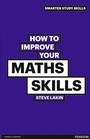
Steve Lakin
How to Improve your Maths Skills
Book
06/2011
2nd Edition
Pearson Education Limited
€17.50
Shipment within 10-20 days
Person
Steve Lakin is the Foundation Year Tutor in Mathematics and module leader for the foundation level basic mathematics module at the University of Glamorgan. He has experience of teaching mathematical techniques to computer scientists, and has worked at a maths drop-in centre, helping students from all courses with a variety of basic mathematical problems. Through this experience, he has gained a reputation for being able to explain mathematical concepts to even the most maths-terrified of students
Content
Preface and acknowledgements
How to use this book
Times tables
Arithmetic
1 - Basic Arithmetic and the "BODMAS" rule. Getting used to basic arithmetic and simple calculations, and making sure you perform them correctly
2 - Negative numbers. Understanding negative numbers and dealing with them accurately.
3 Fractions. Understanding what fractions mean and being able to manipulate them correctly.
4 Percentages, ratios and proportions. Using percentages and ratios to describe and compare values.
5 Decimals, decimal places and significant figures. Using decimal numbers and rounding numbers to a certain number of decimal places.
6 Scientific notation. Representing very small and very large numbers using scientific notation
7 - Indices. Writing repeated multiplications easily, roots and the laws of powers.
Algebra
8 An introduction to algebra. Using symbols to represent numbers and an introduction to algebra
9 Brackets in algebra. Using brackets in algebraic expressions
10 Solving linear equations. Solving simple equations using algebra.
11 - Transposition and algebraic fractions. Rearranging expressions using basic rules of algebra.
12 - Simultaneous equations. Solving two equations at the same time.
Data
13 Presentation of data. Using various types of graphs and charts to illustrate data visually.
14 Measures of location and dispersion. Working out "averages" and a measure of the spread of a set of data.
15 - Straight Lines. Linear data and calculating the equation of a straight line.
16 Introduction to probability. Working out probabilities - the chances of something happening
Other topics
17 Areas and volumes. Calculating the areas and volumes of basic shapes
18 Logarithms. Calculating logarithms - the opposite of powers
19 Quadratic equations. Solving equations involving powers of x.
20 Trigonometry. Calculations with triangles, including angles and trigonometric functions.
21 Inequalities and basic logic. Using mathematical symbols to represent inequalities and basic logical concepts
Summary
Further work on our website
Glossary
Index
How to use this book
Times tables
Arithmetic
1 - Basic Arithmetic and the "BODMAS" rule. Getting used to basic arithmetic and simple calculations, and making sure you perform them correctly
2 - Negative numbers. Understanding negative numbers and dealing with them accurately.
3 Fractions. Understanding what fractions mean and being able to manipulate them correctly.
4 Percentages, ratios and proportions. Using percentages and ratios to describe and compare values.
5 Decimals, decimal places and significant figures. Using decimal numbers and rounding numbers to a certain number of decimal places.
6 Scientific notation. Representing very small and very large numbers using scientific notation
7 - Indices. Writing repeated multiplications easily, roots and the laws of powers.
Algebra
8 An introduction to algebra. Using symbols to represent numbers and an introduction to algebra
9 Brackets in algebra. Using brackets in algebraic expressions
10 Solving linear equations. Solving simple equations using algebra.
11 - Transposition and algebraic fractions. Rearranging expressions using basic rules of algebra.
12 - Simultaneous equations. Solving two equations at the same time.
Data
13 Presentation of data. Using various types of graphs and charts to illustrate data visually.
14 Measures of location and dispersion. Working out "averages" and a measure of the spread of a set of data.
15 - Straight Lines. Linear data and calculating the equation of a straight line.
16 Introduction to probability. Working out probabilities - the chances of something happening
Other topics
17 Areas and volumes. Calculating the areas and volumes of basic shapes
18 Logarithms. Calculating logarithms - the opposite of powers
19 Quadratic equations. Solving equations involving powers of x.
20 Trigonometry. Calculations with triangles, including angles and trigonometric functions.
21 Inequalities and basic logic. Using mathematical symbols to represent inequalities and basic logical concepts
Summary
Further work on our website
Glossary
Index