

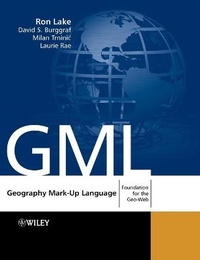
Geography Mark-Up Language
Foundation for the Geo-Web
1st Edition
Published on 26. April 2004
Book
Paperback/Softback
432 pages
978-0-470-87154-6 (ISBN)
Description
The development of the Internet has changed the environment for Geographical Information Systems (GIS), with the emphasis shifting from analysis to the sharing of data and information over the Internet thus making GIS more mobile and powerful. The Geography Mark-Up Language (GML) was developed as the standard language and is emerging as the foundation for Internet GIS. Geography Mark-Up Language: Foundation for the Geo-Web provides a broad coverage of the use of GML in different application areas, along with the technical means for building these applications. Starting from the basic concepts, this book works through all the important topics in both GML 2.0 and GML 3.0, with illustrations and worked examples to demonstrate its use. Organized into two sections, Volume I introduces readers to the new world of GML, and explains how it can be used across a broad range of GIS projects. It deals with the basic concepts of XML and GML, and enables readers to make decisions on the utility of GML in their projects and software acquisitions. Volume II is intended for the technical reader and answers questions on the meaning and structure of GML schema components, the development of GML application schemas, and the use of GML in connection with web services, legacy GIS and relational databases.
Contains worked examples
Covers all aspects of GML 3.0 from geometry and topology to units of measure, default styling and coverages
Explains the Geo-Web and its impact on vertical applications
Authored by leading figures in GML development
This book is a must have for GIS vendors, system integrators and data providers; local/state/provincial and national government agencies; utilities and telecommunication companies; location-based services companies; data distributors; software developers and technical managers. It would make an excellent reference for mid and upper-level undergraduate students and Masters students taking technical GIS modules as part of a GIS or Technical Geography programmes.
Contains worked examples
Covers all aspects of GML 3.0 from geometry and topology to units of measure, default styling and coverages
Explains the Geo-Web and its impact on vertical applications
Authored by leading figures in GML development
This book is a must have for GIS vendors, system integrators and data providers; local/state/provincial and national government agencies; utilities and telecommunication companies; location-based services companies; data distributors; software developers and technical managers. It would make an excellent reference for mid and upper-level undergraduate students and Masters students taking technical GIS modules as part of a GIS or Technical Geography programmes.
Reviews / Votes
"...this book marks a welcome addition to GIS literature...highly recommended as a well written, well structured and reasonably detailed outline of GML..." (GIS Professional, No.2, January - February, 2005)More details
Language
English
Place of publication
New York
United States
Target group
Professional and scholarly
Dimensions
Height: 250 mm
Width: 191 mm
Thickness: 24 mm
Weight
879 gr
ISBN-13
978-0-470-87154-6 (9780470871546)
Copyright in bibliographic data and cover images is held by Nielsen Book Services Limited or by the publishers or by their respective licensors: all rights reserved.
Schweitzer Classification
Other editions
Additional editions
Book
04/2004
1st Edition
Wiley
€149.00
Article exhausted; check different version
Persons
Ron Lake is the 'inventor' of geography mark-up language, and a leading member of the Open GIS Consortium. He is CEO of Galdos Systems Inc (Canada) and travels extensively to promote the awareness and useability of GML.
Content
Introduction. PART I GML: AN INTRODUCTION.
1 Once over lightly.
2 XML and GML.
3 Basic Concepts of GML.
4 GML Core and Application Schemas.
5 Technical Issues for Deploying GML.
6 GML and Geospatial Web Services.
7 Real-World Deployment Examples.
PART II GML: A TECHNICAL REFERENCE GUIDE.
8 Basic Concepts.
9 Introducing the GML Model and GML Features.
10 GML Core Schemas Overview.
11 Developing and Managing GML Application Schemas.
12 GML Geometry.
13 GML Topology.
14 GML Temporal Elements and Dynamic Features.
15 GML Coordinate Referenc Systems.
16 Units of Measure, Values and Observations.
17 GML Coverages.
18 GML Default Styling.
19 GML And Geospatial Web Services.
20 GML, Relational Databases and Legacy GIS.
APPENDICES.
1 Once over lightly.
2 XML and GML.
3 Basic Concepts of GML.
4 GML Core and Application Schemas.
5 Technical Issues for Deploying GML.
6 GML and Geospatial Web Services.
7 Real-World Deployment Examples.
PART II GML: A TECHNICAL REFERENCE GUIDE.
8 Basic Concepts.
9 Introducing the GML Model and GML Features.
10 GML Core Schemas Overview.
11 Developing and Managing GML Application Schemas.
12 GML Geometry.
13 GML Topology.
14 GML Temporal Elements and Dynamic Features.
15 GML Coordinate Referenc Systems.
16 Units of Measure, Values and Observations.
17 GML Coverages.
18 GML Default Styling.
19 GML And Geospatial Web Services.
20 GML, Relational Databases and Legacy GIS.
APPENDICES.