

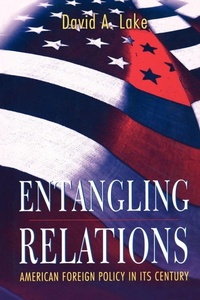
Entangling Relations
American Foreign Policy in Its Century
Will be published approx. on 2. May 1999
Book
Paperback/Softback
312 pages
978-0-691-05991-4 (ISBN)
Description
Throughout what publisher Henry Luce dubbed the "American century," the United States has wrestled with two central questions. Should it pursue its security unilaterally or in cooperation with others? If the latter, how can its interests be best protected against opportunism by untrustworthy partners? In a major attempt to explain security relations from an institutionalist approach, David A. Lake shows how the answers to these questions have differed after World War I, during the Cold War, and today. In the debate over whether to join the League of Nations, the United States reaffirmed its historic policy of unilateralism. After World War II, however, it broke decisively with tradition and embraced a new policy of cooperation with partners in Europe and Asia. Today, the United States is pursuing a new strategy of cooperation, forming ad hoc coalitions and evincing an unprecedented willingness to shape but then work within the prevailing international consensus on the appropriate goals and means of foreign policy.
In interpreting these three defining moments of American foreign policy, Lake draws on theories of relational contracting and poses a general theory of security relationships. He arrays the variety of possible security relationships on a continuum from anarchy to hierarchy, and explains actual relations as a function of three key variables: the benefits from pooling security resources and efforts with others, the expected costs of opportunistic behavior by partners, and governance costs. Lake systematically applies this theory to each of the "defining moments" of twentieth-century American foreign policy and develops its broader implications for the study of international relations.
In interpreting these three defining moments of American foreign policy, Lake draws on theories of relational contracting and poses a general theory of security relationships. He arrays the variety of possible security relationships on a continuum from anarchy to hierarchy, and explains actual relations as a function of three key variables: the benefits from pooling security resources and efforts with others, the expected costs of opportunistic behavior by partners, and governance costs. Lake systematically applies this theory to each of the "defining moments" of twentieth-century American foreign policy and develops its broader implications for the study of international relations.
Reviews / Votes
"An innovative approach to understanding how and why polities choose to structure their relations with one another... Lake has some interesting ideas, which he presents clearly and intelligently."--ChoiceMore details
Series
Language
English
Place of publication
New Jersey
United States
Target group
Professional and scholarly
College/higher education
Product notice
Paperback (trade)
Illustrations
9 tables 4 line illus.
Dimensions
Height: 234 mm
Width: 156 mm
Thickness: 19 mm
Weight
529 gr
ISBN-13
978-0-691-05991-4 (9780691059914)
Copyright in bibliographic data and cover images is held by Nielsen Book Services Limited or by the publishers or by their respective licensors: all rights reserved.
Schweitzer Classification
Other editions
Additional editions
E-Book
09/2020
1st Edition
Princeton University Press
€54.49
Available for download
Person
David A. Lake is Professor of Political Science at the University of California, San Diego, and coeditor of the journal International Organization. He has published widely in the field of international relations and has, most recently, coedited The International Spread of Ethnic Conflict: Fear, Diffusion, and Escalation and Strategic Choice and International Relations, both available from Princeton University Press.
Content
List of Figures and TablesPrefaceCh. 1Introduction3Ch. 2Security Relationships17Ch. 3A Theory of Relational Contracting35Ch. 4The Lone Hand78Ch. 5Cold War Cooperation128Ch. 6Gulliver's Triumph198Ch. 7Relational Contracting and International Relations263Ch. 8Conclusion285References299Index325