

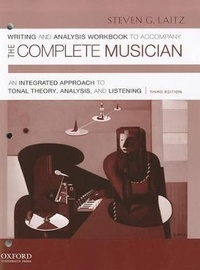
Writing and Analysis Workbook 1
to Accompany The Complete Musician 3e
3rd Edition
Published on 27. October 2011
Book
Paperback/Softback
656 pages
978-0-19-974279-0 (ISBN)
Description
Designed specifically for greater flexibility of use, the two workbooks that accompany The Complete Musician: An Integrated Approach to Tonal Theory, Analysis, and Listening, Third Edition, feature a new organization. Workbook 1: Writing and Analysis is dedicated exclusively to written and analytical activities. Workbook 2: Skills and Musicianship focuses on musicianship skills. Between the two workbooks-each of which is packaged with a CD-there are more than 2,000 recorded analytical and dictation examples and fifteen hours of recorded music (all music is performed, recorded, and engineered at Eastman). Additional supplementary material is available on the new companion website (www.oup.com/us/laitz).
Features of Workbook 1: Writing and Analysis * Accompanied by a CD (packaged FREE with workbook) containing high-quality MP3 recordings of nearly all the music in the workbook (performances range from solo piano to full orchestra) * Presents a variety of written and analytical activities including figured bass, melody harmonization, model composition, and analysis * Includes more-focused and shorter assignments (each chapter is organized into discrete assignments, usually four assignments per chapter) * Contains carefully graduated exercises, ranging from basic, introductory tasks, to more active writing exercises, and finally to creative compositional projects
Features of Workbook 1: Writing and Analysis * Accompanied by a CD (packaged FREE with workbook) containing high-quality MP3 recordings of nearly all the music in the workbook (performances range from solo piano to full orchestra) * Presents a variety of written and analytical activities including figured bass, melody harmonization, model composition, and analysis * Includes more-focused and shorter assignments (each chapter is organized into discrete assignments, usually four assignments per chapter) * Contains carefully graduated exercises, ranging from basic, introductory tasks, to more active writing exercises, and finally to creative compositional projects
Reviews / Votes
"The Complete Musician offers a depth of theoretical training and analytical insight that its competitors do not. It has, by far, the best musical examples of any textbook available on the market today. The exercises, which incrementally progress from easier to harder, are highly original and just plain fun to do."--Reginald Bain, University of South Carolina"The integration of composition, analysis, aural recognition, and performance is the best feature of The Complete Musician. It subtly reinforces the idea that a musician needs an understanding of each aspect of the musical universe in order to excel in any of its specialized areas. The Complete Musician trains music students to think like composers, which cannot help but make them better performers."--Ciro Scotto, University of South
Florida
"The most comprehensive, musically intelligent, and easy-to-use music theory textbook on the market."--Stefan Eckert, University of Northern Colorado
"This title ranks among the very best of its kind. . . . If you want a thorough and approachable book that gets behind, or into the head (indeed, heart and soul) of composers whose music you've known; want to know how it works the way it does, and why; want to see the mechanics, an appreciation of which serves only to enhance your sense of admiration for their technique, then The Complete Musician can be recommended wholeheartedly."--Review from
Classical.net
More details
Edition
3rd edition
Language
English
Place of publication
New York
United States
Dimensions
Height: 277 mm
Width: 217 mm
Thickness: 30 mm
Weight
1540 gr
ISBN-13
978-0-19-974279-0 (9780199742790)
Copyright in bibliographic data and cover images is held by Nielsen Book Services Limited or by the publishers or by their respective licensors: all rights reserved.
Schweitzer Classification
Other editions
Additional editions
Book
10/2011
3rd Edition
OUP Australia and New Zealand
€57.03
Article exhausted; check different version
Steven G. Laitz
The Complete Musician
An Integrated Approach to Tonal Theory, Analysis, and Listening
Book
06/2011
3rd Edition
Oxford University Press Inc
€78.12
Article exhausted; check different version
Person
Steven G. Laitz is Professor of Music Theory at the Eastman School of Music at the University of Rochester. He is also an Affiliate Faculty Member in the Chamber Music Department at Eastman. Dr. Laitz is the current editor of the Journal of Music Theory Pedagogy.
Content
PART ONE: THE FOUNDATION OF TONAL MUSIC ; 1: Musical Space and Time ; 2: Harnessing Space and Time: Introduction to Melody and Two-Voice Counterpoint ; 3: Musical Density: Triads, Seventh Chords and Texture ; PART TWO: MERGING MELODY AND HARMONY ; 4: When Harmony, Melody, and Rhythm Converge ; 5: Tonic and Dominant as Tonal Pillars and Introduction to Voice Leading ; 6: The Impact of Melody, Rhythm, and Meter on Harmony; Introduction to V7 ; 7: Contrapuntal Expansions of Tonic and Dominant: Six-Three Chords ; 8: More Contrapuntal Expansions: Inversions of V7, and Leading-Tone Seventh Chords ; PART THREE: A NEW HARMONIC FUNCTION AND ADDITIONAL MELODIC AND HARMONIC EMBELLISHMENTS ; 9: The Pre-Dominant Function and the Phrase Model ; 10: Accented and Chromatic Dissonances ; 11: Six-Four Chords, the Subdominant, and Summary of Contrapuntal Expansions ; 12: The Pre-Dominant Refines the Phrase Model ; PART FOUR: NEW CHORDS AND NEW FORMS ; 13: The Submediant: A New Diatonic Harmony, and Further Extensions of the Phrase Model ; 14: The Mediant, the Back-Relating Dominant, and a Synthesis of Diatonic Harmonic Relationships ; 15: The Period ; 16: Other Small Musical Structures: Sentences, Double Periods, and Asymmetrical Periods ; 17: Harmonic Sequences ; PART FIVE: FUNCTIONAL CHROMATICISM ; 18: Applied Chords ; 19: Tonicization and Modulation ; 20: Binary Form and Variations ; PART SIX: EXPRESSIVE CHROMATICISM ; 21: Modal Mixture ; 22: Expansion of Modal Mixture Harmonies: Chromatic Modulation and the German Lied ; 23: The Neapolitan Chord (bII) ; 24: The Augmented Sixth Chord ; PART SEVEN: LARGE FORMS: TERNARY, RONDO, SONATA ; 25: Ternary Form ; 26: Rondo ; 27: Sonata Form ; PART EIGHT: INTRODUCTION TO NINETEENTH-CENTURY HARMONY: THE SHIFT FROM ASYMMETRY TO SYMMETRY ; 28: New Harmonic Tendencies ; 29: The Rise of Symmetrical Harmony in Tonal Music ; 30: Melodic and Harmonic Symmetry Combine: Chromatic Sequences ; 31: At Tonality's Edge ; APPENDIX 1: FUNDAMENTALS ; a. The Pitch Realm ; b. Pulse, Rhythm, and Meter ; c. Intervals ; d. Triads, Inversions, Figured Bass, and Harmonic Analysis ; e. Seventh Chords and Harmonic Analysis ; APPENDIX 2: INVERTIBLE COUNTERPOINT, COMPOUND MELODY, AND IMPLIED HARMONIES ; APPENDIX 3: THE MOTIVE ; APPENDIX 4: ADDITIONAL HARMONIC SEQUENCE TOPICS ; APPENDIX 6: SELECTED ANSWERS TO TEXTBOOK EXERCISES