

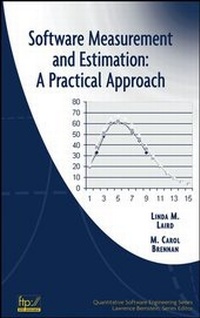
Software Measurement and Estimation
A Practical Approach
Published on 7. July 2006
Book
Hardback
280 pages
978-0-471-67622-5 (ISBN)
Description
An effective, quantitative approach for estimating and managing software projects
How many people do I need? When will the quality be good enough for commercial sale? Can this really be done in two weeks? Rather than relying on instinct, the authors of Software Measurement and Estimation offer a new, tested approach that includes the quantitative tools, data, and knowledge needed to make sound estimations.
The text begins with the foundations of measurement, identifies the appropriate metrics, and then focuses on techniques and tools for estimating the effort needed to reach a given level of quality and performance for a software project. All the factors that impact estimations are thoroughly examined, giving you the tools needed to regularly adjust and improve your estimations to complete a project on time, within budget, and at an expected level of quality.
This text includes several features that have proven to be successful in making the material accessible and easy to master:
* Simple, straightforward style and logical presentation and organization enables you to build a solid foundation of theory and techniques to tackle complex estimations
* Examples, provided throughout the text, illustrate how to use theory to solve real-world problems
* Projects, included in each chapter, enable you to apply your newfound knowledge and skills
* Techniques for effective communication of quantitative data help you convey your findings and recommendations to peers and management
Software Measurement and Estimation: A Practical Approach allows practicing software engineers and managers to better estimate, manage, and effectively communicate the plans and progress of their software projects. With its classroom-tested features, this is an excellent textbook for advanced undergraduate-level and graduate students in computer science and software engineering.
Reviews / Votes
"It is a good and welcome addition to any technical library...and for anyone...who needs to manage software, either development or acquisition." (ACM Software Engineering Notes, January 2007) "...an excellent book on this important area of software development." (CHOICE, December 2006) "The authors offer software engineers and project managers a new, tested approach that provides the quantitative tools, data, and knowledge needed to make sound estimations." (IEEE Computer Magazine, August 2006) "Corporations should advise both their project managers and their software teams to study methods introduced in this worthy text." (Kybernetes, Vol.36 Issue 1)More details
Product info
gebunden
Series
Edition
1. Auflage
Language
English
Place of publication
New York
United States
Target group
Professional and scholarly
Product notice
sewn/stitched
Paper over boards
Illustrations
Photos: 0 B&W, 0 Color; Drawings: 118 B&W, 0 Color
Dimensions
Height: 240 mm
Width: 161 mm
Thickness: 20 mm
Weight
589 gr
ISBN-13
978-0-471-67622-5 (9780471676225)
Schweitzer Classification
Other editions
New editions

Book
2nd Edition
Wiley
€105.00
The article will not be published
Additional editions
E-Book
07/2006
Wiley
€112.99
Available for download
Persons
LINDA M. LAIRD is Adjunct Professor at Stevens Institute of Technology, where she teaches Quantitative Software Engineering. Dr. Laird has more than thirty years of experience building and managing systems for Lucent Technologies, AT&T, and Bell Laboratories.
M. CAROL BRENNAN is former vice president and general manager of the Quality and Operations Center at Telcordia Technologies, where she was responsible for design, development, and implementation of the Telcordia quality management system. She has more than twenty-five years of experience in software design, development, testing, performance, maintenance, and customer support as well as quality strategy, policy, and implementation.
Content
Acknowledgments.
1. Introduction.
1.1 Objective.
1.2 Approach.
1.3 Motivation.
1.4 Summary.
References.
Chapter 1 Side Bar.
2. What to Measure.
2.1 Method 1: The Goal Question Metrics Approach.
2.2 Extension to GQM: Metrics Mechanism is Important.
2.3 Method 2: Decision Maker Model.
2.4 Method 3: Standards Driven Metrics.
2.5 What to Measure is a Function of Time.
2.6 Summary.
References.
Exercises.
Project.
3. Fundamentals of Measurement.
3.1 Initial Measurement Exercise.
3.2 The Challenge of Measurement.
3.3 Measurement Models.
3.4 Meta-Model for Metrics.
3.5 The Power of Measurement.
3.6 Measurement Theory.
3.7 Accuracy versus Precision and the Limits of Software Measurement.
References.
4. Measuring the Size of Software.
4.1 Physical Measurements of Software.
4.2 Measuring Functionality.
4.3 Feature Points.
4.4 Size Summary.
4.5 Size Exercises.
4.6 Theater Tickets Project.
References.
5. Measuring Complexity.
5.1 Structural Complexity.
5.2 Conceptual Complexity.
5.3 Computational Complexity.
5.4 Complexity Metrics Summary.
5.5 Complexity Exercises.
5.6 Projects.
References.
6. Estimating Effort.
6.1 Effort Estimation - Where are we?.
6.2 Software Estimation Methodologies and Models.
6.3 Combining Estimates.
6.4 Estimating Issues.
6.5 Estimating Early and Often.
6.6 Estimation Summary.
6.7 Estimation Problems.
6.8 Estimation Project - Theater Tickets.
References.
7. In Praise of Defects: Defects and Defect Metrics.
7.1 Why study and measure defects?.
7.2 Faults vs. failures.
7.3 Defect Dynamics and Behaviors.
7.4 Defect Projection Techniques and Models.
7.5 Additional Defect Benchmark Data.
7.6 Cost Effectiveness of Defect Removal by Phase.
7.7 Defining and Using Simple Defect Metrics: An example.
7.8 Some Paradoxical Patterns for Customer Reported Defects.
7.9 Defect Summary.
7.10 Problems.
7.11 Projects.
7.12 Answers to the initial questions.
References.
8. Software Reliability Measurement and Prediction.
8.1 Why study and measure software reliability?.
8.2 What is reliability?.
8.3 Faults and failures.
8.4 Failure Severity Classes.
8.5 Failure Intensity.
8.6 The Cost of Reliability.
8.7 Software Reliability Theory.
8.8 Reliability Models.
8.9 Failure Arrival Rates.
8.10 But when do I ship?.
8.11 System Configurations: Probability and Reliability.
8.12 Answers to Initial Question.
8.13 Reliability Summary.
8.14 Reliability Exercises.
8.15 Reliability Project.
References.
9. Response Time and Availability.
9.1 Response Time Measurements.
9.2 Availability.
9.3 Summary.
9.4 Problems.
9.5 Project.
References.
10. Measuring Progress.
10.1 Project Milestones.
10.2 Code Integration.
10.3 Testing Progress.
10.4 Defects Discovery and Closure.
10.5 Process Effectiveness.
10.6 Summary.
References.
Problems.
11. Outsourcing.
11.1 The "O" Word.
11.2 Defining Outsourcing.
11.3 Risks Management and Outsourcing.
11.4 Metrics and the Contract.
11.5 Summary.
References.
Exercises.
Problems.
Chapter 11 Sidebar.
12. Financial Measures for the Software Engineer.
12.1 It's All About the Green.
12.2 Financial Concepts.
12.3 Building the Business Case.
12.4 Living the Business Case.
12.5 Summary.
References.
Problems.
Projects.
13. Benchmarking.
13.1 What is Benchmarking.
13.2 Why Benchmark.
13.3 What to Benchmark.
13.4 Identifying and Obtaining a Benchmark.
13.5 Collecting Actual Data.
13.6 Taking Action.
13.7 Current Benchmarks.
13.8 Summary.
References.
Problems.
Projects.
14. Presenting Metrics Effectively to Management.
14.1 Decide on the Metrics.
14.2 Draw the Picture.
14.3 Create a Dashboard.
14.4 Drilling for Information.
14.5 Example for the Big Cheese.
14.6 Evolving Metrics.
14.7 Summary.
References.
Problems.
Project.
Index.