

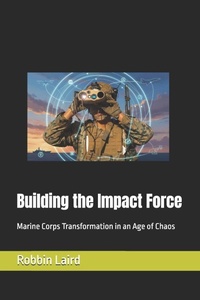
Building the Impact Force
Description
For more than twenty years, the United States Marine Corps was associated with dusty forward operating bases, counterinsurgency, and crisis response on the margins of larger land wars. That world has vanished. In its place is a far more dangerous environment, where adversaries blur the line between peace and war, logistics are contested from the outset, and a single radio transmission can invite immediate attack. Building the Impact Force tells the story of how the Marines are reinventing themselves for this new age of chaos.
In his 2022 book, Robbin Laird argued that the Corps had already begun to pivot away from CENTCOM-centric land campaigns toward high-end maritime competition, led by aviation innovations like the MV-22 Osprey and F-35B/C. This new volume takes the next step. Instead of asking whether the Marines are leaving the land-war paradigm, it asks whether they can become an "impact force" a forward, distributed, digitally integrated force designed to generate disproportionate effects for the joint and allied team inside an adversary's weapons engagement zone.
At the center of the book is Steel Knight 2025, I MEF's December 2025 campaign-scale exercise across Southern California and the greater Southwest. Steel Knight is treated not as a scripted readiness drill, but as a campaign laboratory for stand-in operations, chaos management, and kill-web enabled warfare. Embassy reinforcement, noncombatant evacuation, distributed fires, contested logistics, and Marine Rotational Force-Darwin certification are woven into a single continuous problem, forcing Marines to operate as impact nodes from the first hours of a crisis.
Drawing on extensive interviews with commanders, aviators, communicators, logisticians, and coalition partners, Laird shows how new concepts are being translated into practice. Readers go inside 3rd Marine Aircraft Wing's experimentation with hub-and-spoke aviation architectures, expeditionary airfields, and digital interoperability that allows platforms like the H-1, CH-53, MV-22, F-35, and MQ-9 to function as a connected sensing and decision network. The result is a detailed, ground-truth view of what distributed, impact-oriented operations really demand.
The book also traces how Force Design 2030 is evolving in contact with reality. Laird explores the October 2025 Force Design Update, the adjustments to littoral formations and amphibious capabilities, and the way exercise-derived lessons are reshaping assumptions about stand-in forces, traditional infantry, breaching, and bridging. Rather than presenting a flawless blueprint, Building the Impact Force offers an honest account of a service learning under pressure and willing to revise its own concepts.
For Marines, joint operators, and serious students of contemporary warfare, this book provides an operational audit of where the Corps truly stands on its transformation path. For policymakers and allies, it offers a rare window into how an American service is adapting to contested logistics, ubiquitous sensors, and compressed decision timelines. Above all, Building the Impact Force makes the case that platforms and networks are not enough; culture, command, and a genuine campaign of learning will determine whether the Marine Corps can deliver the impact the nation and its partners now require.