

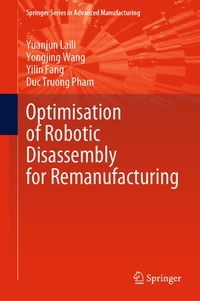
Optimisation of Robotic Disassembly for Remanufacturing
Description
This book illustrates the main characteristics, challenges and optimisation requirements of robotic disassembly. It provides a comprehensive insight on two crucial optimisation problems in the areas of robotic disassembly through a group of unified mathematical models. The online and offline optimisation of the operational sequence to dismantle a product, for example, is represented with a list of conflicting objectives and constraints. It allows the decision maker and the robots to match the situation automatically and efficiently.
To identify a generic solution under different circumstances, classical metaheuristics that can be used for the optimisation of robotic disassembly are introduced in detail. A flexible framework is then presented to implement existing metaheuristics for sequence planning and line balancing in the circumstance of robotic disassembly.Optimisation of Robotic Disassembly for Remanufacturing provides practical case studies on typical product instances to help practitioners design efficient robotic disassembly with minimal manual operation, and offers comparisons of the state-of-the-art metaheuristics on solving the key optimisation problems. Therefore, it will be of interest to engineers, researchers, and postgraduate students in the area of remanufacturing.
More details
Other editions
Additional editions
Persons
Yongjing Wang is a scientist and a research engineer at School of Engineering, University of Birmingham, UK, where he has been a key member of Autonomous Remanufacturing Laboratory since its foundation in 2016. He is the designer and manager of the lab and a leading developer of multiple robotic disassembly cells. His has a passion to discover autonomy phenomenon in nature and society, and how to use the knowledge to construct autonomous systems. The experience contributes to his interdisciplinary background in automation, autonomous structures, and control systems. He obtained his PhD and BEng in 2016 and 2013 respectively, through which he became alumni of the University of Birmingham, and Harbin Institute of Technology. His current fellowship is sponsored by The Engineering and Physical Sciences Research Council (EPSRC).
Professor Duc Truong Pham holds the Chance Chair of Engineering at the University of Birmingham where he started his career as a lecturer in robotics and control engineering following undergraduate and postgraduate studies at the University of Canterbury in New Zealand. Prior to returning to Birmingham in 2011, he was Professor of Computer-Controlled Manufacture and Director of the Manufacturing Engineering Centre at Cardiff University. His research is in the areas of intelligent systems, robotics and autonomous systems and advanced manufacturing technology.
Content
A Brief Introduction on Remanufacturing.- Robotic Disassembly for Remanufacturing.- The Product Representation for Disassembly Sequence Generation.- Component and Subassembly Detection.- Modeling of Robotic Disassembly Sequence Planning.- Modeling of Robotic Disassembly Line Balancing.- Evolutionary Optimization for Robotic Disassembly.- Solutions of Robotic Disassembly Sequence Planning with Backup Actions.- Solutions of Robotic Disassembly Sequence Re-planning.- Solutions of Robotic Disassembly Line Balancing.- Solutions of Mixed Model Disassembly Line Balancing with Multi-Robotic Workstations.