

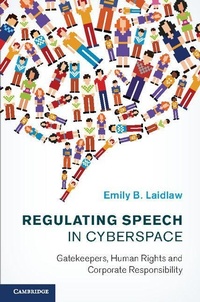
Regulating Speech in Cyberspace
Gatekeepers, Human Rights and Corporate Responsibility
Published on 2. February 2017
Book
Paperback/Softback
356 pages
978-1-107-62699-7 (ISBN)
Description
Private companies exert considerable control over the flow of information on the internet. Whether users are finding information with a search engine, communicating on a social networking site or accessing the internet through an ISP, access to participation can be blocked, channelled, edited or personalised. Such gatekeepers are powerful forces in facilitating or hindering freedom of expression online. This is problematic for a human rights system which has historically treated human rights as a government responsibility, and this is compounded by the largely light-touch regulatory approach to the internet in the West. Regulating Speech in Cyberspace explores how these gatekeepers operate at the intersection of three fields of study: regulation (more broadly, law), corporate social responsibility and human rights. It proposes an alternative corporate governance model for speech regulation, one that acts as a template for the increasingly common use of non-state-based models of governance for human rights.
More details
Language
English
Place of publication
Cambridge
United Kingdom
Target group
Professional and scholarly
Product notice
Paperback (trade)
Illustrations
7 Halftones, unspecified; 7 Halftones, black and white; 2 Line drawings, black and white
Dimensions
Height: 229 mm
Width: 152 mm
Thickness: 19 mm
Weight
516 gr
ISBN-13
978-1-107-62699-7 (9781107626997)
Copyright in bibliographic data and cover images is held by Nielsen Book Services Limited or by the publishers or by their respective licensors: all rights reserved.
Schweitzer Classification
Person
Emily B. Laidlaw is an Assistant Professor in the Faculty of Law at the University of Calgary, prior to which she spent almost ten years in the United Kingdom where she completed her LLM and PhD at the London School of Economics and Political Science and held a lectureship at the University of East Anglia. She researches and advises in the areas of information technology, copyright and media law, human rights and corporate social responsibility.
Content
1. The internet as democratising force; 2. A framework for identifying internet information gatekeepers; 3. Corporate social responsibility in cyberspace; 4. Mechanisms of information control: ISPs; 5. Mechanisms of information control: search engines; 6. A corporate governance model for the digital age.