

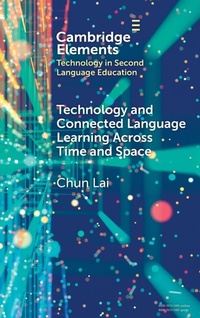
Technology and Connected Language Learning Across Time and Space
Published on 4. June 2026
Book
Hardback
75 pages
978-1-009-65782-2 (ISBN)
Description
Language is integral to human doing, being, becoming and belonging, and its acquisition is naturally distributed in and across activity spaces over time. Different learning experiences form 'a dialectical unity', where one brings the others into existence, and the capacities fostered in one inform and transform those in the others. Thus, connected learning across time and space is fundamental to the coherence, relevance, and meaningfulness of language learning, yet is not given sufficient attention in second language education. Connected learning is particularly relevant in the GenAI era where learner-driven lifelong and lifewide learning is much emphasized. This Element hence conceptualizes the framework of connected language learning with technology, and discusses how the framework could be operationalized and implemented in teaching and learning. It further foregrounds four concepts in this learning framework - agential literacy, interest development, self-regulation support, and identity intervention - and charts out an agenda for research.
More details
Series
Language
English
Place of publication
Cambridge
United Kingdom
Target group
College/higher education
Illustrations
Worked examples or Exercises
ISBN-13
978-1-009-65782-2 (9781009657822)
Copyright in bibliographic data and cover images is held by Nielsen Book Services Limited or by the publishers or by their respective licensors: all rights reserved.
Schweitzer Classification
Other editions
Additional editions
Book
06/2026
Cambridge University Press
€22.50
Shipment within 15-20 days
Person
Content
1. Introduction: Why Connected Language Learning?; 2. Theorize Connected Language Learning with Technology; 3. Operationalize Connected Language Learning with Technology; 4. Implementing Connected Language Learning with Technology; 5. Researching Connected Language Learning with Technology; 6. Concluding Remarks.