

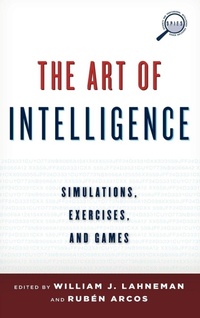
The Art of Intelligence
Simulations, Exercises, and Games
Published on 14. March 2014
Book
Hardback
298 pages
978-1-4422-2896-2 (ISBN)
Description
Since the 9/11 attacks, the number of intelligence courses and related curricula have soared. Many instructors look for interactive learning tools because they add immeasurable value to the student's understanding of the intelligence enterprise. Such tools, however, take time and effort to develop and are not circulated among faculty.
This is the first textbook to offer in one volume original simulations, exercises, and games designed by academics and intelligence professionals from several countries. These innovative methods are meant to enhance the learning experience and provide an international perspective to the topics and approaches discussed in class.
Intelligence simulations and games are presented in ready-to run formats, from easy instructions to result recordings matrices, to minimize preparation time for both instructors and students. Exercises, such as cyber attack simulation, information sharing, ethical scenarios and more, expose the student to the many subtle aspects of the intelligence enterprise through active role-playing in simulations and game exercises. The cases cover a wide range of key analytical issues and contexts with an international focus for an innovative text that will suit intelligence training courses at all levels.
This is the first textbook to offer in one volume original simulations, exercises, and games designed by academics and intelligence professionals from several countries. These innovative methods are meant to enhance the learning experience and provide an international perspective to the topics and approaches discussed in class.
Intelligence simulations and games are presented in ready-to run formats, from easy instructions to result recordings matrices, to minimize preparation time for both instructors and students. Exercises, such as cyber attack simulation, information sharing, ethical scenarios and more, expose the student to the many subtle aspects of the intelligence enterprise through active role-playing in simulations and game exercises. The cases cover a wide range of key analytical issues and contexts with an international focus for an innovative text that will suit intelligence training courses at all levels.
Reviews / Votes
[T]his anthology deserves to be widely used in intelligence education. * Intelligencer * The Art of Intelligence: Simulations, Exercises, and Games is an important and highly engaging addition to the intelligence education library, providing teachers and students with a set of well-crafted simulations that will allow for in-class, hands-on instruction that cannot be found elsewhere. -- Mark Lowenthal, author of Intelligence: From Secrets to Policy; President of the Intelligence & Security Academy This innovative book is a most welcome resource, providing a wide range of useful and engaging teaching/training materials that will enrich the student experience and facilitate improved understanding of analytic techniques. -- Mark Phythian, Professor of Politics, University of LeicesterMore details
Series
Language
English
Place of publication
United States
Publishing group
Bloomsbury Publishing Plc
Target group
College/higher education
US School Grade: From College Freshman to College Graduate Student, Interest Age: From 18 to 22 years
Illustrations
12 b/w illustrations; 16 b/w photos; 24 tables; 3 textboxes
Dimensions
Height: 235 mm
Width: 157 mm
Thickness: 22 mm
Weight
640 gr
ISBN-13
978-1-4422-2896-2 (9781442228962)
Copyright in bibliographic data and cover images is held by Nielsen Book Services Limited or by the publishers or by their respective licensors: all rights reserved.
Schweitzer Classification
Other editions
Additional editions
E-Book
03/2014
1st Edition
Rowman & Littlefield Publishers
from
€55.19
Available for download
E-Book
03/2014
1st Edition
Rowman & Littlefield Publishers
€65.99
Available for download
Persons
William J. Lahneman is associate professor of homeland security at Embry-Riddle Aeronautical University, Daytona Beach, Florida.
Ruben Arcos is professor of communication sciences at Rey Juan Carlos University (Madrid, Spain), professor and deputy director at the Centre for Intelligence Services and Democratic Systems, and coordinator of the MA Program in Intelligence Analysis.
Ruben Arcos is professor of communication sciences at Rey Juan Carlos University (Madrid, Spain), professor and deputy director at the Centre for Intelligence Services and Democratic Systems, and coordinator of the MA Program in Intelligence Analysis.
Content
Introduction
William J. Lahneman and Ruben Arcos
Part 1. 1-2 Class Session Simulations
1. Estimating Iraqi Weapons of Mass Destruction
William J. Lahneman and Hugo A. Keesing
2. Competing Hypotheses in Contemporary Intelligence Analysis
Julian Richards
3. Facing Intelligence Analysts with ethical Scenarios
Fernando Velasco and Ruben Arcos
4. Spies and Lies: The Perils of Collection (A Simulation)
Kristan J. Wheaton and James Breckenridge
5. Learning Intelligence Analysis: The Development of Cognitive Strategies
Dan Mazare and Gabriel Sebe
6. Kim's Game: Developing Powers of Observation and Memory
William J. Lahneman
Part 2. 1-2 Week Simulations
7. Cyber Attack on the Office of Intelligence Production: A Collaborative Simulation
Randolph H. Pherson and Vaughn F. Bishop
8. Market and Competitor Analysis: Real Exercise
Luis Madureira
9. "Need to Share" Intelligence and Crisis Management in Fighting Terrorism and Organized Crime: the Need for Integrated Training Solutions
Gheorghe-Teodoru Stefan and Cristian Barna
10. A 3-D Intelligence Analysis on Migration as a Security Threat: From Data to Intelligence
Irena Dumitru and Ella Ciuperca
11. TEST Simulation Model: Team Working and Experiential Scenario-based Training
Chris Jagger and Julian Richards
Part 3. Multi-week Simulations
12. Understanding Baynesian Thinking: Prior and Posterior Probabilities and Analysis of Competing
Hypotheses in intelligence Analysis
Sir David Omand, GCB
13. Assessment BASE: Simulating National Intelligence Assessment in a Graduate Course
Philip H.J. Davies
14. Social Intelligence Survey: Mapping the Webs of embedded Intelligence Functions
Wilhelm Agrell and Tobbe Peterson
15. Multimedia Intelligence Products: Experiencing the Intelligence Production Process and Adding Layers of Information to Intelligence Reports
Ruben Arcos, Manuel Gertrudix & Jose Ignacio Prieto
William J. Lahneman and Ruben Arcos
Part 1. 1-2 Class Session Simulations
1. Estimating Iraqi Weapons of Mass Destruction
William J. Lahneman and Hugo A. Keesing
2. Competing Hypotheses in Contemporary Intelligence Analysis
Julian Richards
3. Facing Intelligence Analysts with ethical Scenarios
Fernando Velasco and Ruben Arcos
4. Spies and Lies: The Perils of Collection (A Simulation)
Kristan J. Wheaton and James Breckenridge
5. Learning Intelligence Analysis: The Development of Cognitive Strategies
Dan Mazare and Gabriel Sebe
6. Kim's Game: Developing Powers of Observation and Memory
William J. Lahneman
Part 2. 1-2 Week Simulations
7. Cyber Attack on the Office of Intelligence Production: A Collaborative Simulation
Randolph H. Pherson and Vaughn F. Bishop
8. Market and Competitor Analysis: Real Exercise
Luis Madureira
9. "Need to Share" Intelligence and Crisis Management in Fighting Terrorism and Organized Crime: the Need for Integrated Training Solutions
Gheorghe-Teodoru Stefan and Cristian Barna
10. A 3-D Intelligence Analysis on Migration as a Security Threat: From Data to Intelligence
Irena Dumitru and Ella Ciuperca
11. TEST Simulation Model: Team Working and Experiential Scenario-based Training
Chris Jagger and Julian Richards
Part 3. Multi-week Simulations
12. Understanding Baynesian Thinking: Prior and Posterior Probabilities and Analysis of Competing
Hypotheses in intelligence Analysis
Sir David Omand, GCB
13. Assessment BASE: Simulating National Intelligence Assessment in a Graduate Course
Philip H.J. Davies
14. Social Intelligence Survey: Mapping the Webs of embedded Intelligence Functions
Wilhelm Agrell and Tobbe Peterson
15. Multimedia Intelligence Products: Experiencing the Intelligence Production Process and Adding Layers of Information to Intelligence Reports
Ruben Arcos, Manuel Gertrudix & Jose Ignacio Prieto