


Dimensions of Psychological Problems
Replacing Diagnostic Categories with a More Science-Based and Less Stigmatizing Alternative
Published on 25. October 2021
Book
Paperback/Softback
256 pages
978-0-19-760790-9 (ISBN)
Description
A remarkable and extremely important ongoing positive revolution in how we think about psychological problems is rapidly reaching a tipping point. This book provides a manifesto for this revolution. An increasing number of psychologists and psychiatrists are proposing that we either radically change the next edition of the Diagnostic and Statistical Manual of the Mental Disorders and the International Classification of Diseases or leave them behind entirely. The author argues for a view of psychological problems that is far less stigmatizing and better supported by the data but which will require large changes in thinking. First, there is no clear distinction between "normal" and "abnormal" psychological functioning. Psychological problems do not reflect rare and terrifying "illnesses" of the mind, but are problematic ways of thinking, feeling, and behaving that lie on continuous dimensions from minor to severe. Crucially, psychological problems are ordinary aspects of the human experience. They are ordinary in the sense of being commonplace-the great majority of us will experience distressing and disruptive psychological problems at some time during our lives-and are ordinary in arising through the same natural interplay of genetic and environmental influences as any other aspect of behavior. The dimensions of psychological problems are highly correlated and these correlations provide vital clues as that allow us to see a hierarchy of causes of psychological problems for the first time. These range from factors that influence the likelihood of exhibiting some kind of psychological problem, but not which kind, to highly specific causes.
More details
Language
English
Place of publication
New York
United States
Target group
Professional and scholarly
Dimensions
Height: 210 mm
Width: 140 mm
Thickness: 14 mm
Weight
316 gr
ISBN-13
978-0-19-760790-9 (9780197607909)
Copyright in bibliographic data and cover images is held by Nielsen Book Services Limited or by the publishers or by their respective licensors: all rights reserved.
Schweitzer Classification
Other editions
Additional editions
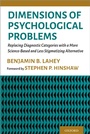
Benjamin B. Lahey
Dimensions of Psychological Problems
Replacing Diagnostic Categories with a More Science-Based and Less Stigmatizing Alternative
E-Book
08/2021
OUP eBook
€24.99
Available for download
Benjamin B. Lahey
Dimensions of Psychological Problems
Replacing Diagnostic Categories with a More Science-Based and Less Stigmatizing Alternative
E-Book
08/2021
OUP eBook
€24.99
Available for download
Persons
Benjamin B. Lahey
Irving B. Harris Professor of Epidemiology, Psychiatry and Behavioral Neuroscience
Department of Public Health Sciences
University of Chicago
Irving B. Harris Professor of Epidemiology, Psychiatry and Behavioral Neuroscience
Department of Public Health Sciences
University of Chicago
Content
Preface
Chapter 1: Conceptualizing Psychological Problems
Chapter 2: From Binary Diagnostic Categories to Dimensions of Psychological Problems
Chapter 3: Dimensions of Internalizing Problems
Chapter 4: Dimensions of Externalizing Problems
Chapter 5: Dimensions of Psychotic and Other Problems of Thought and Affect
Chapter 6: Hierarchical Nature of Psychological Problems
Chapter 7: Sex Differences and the Development of Psychological Problems
Chapter 8. Ordinary Origins of Psychological Problems-Gene-Environment Interplay
Chapter 9: Ordinary Origins of Psychological Problems-Transacting with the World
Epilogue
Technical Appendix
Chapter 1: Conceptualizing Psychological Problems
Chapter 2: From Binary Diagnostic Categories to Dimensions of Psychological Problems
Chapter 3: Dimensions of Internalizing Problems
Chapter 4: Dimensions of Externalizing Problems
Chapter 5: Dimensions of Psychotic and Other Problems of Thought and Affect
Chapter 6: Hierarchical Nature of Psychological Problems
Chapter 7: Sex Differences and the Development of Psychological Problems
Chapter 8. Ordinary Origins of Psychological Problems-Gene-Environment Interplay
Chapter 9: Ordinary Origins of Psychological Problems-Transacting with the World
Epilogue
Technical Appendix