

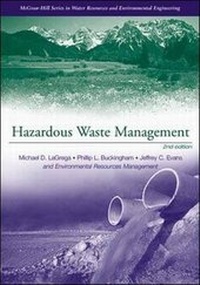
Hazardous Waste Management
2nd Edition
Published on 1. March 2001
Book
Paperback/Softback
1184 pages
978-0-07-118170-9 (ISBN)
Description
This book provides a comprehensive introduction to the complex, interdisciplinary field of hazardous waste management, with thoroughly updated information on the most current methods of treatment, disposal, and site remediation. The management of hazardous waste has changed dramatically since the 1960's and continues to evolve as our knowledge of both the hazards and management methods grows. Since the last edition was published (1994), much of the emphasis has shifted: from site assessments to site remediation, from new facility siting to pollution prevention, and from a newly emerging market to a mature market. The new edition provides comprehensive coverage of these changes in the field.
More details
Series
Edition
2nd Revised edition
Language
English
Place of publication
London
United States
Publishing group
McGraw-Hill Education - Europe
Target group
College/higher education
Edition type
Revised edition
Illustrations
illustrations
Dimensions
Height: 228 mm
Width: 177 mm
Thickness: 53 mm
Weight
1958 gr
ISBN-13
978-0-07-118170-9 (9780071181709)
Copyright in bibliographic data and cover images is held by Nielsen Book Services Limited or by the publishers or by their respective licensors: all rights reserved.
Schweitzer Classification
Other editions
Previous edition

Michael D. Lagrega | Phillip L. Buckingham | Jeffrey C. Evans
Hazardous Waste Management
Book
06/1994
McGraw-Hill Education (ISE Editions)
€45.87
Article exhausted; check for reprint
Persons
Michael LaGrega (deceased) received his Ph.D in Environmental Engineering at Syracuse University, Phillip buckingham (Lewisberg, PA) Buckness University, and Jeffrey Evans (Exton, PA) teaches at Buckness University. 1996 Organizational Behavior Custom Planning/Bucknell University
Content
I Fundamentals 1 Hazardous Waste 2 The Legal Framework 3 Process Fundamentals 4 Fate and Transport of Contaminants 5 Toxicology II Current Management Practices 6 Environmental Audits 7 Pollution Prevention 8 Facility Development and Operations III Treatment and Disposal Methods 9 Physicochemical Processes 10 Biological Methods 11 Stabilization and Solidification 12 Thermal Methods 13 Land Disposal IV Site Remediation 14 Quantitative Risk Assessment 15 Site and Subsurface Characterization 16 Remedial Technologies 17 Evaluation and Selection of Remedial Actions and Corrective Measures Appendices A Basel Convention B Contaminant Properties C Thermodynamic Properties D Conversion Factors