

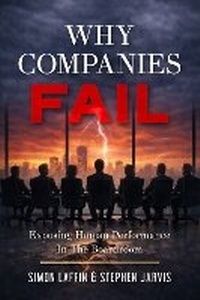
Why Companies Fail
Exposing Human Performance In The Boardroom
Will be published approx. on 8. October 2026
Book
Paperback/Softback
978-1-917377-60-7 (ISBN)
Description
Corporate governance has had eight iterations of the UK Code since 1992. The scandals have kept coming anyway. Why Companies Fail argues that this is not a coincidence - it is the inevitable consequence of a system that treats directors like rational machines and reaches for more rules every time they prove not to be.
Drawing on 27 major corporate failures spanning 300 years - from the South Sea Bubble to Carillion, from Barings to FTX, from Chernobyl to the Post Office - Simon Laffin and Stephen Jarvis identify the real patterns behind corporate collapse. Laffin brings three decades of boardroom experience as chairman, CFO and non-executive director across listed and private companies. Jarvis is one of the world's leading experts in aviation human factors, designer of the UK CAA's Flight Crew Human Factors Handbook and the man who ended a multi-million-pound door deployment problem at easyJet - not by retraining the cabin crew, but by redesigning the process.
Together, they apply the lessons of aviation's Crew Resource Management revolution to the boardroom. The aviation industry long ago accepted that experienced, intelligent, well-intentioned professionals still make predictable errors under pressure, and built systems to absorb and reduce those errors rather than simply blaming individuals when they occurred. The corporate world has not done this. It still reaches for culprits rather than causes, and for new rules rather than new understanding.
Why Companies Fail examines the cognitive and group dynamics that derail even the most capable boards: confirmation bias and cognitive dissonance; groupthink and diffusion of responsibility; authority gradients and the failure to speak up; the illusion of control and decision-making under uncertainty. It shows why the proximate causes of failure - poor strategy, weak operations, dysfunctional leadership, unethical behaviour - are themselves symptoms of something deeper, and why blame, however satisfying, is not a system.
The book closes with a practical manifesto for change: Boardroom Resource Management, a new Decision Support System for boards, and a fundamentally different approach to risk, feedback and accountability - one built around how humans actually behave, not how we wish they would.
Provocative, evidence-based and ultimately optimistic, this is the book for anyone who governs, regulates, advises or writes about corporate leadership - and for anyone who wants to understand why, when the boards of Carillion, Northern Rock and the Post Office evaluated their own performance months before catastrophic collapse, every single one concluded they were performing well.
Drawing on 27 major corporate failures spanning 300 years - from the South Sea Bubble to Carillion, from Barings to FTX, from Chernobyl to the Post Office - Simon Laffin and Stephen Jarvis identify the real patterns behind corporate collapse. Laffin brings three decades of boardroom experience as chairman, CFO and non-executive director across listed and private companies. Jarvis is one of the world's leading experts in aviation human factors, designer of the UK CAA's Flight Crew Human Factors Handbook and the man who ended a multi-million-pound door deployment problem at easyJet - not by retraining the cabin crew, but by redesigning the process.
Together, they apply the lessons of aviation's Crew Resource Management revolution to the boardroom. The aviation industry long ago accepted that experienced, intelligent, well-intentioned professionals still make predictable errors under pressure, and built systems to absorb and reduce those errors rather than simply blaming individuals when they occurred. The corporate world has not done this. It still reaches for culprits rather than causes, and for new rules rather than new understanding.
Why Companies Fail examines the cognitive and group dynamics that derail even the most capable boards: confirmation bias and cognitive dissonance; groupthink and diffusion of responsibility; authority gradients and the failure to speak up; the illusion of control and decision-making under uncertainty. It shows why the proximate causes of failure - poor strategy, weak operations, dysfunctional leadership, unethical behaviour - are themselves symptoms of something deeper, and why blame, however satisfying, is not a system.
The book closes with a practical manifesto for change: Boardroom Resource Management, a new Decision Support System for boards, and a fundamentally different approach to risk, feedback and accountability - one built around how humans actually behave, not how we wish they would.
Provocative, evidence-based and ultimately optimistic, this is the book for anyone who governs, regulates, advises or writes about corporate leadership - and for anyone who wants to understand why, when the boards of Carillion, Northern Rock and the Post Office evaluated their own performance months before catastrophic collapse, every single one concluded they were performing well.
More details
Language
English
Place of publication
United Kingdom
Publishing group
Chronos Publishing
Illustrations
18 colour images
Dimensions
Height: 229 mm
Width: 152 mm
ISBN-13
978-1-917377-60-7 (9781917377607)
Copyright in bibliographic data and cover images is held by Nielsen Book Services Limited or by the publishers or by their respective licensors: all rights reserved.
Schweitzer Classification