

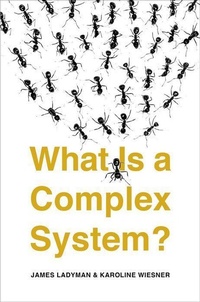
What Is a Complex System?
Published on 8. September 2020
Book
Paperback/Softback
184 pages
978-0-300-25110-4 (ISBN)
Description
A clear, concise introduction to the quickly growing field of complexity science that explains its conceptual and mathematical foundations
What is a complex system? Although "complexity science" is used to understand phenomena as diverse as the behavior of honeybees, the economic markets, the human brain, and the climate, there is no agreement about its foundations. In this introduction for students, academics, and general readers, philosopher of science James Ladyman and physicist Karoline Wiesner develop an account of complexity that brings the different concepts and mathematical measures applied to complex systems into a single framework. They introduce the different features of complex systems, discuss different conceptions of complexity, and develop their own account. They explain why complexity science is so important in today's world.
What is a complex system? Although "complexity science" is used to understand phenomena as diverse as the behavior of honeybees, the economic markets, the human brain, and the climate, there is no agreement about its foundations. In this introduction for students, academics, and general readers, philosopher of science James Ladyman and physicist Karoline Wiesner develop an account of complexity that brings the different concepts and mathematical measures applied to complex systems into a single framework. They introduce the different features of complex systems, discuss different conceptions of complexity, and develop their own account. They explain why complexity science is so important in today's world.
Reviews / Votes
"A clear analysis of systems ranging from radiation to human brains"-Nature"Many people might not bother to define complexity, thinking that we know it when we see it. Scientists and philosophers have no such luxury, and for them this book will be invaluable. Ladyman and Wiesner have provided a compact but comprehensive overview of the different ways that systems can be complex, ultimately arguing that complexity comes in distinct forms, but that their commonalities are nevertheless quite real."-Sean Carroll, author of Something Deeply Hidden: Quantum Worlds and the Emergence of Spacetime
"This is an outstanding, original, and much-needed book. Ladyman and Wiesner give an accessible, engaging, and precise overview of complexity science from a panoptic perspective, spanning many different kinds of examples from a variety of disciplines"-James Owen Weatherall, coauthor of The Misinformation Age: How False Beliefs Spread
"Written in a lively and readable style, What Is a Complex System? provides a clear and coherent synthesis of the myriad and sometimes contradictory descriptions and definitions of complex systems."-Colm Connaughton, Director of the Centre for Complexity Science, University of Warwick
"This is highly thoughtful incisive essay on the meaning and use of the concept of complex systems. I particularly like the attempt to formulate syntheses across fields, across features and across mechanisms."-Didier Sornette, author of Why Stock Markets Crash: Critical Events in Complex Financial Systems
"This book is a superb introduction to complex systems. Ladyman and Wiesner skillfully guide the reader from examples of complex systems all-around us, to ten common features of such systems and how to mathematically measure them, to a discussion of complexity as a scientific field by itself. Anyone interested in complex systems should read this book before any other."-Tina Eliassi-Rad, Professor of Network Science, Northeastern University
More details
Language
English
Place of publication
United States
Target group
College/higher education
Professional and scholarly
Product notice
Paperback (trade)
Illustrations
1 b-w illus.
Dimensions
Height: 233 mm
Width: 154 mm
Thickness: 17 mm
Weight
297 gr
ISBN-13
978-0-300-25110-4 (9780300251104)
Copyright in bibliographic data and cover images is held by Nielsen Book Services Limited or by the publishers or by their respective licensors: all rights reserved.
Schweitzer Classification
Persons
James Ladyman is professor of philosophy at the University of Bristol and works mainly in the philosophy of science. Karoline Wiesner is associate professor of mathematics at the University of Bristol and uses information theory to understand complex systems.