

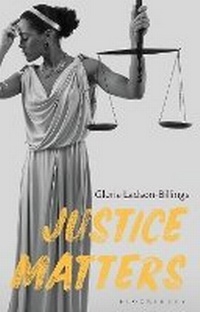
Justice Matters
Published on 14. December 2023
Book
Hardback
184 pages
978-1-350-26882-1 (ISBN)
Description
Shortlisted for the 2024 O.L. Davis Outstanding Book Award from the AATC
Social justice has become a buzzword to suggest we are serious about racism, sexism, classism, heterosexism, and ableism. But justice remains elusive and contested. It is written in founding documents, street soldiers declare it: 'no justice, no peace!', but is absent from public interactions. Building on Cornel West's notion of 'race matters' and the Black Lives Matter movement, Justice Matters strips away the rhetoric that keeps us from understanding what justice is, particularly in education, but also in relation to health, race, economy, and environment.
Ladson-Billings interrogates the meaning of justice, looking at Western notions of justice from Aristotle to Kant to Rorty, alongside Eastern notions of Justice, from Lao Tzu, to Rumi to Frantz Fanon and W.E.B. Dubois. She shows how the pandemic has exposed deep injustices in society, and how schooling and the curriculum are largely blind to the race, White supremacy, and the racial trauma that plagues marginalized people. She argues that teaching strategies that rely on hierarchy, such as ability groups, tell students who they are and what we expect of them, supposedly doing a 'just' thing but also suggesting that some people are 'less' than others - the very narrative of White supremacy. Schooling is the genesis of exclusion and incarceration, with strategies like classroom exclusion, suspension, and expulsion laying the groundwork for the school to prison pipeline. Offering hope for a way forward, she looks at how hip hop can champion justice, and considers justice in the context of social movements, including Black Lives Matter, MoveOn.org, and #MeToo, and explores the pros and cons of 'hashtag activism'. Ultimately she shows us how justice can and should be the central tenet of education and society, and how we can save it from being obscured and watered down.
Social justice has become a buzzword to suggest we are serious about racism, sexism, classism, heterosexism, and ableism. But justice remains elusive and contested. It is written in founding documents, street soldiers declare it: 'no justice, no peace!', but is absent from public interactions. Building on Cornel West's notion of 'race matters' and the Black Lives Matter movement, Justice Matters strips away the rhetoric that keeps us from understanding what justice is, particularly in education, but also in relation to health, race, economy, and environment.
Ladson-Billings interrogates the meaning of justice, looking at Western notions of justice from Aristotle to Kant to Rorty, alongside Eastern notions of Justice, from Lao Tzu, to Rumi to Frantz Fanon and W.E.B. Dubois. She shows how the pandemic has exposed deep injustices in society, and how schooling and the curriculum are largely blind to the race, White supremacy, and the racial trauma that plagues marginalized people. She argues that teaching strategies that rely on hierarchy, such as ability groups, tell students who they are and what we expect of them, supposedly doing a 'just' thing but also suggesting that some people are 'less' than others - the very narrative of White supremacy. Schooling is the genesis of exclusion and incarceration, with strategies like classroom exclusion, suspension, and expulsion laying the groundwork for the school to prison pipeline. Offering hope for a way forward, she looks at how hip hop can champion justice, and considers justice in the context of social movements, including Black Lives Matter, MoveOn.org, and #MeToo, and explores the pros and cons of 'hashtag activism'. Ultimately she shows us how justice can and should be the central tenet of education and society, and how we can save it from being obscured and watered down.
Reviews / Votes
Insightful and timely. Ladson-Billings challenges us to think again about concepts like 'social justice' that have become buzz words while robustly interrogating own understandings of what justice means. At last a book that explores the concept of justice from a global perspective, drawing from thinkers from the East and West. For me, this is a basic reader for those involved in educating for justice and against discrimination and should be read by every teacher, university/college lecturer engaged in teacher preparation and those who shape and design curricular frameworks. -- Rowena Arshad CBE, Professor Emerita, University of Edinburgh, UKMore details
Language
English
Place of publication
London
United Kingdom
Publishing group
Bloomsbury Publishing PLC
Dimensions
Height: 218 mm
Width: 140 mm
Thickness: 16 mm
Weight
360 gr
ISBN-13
978-1-350-26882-1 (9781350268821)
Copyright in bibliographic data and cover images is held by Nielsen Book Services Limited or by the publishers or by their respective licensors: all rights reserved.
Schweitzer Classification
Person
Gloria Ladson-Billings is Professor Emerita at the University of Wisconsin-Madison, USA. She is a Fellow of the British Academy, the American Academy of Arts & Sciences, the American Educational Research Association, and the Hagler Institute at Texas A&M University, USA. She is Past-President of the National Academy of Education (2017-2021) and former President of the American Educational Research Association (2005-2006), and the author of multiple books including the critically acclaimed The Dreamkeepers: Successful Teachers of African-American Children, 3rd Edition (2022).
Content
Introduction
1. Saving the Language of Justice (Or the Meaning of the Word 'Justice')
2. Saving Justice During the Pandemic (Or How to Recognize Fundamental Injustice in Society)
3. Saving Justice in Curriculum (Or What We Teach)
4. Saving Justice in Instruction (Or How We Teach)
5. Saving Justice in Discipline (Or How We Dismantle the Carceral State)
6. Saving Justice In Popular Culture (Or How Hip Hop Can Rescue Justice)
7. Saving Justice In Social Activism (Or How it Has to be More Than a Hashtag)
Conclusion: The Future of a Society that Fails to Save Justice
References
Index
1. Saving the Language of Justice (Or the Meaning of the Word 'Justice')
2. Saving Justice During the Pandemic (Or How to Recognize Fundamental Injustice in Society)
3. Saving Justice in Curriculum (Or What We Teach)
4. Saving Justice in Instruction (Or How We Teach)
5. Saving Justice in Discipline (Or How We Dismantle the Carceral State)
6. Saving Justice In Popular Culture (Or How Hip Hop Can Rescue Justice)
7. Saving Justice In Social Activism (Or How it Has to be More Than a Hashtag)
Conclusion: The Future of a Society that Fails to Save Justice
References
Index