

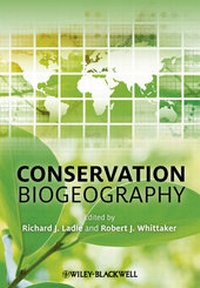
Conservation Biogeography
Published on 18. February 2011
Book
Paperback/Softback
320 pages
978-1-4443-3504-0 (ISBN)
Unfortunately, price unknown
Article exhausted; check different version
Description
This book provides an authoritative and concise overview of the key themes and emerging concepts in conservation biogeography. It serves as an introduction to the subject and a strong framework for more advanced undergraduate or Masters level courses. Each of the ten chapters establishes the state of knowledge, the key questions, major uncertainties and research needs.
The book opens with a short section examining the origins and philosophical roots of conservation biogeography and then move on to addressing the challenges and practical applications of mapping biodiversity at different spatial scales in a rapidly changing world. The varying design principles of networks of protected areas, and major approaches adopted hitherto in this endeavour, and the implications of habitat loss, fragmentation and alteration, plus issues associated with biological invasions form much of the core material of the volume. The book concludes with a critical assessment of the scale of the future conservation challenge and research needs and directions.
Reviews / Votes
"In all of these respects, this volume succeeds admirably, and deserves a place of prominence in any conservation biologist's perspective on how to advance our field." (The Quarterly Review of Biology, 1 June 2013)With a glossary and references, this book will be very useful for students." (Mammalia, 1 January 2013)
"The entire collection certainly has a distinctive and unique niche among ecological texts. It is aimed at a postgraduate market and is most likely to be used by conservationists and planners who daily face the problems with which these essays deal." (Bulletin of the British Ecological Society, 1 June 2012)
"Ladle, Whittaker, and their contributors have provided a volume that is informative, engaging, and respectful of the many scientists, naturalists, and practitioners who work and philosophies inform contemporary biogeographic research and its application." (Ecology, 1 March 2012)
"This book represent a nice, clear presentation of conservation biogeography from the perspective of ecological biogeography ... We sincerely congratulate the editors and we believe that this book represents a gateway to a new vision of conservation." (Biological Conservation Reviewers, 2011) "Conservation Biogeography provides an exceptionally well-done introduction to, and status report of, an emerging field of inquiry. . . Summing Up: Essential. All readership levels." (Choice, 1 September 2011)
More details
Other editions
Additional editions
Richard J. Ladle | Robert J. Whittaker
Conservation Biogeography
Book
02/2011
Wiley
Unfortunately, price unknown
Article exhausted; check different version
Richard Ladle | Robert J. Whittaker
Conservation Biogeography
E-Book
01/2011
Wiley-Blackwell
€56.99
Available for download
Richard Ladle | Robert J. Whittaker
Conservation Biogeography
E-Book
12/2010
Wiley-Blackwell
€56.99
Available for download
Persons
Richard J. Ladle was the founding Director of Oxford University's MSc in Biodiversity, Conservation and Management. Since 2009 he has been working in Brazil as an international conservation consultant and science writer. He is currently a Visiting Professor at the Federal University of Alagoas, teaching and doing research on diverse and interdisciplinary aspects of conservation, biogeography and ecology.
Robert J. Whittaker is the current Academic Director of the MSc in Biodiversity, Conservation and Management, and holds the title of Professor of Biogeography in the School of Geography and the Environment, University of Oxford. He is a founding member and past President (2009-2010) of the International Biogeography Society and since 2004 has been the editor-in-chief of the Journal of Biogeography. He has a long-standing interest in island biogeography, patterns and processes controlling diversity, and the application of biogeography to conservation.
The author/editor royalties for this book are to be donated to the International Biogeography Society, for furtherance of its work promoting the study, dissemination and application of biogeography. For further information on the IBS visit www.biogeography.org.
Robert J. Whittaker is the current Academic Director of the MSc in Biodiversity, Conservation and Management, and holds the title of Professor of Biogeography in the School of Geography and the Environment, University of Oxford. He is a founding member and past President (2009-2010) of the International Biogeography Society and since 2004 has been the editor-in-chief of the Journal of Biogeography. He has a long-standing interest in island biogeography, patterns and processes controlling diversity, and the application of biogeography to conservation.
The author/editor royalties for this book are to be donated to the International Biogeography Society, for furtherance of its work promoting the study, dissemination and application of biogeography. For further information on the IBS visit www.biogeography.org.
Content
List of Contributors
SECTION 1: ROOTS, RELEVANCE, AIMS, AND VALUES
1 The roots of conservation biogeography (Robert J. Whittaker and Richard J. Ladle).
2 Social values and conservation biogeography (Richard J. Ladle, Paul Jepson and Lindsey Gillson).
3 Base-lines, patterns and process (Lindsey Gillson, Richard J. Ladle and Miguel B. Araújo).
SECTION 2: THE DISTRIBUTION OF DIVERSITY: CHALLENGES AND APPLICATIONS
4 Basic biogeography: estimating biodiversity and mapping nature (Brett R. Riddle, Richard J. Ladle, Sara Lourie, Robert J. Whittaker).
5 The shaping of the global protected area estate (Paul Jepson, Robert J. Whittaker & Sara Lourie).
6 Systematic conservation planning: past, present, and future (James E.M. Watson, Hedley S. Grantham, Kerrie A. Wilson and Hugh P. Possingham).
SECTION 3: CONSERVATION PLANNING IN A CHANGING WORLD
7 Planning for persistence in a changing world (Richard A. Fuller, Richard J. Ladle, Robert J. Whittaker & Hugh P. Possingham
8 Applied island biogeography (Kostas A. Triantis and Shonil A. Bhagwat).
9 Biological invasions and the homogenization of faunas and floras (Julian D. Olden, Julie L. Lockwood, and Catherine L. Parr).
SECTION 4: FUTURE DIRECTIONS
10 Prospects and challenges (Richard J. Ladle & Robert J. Whittaker).
Glossary of Terms.
References.
Index.