

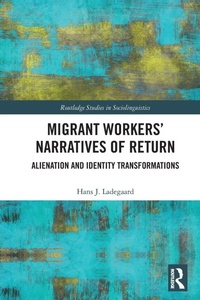
Migrant Workers' Narratives of Return
Alienation and Identity Transformations
1st Edition
Published on 18. December 2024
Book
Paperback/Softback
156 pages
978-1-032-20281-5 (ISBN)
Description
Drawing on a corpus of 113 narratives told by migrant workers who have returned to their home country, Ladegaard details Indonesian and Filipina (domestic) migrant workers' experiences of homecoming after years of work abroad, separated from their loved ones.
The narratives deal with two major themes: 1) Migrant workers' experiences in the diaspora, which for many, particularly Indonesian workers, were associated with abuse and exploitation leading to trauma; and 2) migrant workers' experiences of coming home, which include both the happy reunion with the family but also concerns about not 'fitting in' and the need to reinvent themselves because they are not who they were when they left. This is particularly true for workers whose migratory journeys have failed and who have come back to their hometowns without any financial award. Chapters also explore the major difference between Filipina and Indonesian migrant workers' overseas experiences. The Filipina returnees share mostly positive stories while the Indonesian returnees uncover mostly negative stories, further illuminating what may explain these diverse migratory experiences. Finally, the book discusses how research on disenfranchised groups like (domestic) migrant workers can be used for social and political action.
An excellent text that will appeal to academics, teachers and postgraduate students in the humanities and social sciences, particularly in sociolinguistics, applied linguistics, intercultural communication, anthropology, and migration studies.
The narratives deal with two major themes: 1) Migrant workers' experiences in the diaspora, which for many, particularly Indonesian workers, were associated with abuse and exploitation leading to trauma; and 2) migrant workers' experiences of coming home, which include both the happy reunion with the family but also concerns about not 'fitting in' and the need to reinvent themselves because they are not who they were when they left. This is particularly true for workers whose migratory journeys have failed and who have come back to their hometowns without any financial award. Chapters also explore the major difference between Filipina and Indonesian migrant workers' overseas experiences. The Filipina returnees share mostly positive stories while the Indonesian returnees uncover mostly negative stories, further illuminating what may explain these diverse migratory experiences. Finally, the book discusses how research on disenfranchised groups like (domestic) migrant workers can be used for social and political action.
An excellent text that will appeal to academics, teachers and postgraduate students in the humanities and social sciences, particularly in sociolinguistics, applied linguistics, intercultural communication, anthropology, and migration studies.
More details
Series
Language
English
Place of publication
London
United Kingdom
Publishing group
Taylor & Francis Ltd
Target group
College/higher education
Postgraduate
Illustrations
14 s/w Photographien bzw. Rasterbilder, 14 s/w Abbildungen
14 Halftones, black and white; 14 Illustrations, black and white
Dimensions
Height: 234 mm
Width: 156 mm
Thickness: 9 mm
Weight
266 gr
ISBN-13
978-1-032-20281-5 (9781032202815)
Copyright in bibliographic data and cover images is held by Nielsen Book Services Limited or by the publishers or by their respective licensors: all rights reserved.
Schweitzer Classification
Other editions
Additional editions
Book
08/2023
1st Edition
Routledge
€205.90
Shipment within 10-20 days
E-Book
08/2023
1st Edition
Routledge
€55.49
Available for download
E-Book
08/2023
1st Edition
Routledge
€55.49
Available for download
Person
Hans J. Ladegaard is Professor and former Head of the Department of English and Communication at The Hong Kong Polytechnic University.
Content
1. Setting the scene 2. How and Why: A Dash of Theory and Methodology 3. Struggling to Reconnect: Identity Transformations 4. Haunted by Ghosts: Remembering Trauma 5. Spurning Exploitation: The Empowered Migrant Worker 6. Sinking and Drowning, or Surviving and Thriving 7. Reflexivity and Social Activism in Migrant Worker Research 8. Summary and Concluding Remarks