

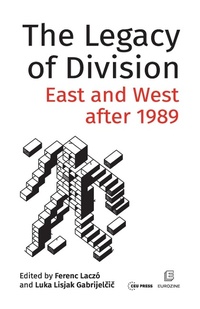
The Legacy of Division
East and West after 1989
Published on 15. October 2020
Book
Paperback/Softback
344 pages
978-963-386-374-9 (ISBN)
Description
This volume examines the legacy of the East-West divide since the implosion of the communist regimes in Europe. The ideals of 1989 have largely been frustrated by the crises and turmoil of the past decade. The liberal consensus was first challenged as early as the mid-2000s. In Eastern Europe, grievances were directed against the prevailing narratives of transition and ever sharper ethnic-racial antipathies surfaced in opposition to a supposedly postnational and multicultural West. In Western Europe, voices regretting the European Union's supposedly careless and premature expansion eastward began to appear on both sides of the left-right and liberal-conservative divides. The possibility of convergence between Europe's two halves has been reconceived as a threat to the European project.
In a series of original essays and conversations, thirty-three contributors from the fields of European and global history, politics and culture address questions fundamental to our understanding of Europe today: How have perceptions and misperceptions between the two halves of the continent changed over the last three decades? Can one speak of a new East-West split? If so, what characterizes it and why has it reemerged? The contributions demonstrate a great variety of approaches, perspectives, emphases, and arguments in addressing the daunting dilemma of Europe's assumed East-West divide.
In a series of original essays and conversations, thirty-three contributors from the fields of European and global history, politics and culture address questions fundamental to our understanding of Europe today: How have perceptions and misperceptions between the two halves of the continent changed over the last three decades? Can one speak of a new East-West split? If so, what characterizes it and why has it reemerged? The contributions demonstrate a great variety of approaches, perspectives, emphases, and arguments in addressing the daunting dilemma of Europe's assumed East-West divide.
Reviews / Votes
"Some books answer questions, and some books inspire readers to ask more questions. The Legacy of Division belongs to the latter group. In an essayistic way, it invites a broad audience to consider questions of the present and the past. Readers might include scholars, students, and journalists, but thanks to the essayistic style, any member of the broader public interested in understanding the varied nature and legacies of the East-West divisions will find the book engaging. The future is open, and our thinking about it is richer thanks to The Legacy of Division."https://www.ceeol.com/search/article-detail?id=999140 -- Petra Guasti * Hungarian Historical Review * "This rich and insightful collection of twenty-eight essays, originally published in Eurozine online in 2019, reflects on the fate of eastern Europe thirty years after the fall of the Berlin Wall. It is an impressive but depressing compilation that captures the angst experienced by many of the region's inhabitants-and by a majority of outside observers."
https://www.cambridge.org/core/journals/slavic-review/article/legacy-of-division-east-and-west-after-1989-ed-ferenc-laczo-and-luka-lisjak-gabrijelcic-budapest-central-european-university-press-2020-x-337-pp-appendix-notes-bibliography-index-illustrations-2999-paper/2BCE120EC29C4772AD793957CED9B7DE -- Peter Rutland * Slavic Review * "The overthrow of communism was peaceful in the majority of Central and Eastern European countries. Most citizens of East Central Europe viewed membership in the European Community as a prized goal that will aid rapid improvement in their standards of living, seamless inclusion in the European Market, and a democratic political system. While some economic successes cannot be denied, transformation was slow and unequal. After the global financial crisis of 2008, economic liberalism became burdened with statism, paternalism and oligarchic rule; and the crony model of capitalism or elements of authoritarianism ("illiberal democracy") reappeared. Therefore, largely, the conclusion drawn by most of the contributors for The Legacy of Division is that new curtains have appeared, but these are made of much lighter materials than the old Iron Curtain." -- Susan Glanz * Hungarian Cultural Studies *
More details
Language
English
Place of publication
Oxford
Hungary
Target group
Professional and scholarly
Academic
Product notice
Paperback (trade)
Unsewn / adhesive bound
Dimensions
Height: 216 mm
Width: 140 mm
Thickness: 19 mm
Weight
439 gr
ISBN-13
978-963-386-374-9 (9789633863749)
Copyright in bibliographic data and cover images is held by Nielsen Book Services Limited or by the publishers or by their respective licensors: all rights reserved.
Schweitzer Classification
Other editions
Additional editions
E-Book
10/2020
Central European University Press
€27.99
Available for download
Persons
Ferenc Laczo is an assistant professor in European History at Maastricht University.
Luka Lisjak Gabrijelcic is a Slovene historian, political analyst and translator.
Luka Lisjak Gabrijelcic is a Slovene historian, political analyst and translator.
Content
Acknowledgements
The legacy of division: East and West after 1989
Ferenc Laczo and Luka Lisjak Gabrijelcic
Staring through the mocking glass: Three misperceptions of the East-West divide since 1989
Dorothee Bohle and Bela Greskovits
Back to Cold War and beyond
Richard Sakwa
The cost of unity: The transformation of Germany and East Central Europe after 1989
Philipp Ther
Thirty years on: Germany's unfinished unity
Claus Leggewie
This mess of troubled times
Karl Schloegel
The mythology of the East-West divide
Jan Zielonka
Anxious Europe
Florian Bieber
'But this is the world we live in': Corruption, everyday managing, and civic mobilization in post-socialist Romania
Jill Massino
The end of the liberal world as we know it? Two walls in 1989
James Wang
Wests, East-Wests, and divides
Niall Chithelen
The Great Substitution
Holly Case
The struggle over 1989: The rise and contestation of eastern European populism
Bogdan Iacob, James Mark and Tobias Rupprecht
Beyond anti-democratic temptation
Marius Stan and Vladimir Tismaneanu
Dissidence - doubt - creativity: Revisiting 1983
Joachim von Puttkamer
Gendering dissent: Human rights, gender history and the road to 1989
Robert Brier
Creating feminism in the shadow of male heroes: That other story of 1989
Zsofia Lorand
Legacies of 1989 for dissent today
Barbara J. Falk
Of hopes and ends: Czech transformations after 1989
Ondrej Slacalek
Just because the map says so, doesn't mean it's true: Thirty years after 1989, from an island perspective
Owen Hatherley
The East in you never leaves
Julia Sonnevend
Freedom of movement: A European dialectic
Jannis Panagiotidis
'The Romanians are coming': Emerging divisions and enduring misperceptions in contemporary Europe
Diana Georgescu
The two faces of European disillusionment: An end to myths about the West and the East
Jaroslaw Kuisz
Go East!
Aleida Assmann
?'The future was next to you.': An interview with Ivan Krastev on '89 and the end of liberal hegemony
?'The distorting mirror': A conversation between Igor Pomerantsev and Peter Pomerantsev
Bibliography
List of Contributors
Index
The legacy of division: East and West after 1989
Ferenc Laczo and Luka Lisjak Gabrijelcic
Staring through the mocking glass: Three misperceptions of the East-West divide since 1989
Dorothee Bohle and Bela Greskovits
Back to Cold War and beyond
Richard Sakwa
The cost of unity: The transformation of Germany and East Central Europe after 1989
Philipp Ther
Thirty years on: Germany's unfinished unity
Claus Leggewie
This mess of troubled times
Karl Schloegel
The mythology of the East-West divide
Jan Zielonka
Anxious Europe
Florian Bieber
'But this is the world we live in': Corruption, everyday managing, and civic mobilization in post-socialist Romania
Jill Massino
The end of the liberal world as we know it? Two walls in 1989
James Wang
Wests, East-Wests, and divides
Niall Chithelen
The Great Substitution
Holly Case
The struggle over 1989: The rise and contestation of eastern European populism
Bogdan Iacob, James Mark and Tobias Rupprecht
Beyond anti-democratic temptation
Marius Stan and Vladimir Tismaneanu
Dissidence - doubt - creativity: Revisiting 1983
Joachim von Puttkamer
Gendering dissent: Human rights, gender history and the road to 1989
Robert Brier
Creating feminism in the shadow of male heroes: That other story of 1989
Zsofia Lorand
Legacies of 1989 for dissent today
Barbara J. Falk
Of hopes and ends: Czech transformations after 1989
Ondrej Slacalek
Just because the map says so, doesn't mean it's true: Thirty years after 1989, from an island perspective
Owen Hatherley
The East in you never leaves
Julia Sonnevend
Freedom of movement: A European dialectic
Jannis Panagiotidis
'The Romanians are coming': Emerging divisions and enduring misperceptions in contemporary Europe
Diana Georgescu
The two faces of European disillusionment: An end to myths about the West and the East
Jaroslaw Kuisz
Go East!
Aleida Assmann
?'The future was next to you.': An interview with Ivan Krastev on '89 and the end of liberal hegemony
?'The distorting mirror': A conversation between Igor Pomerantsev and Peter Pomerantsev
Bibliography
List of Contributors
Index