

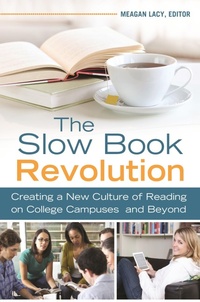
The Slow Book Revolution
Creating a New Culture of Reading on College Campuses and Beyond
Published on 24. September 2014
Book
Paperback/Softback
172 pages
978-1-61069-715-6 (ISBN)
Description
This inspiring guide shows how to implement the principles of the Slow Book movement in college campus libraries as well as public and high school libraries, with the ultimate goals of encouraging pensive reading habits and creating a lifelong enjoyment of books.
In a world of constant Facebook posts and Tweets, digital distractions and online reading habits are wearing at students' ability to focus, reflect, synthesize, and think deeply. This professional text, based on a concept introduced by Maura Kelly in the online edition of The Atlantic, delves into the trend toward contemplative reading-otherwise known as the Slow Book movement-explaining what it is, why it's important, and how you can implement it in various ways and in multiple settings.
Author and librarian Meagan Lacy, along with contributions from others in the field, offers insights, advice, and practical tools to help you foster an appreciation of reading in students both during and after college. The first part of the book establishes the importance of the Slow Book movement, while the second and third sections combine case studies and guidance for employing the principles of this method across multiple genres, including fiction, nonfiction, classics, and contemporary works. Chapters build a rationale for the approach, describe its underlying philosophy, and articulate concrete ways to apply the methodology in different venues.
In a world of constant Facebook posts and Tweets, digital distractions and online reading habits are wearing at students' ability to focus, reflect, synthesize, and think deeply. This professional text, based on a concept introduced by Maura Kelly in the online edition of The Atlantic, delves into the trend toward contemplative reading-otherwise known as the Slow Book movement-explaining what it is, why it's important, and how you can implement it in various ways and in multiple settings.
Author and librarian Meagan Lacy, along with contributions from others in the field, offers insights, advice, and practical tools to help you foster an appreciation of reading in students both during and after college. The first part of the book establishes the importance of the Slow Book movement, while the second and third sections combine case studies and guidance for employing the principles of this method across multiple genres, including fiction, nonfiction, classics, and contemporary works. Chapters build a rationale for the approach, describe its underlying philosophy, and articulate concrete ways to apply the methodology in different venues.
Reviews / Votes
This title is a worthy purchase for every library. It is also a call to action and greater participation. * Technical Services Quarterly *More details
Language
English
Place of publication
United States
Publishing group
Bloomsbury Publishing Plc
Target group
Professional and scholarly
Dimensions
Height: 234 mm
Width: 156 mm
Thickness: 10 mm
Weight
275 gr
ISBN-13
978-1-61069-715-6 (9781610697156)
Copyright in bibliographic data and cover images is held by Nielsen Book Services Limited or by the publishers or by their respective licensors: all rights reserved.
Schweitzer Classification
Other editions
Additional editions
Meagan Lacy
The Slow Book Revolution
Creating a New Culture of Reading on College Campuses and Beyond
E-Book
09/2014
1st Edition
Libraries Unlimited Inc
€47.49
Available for download
Meagan Lacy
The Slow Book Revolution
Creating a New Culture of Reading on College Campuses and Beyond
E-Book
09/2014
1st Edition
Libraries Unlimited Inc
€47.49
Available for download
Person
Meagan Lacy is the information literacy librarian at Guttman Community College at The City University of New York.
Content
Contents
Preface
Acknowledgments
PART I: REASONS TO GO SLOW
Chapter 1: What is Slow Books?
Meagan Lacy
Chapter 2: Slow Books in the Academic Library
Meagan Lacy
PART II: PROMOTING THE SLOW BOOKS MOVEMENT IN THE ACADEMIC LIBRARY
Chapter 3: Getting Started: The Collection, the Service, and the Promotion
Pauline Dewan
Chapter 4: The Library Book Club at Regent University
Harold Henkel
Chapter 5: Ten Years of Theme Reading at Indiana University South Bend
Julie Elliott
Chapter 6: Readers' Advisory in the College Classroom
Barbara Fister
Chapter 7: Revisiting the Dormitory: The RPS Libraries of Indiana University
Willie Miller
Chapter 8: Virtual Readers' Advisory
Elizabeth Brookbank
PART III: BEYOND THE ACADEMIC LIBRARY: A LIFETIME OF SLOW BOOKS
Chapter 9: Collaborating with Local High Schools: Your Senior Will Be My First Year Student
Sarah Fay Philips and Dr. Emerson Case
Chapter 10: Beyond College: Collaborating with your Public Librarian
Rebecca Malinowski
Chapter 11: Redefining "Impossible": A Public Library's Journey Through the Classics
Karen Hansen and Lesley Williams
Conclusion
Further Reading
Index
About the Editor and Contributors
Preface
Acknowledgments
PART I: REASONS TO GO SLOW
Chapter 1: What is Slow Books?
Meagan Lacy
Chapter 2: Slow Books in the Academic Library
Meagan Lacy
PART II: PROMOTING THE SLOW BOOKS MOVEMENT IN THE ACADEMIC LIBRARY
Chapter 3: Getting Started: The Collection, the Service, and the Promotion
Pauline Dewan
Chapter 4: The Library Book Club at Regent University
Harold Henkel
Chapter 5: Ten Years of Theme Reading at Indiana University South Bend
Julie Elliott
Chapter 6: Readers' Advisory in the College Classroom
Barbara Fister
Chapter 7: Revisiting the Dormitory: The RPS Libraries of Indiana University
Willie Miller
Chapter 8: Virtual Readers' Advisory
Elizabeth Brookbank
PART III: BEYOND THE ACADEMIC LIBRARY: A LIFETIME OF SLOW BOOKS
Chapter 9: Collaborating with Local High Schools: Your Senior Will Be My First Year Student
Sarah Fay Philips and Dr. Emerson Case
Chapter 10: Beyond College: Collaborating with your Public Librarian
Rebecca Malinowski
Chapter 11: Redefining "Impossible": A Public Library's Journey Through the Classics
Karen Hansen and Lesley Williams
Conclusion
Further Reading
Index
About the Editor and Contributors