


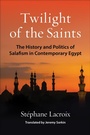
Twilight of the Saints
The History and Politics of Salafism in Contemporary Egypt
Published on 5. August 2025
Book
Paperback/Softback
344 pages
978-0-231-21521-3 (ISBN)
Description
In scarcely a century, Salafism has transformed Sunni Islam. Claiming to be a revival of the purest form of Islam, this movement promotes ultraconservative social and religious norms and rejects all non-Sunni religious groups. In Egypt, its influence has grown to the point of reshaping mainstream conceptions of the faith. How did such a deep religious transformation sweep through Egypt so rapidly? What is the significance of Salafism for the country's political scene, both before and after Hosni Mubarak fell from power in 2011?
Twilight of the Saints examines the history of Salafism in Egypt from its 1920s emergence in Cairo's scholarly circles through the present day, shedding new light on the movement's shifting relationship to politics. Drawing on extensive fieldwork and interviews, Stephane Lacroix illustrates how Salafism redefined what it means to be Muslim for Egyptians. He emphasizes the factors that distinguish the Salafis from the Muslim Brotherhood, despite their parallel trajectories. The Salafis, who initially shunned oppositional politics, were looked upon more favorably by the authorities, who perceived a greater threat from their Islamist counterparts. Lacroix explores how Salafism influenced the dynamics of the 2011 revolution and the democratic transition that ended with the army's takeover of the country, as well as how it has fared since. Twilight of the Saints offers an in-depth, authoritative understanding of the relationship of Salafism, politics, and authoritarianism in Egypt, with significant implications for the wider Muslim world.
Twilight of the Saints examines the history of Salafism in Egypt from its 1920s emergence in Cairo's scholarly circles through the present day, shedding new light on the movement's shifting relationship to politics. Drawing on extensive fieldwork and interviews, Stephane Lacroix illustrates how Salafism redefined what it means to be Muslim for Egyptians. He emphasizes the factors that distinguish the Salafis from the Muslim Brotherhood, despite their parallel trajectories. The Salafis, who initially shunned oppositional politics, were looked upon more favorably by the authorities, who perceived a greater threat from their Islamist counterparts. Lacroix explores how Salafism influenced the dynamics of the 2011 revolution and the democratic transition that ended with the army's takeover of the country, as well as how it has fared since. Twilight of the Saints offers an in-depth, authoritative understanding of the relationship of Salafism, politics, and authoritarianism in Egypt, with significant implications for the wider Muslim world.
Reviews / Votes
In this outstanding book, Stephane Lacroix does more than provide the best available study of Salafism in Egypt. He convincingly shows that Salafism, as any form of religious fundamentalism, should be understood from a dynamic perspective, in a permanent interaction with its social and political surroundings. A book that makes obsolete the essentialist categories (moderate, radical, traditionalist etc.) that used to dominate the field of Islamic studies. -- Olivier Roy, author of <i>The Crisis of Culture: Identity Politics and the Empire of Norms</i> Stephane Lacroix provides a masterful chronicle of Salafism in Egypt, tracing its evolving "grammar" and the shifting ideas that shaped the movement. He guides readers through Salafism's trajectory, the tensions between its scholarly and activist strands, culminating in the dramatic embrace of the democratic process once staunchly rejected. A gripping and insightful read. -- Nelly Lahoud, author of <i>The Bin Laden Papers</i> Rich in detail but clear in argument, Lacroix's Twilight of the Saints weaves together doctrinal, social, and political analysis without any seams showing. The result places Egyptian Salafism at the center of recent Egyptian history. -- Nathan J. Brown, author of <i>Arguing Islam after the Revival of Arab Politics</i>More details
Series
Language
English
Place of publication
New York
United States
Target group
Professional and scholarly
Product notice
Paperback (trade)
Dimensions
Height: 229 mm
Width: 152 mm
ISBN-13
978-0-231-21521-3 (9780231215213)
Copyright in bibliographic data and cover images is held by Nielsen Book Services Limited or by the publishers or by their respective licensors: all rights reserved.
Schweitzer Classification
Other editions
Additional editions
E-Book
08/2025
1st Edition
Columbia University Press
€34.49
Available for download
Persons
Stephane Lacroix is an associate professor of political science at Sciences Po, where he is also a senior researcher at the Centre for International Research (CERI) and the codirector of the Chair for the Study of Religion. His books include Awakening Islam: The Politics of Religious Dissent in Contemporary Saudi Arabia (2011).
Content
Acknowledgments
Introduction: A Grammar Apart
1. Battle of the Corpora: The Role of the First Egyptian Salafis
2. Egypt After Nasser: A "Salafi Awakening"
3. The Salafi Call: Salafism Meets Activism
4. Salafism's Ineluctable Ascent Under Mubarak
5. Salafism Faces Revolution: The Nour Party and Its Rivalry with the Brotherhood
6. The Populist Route: Revolutionary Salafism
Conclusion: The Fortunes and Misfortunes of Egyptian Salafism
Notes
Bibliography
Index
Introduction: A Grammar Apart
1. Battle of the Corpora: The Role of the First Egyptian Salafis
2. Egypt After Nasser: A "Salafi Awakening"
3. The Salafi Call: Salafism Meets Activism
4. Salafism's Ineluctable Ascent Under Mubarak
5. Salafism Faces Revolution: The Nour Party and Its Rivalry with the Brotherhood
6. The Populist Route: Revolutionary Salafism
Conclusion: The Fortunes and Misfortunes of Egyptian Salafism
Notes
Bibliography
Index