

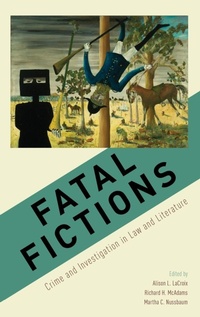
Fatal Fictions
Crime and Investigation in Law and Literature
Published on 5. January 2017
Book
Hardback
340 pages
978-0-19-061078-4 (ISBN)
Description
Writers of fiction have always confronted topics of crime and punishment. This age-old fascination with crime on the part of both authors and readers is not surprising, given that criminal justice touches on so many political and psychological themes essential to literature, and comes equipped with a trial process that contains its own dramatic structure.
This volume explores this profound and enduring literary engagement with crime, investigation, and criminal justice. The collected essays explore three themes that connect the world of law with that of fiction. First, defining and punishing crime is one of the fundamental purposes of government, along with the protection of victims by the prevention of crime. And yet criminal punishment remains one of the most abused and terrifying forms of political power. Second, crime is intensely psychological and therefore an important subject by which a writer can develop and explore character. A third connection between criminal justice and fiction involves the inherently dramatic nature of the legal system itself, particularly the trial. Moreover, the ongoing public conversation about crime and punishment suggests that the time is ripe for collaboration between law and literature in this troubled domain.
The essays in this collection span a wide array of genres, including tragic drama, science fiction, lyric poetry, autobiography, and mystery novels. The works discussed include works as old as fifth-century BCE Greek tragedy and as recent as contemporary novels, memoirs, and mystery novels. The cumulative result is arresting: there are "killer wives" and crimes against trees; a government bureaucrat who sends political adversaries to their death for treason before falling to the same fate himself; a convicted murderer who doesn't die when hanged; a psychopathogical collector whose quite sane kidnapping victim nevertheless also collects; Justice Thomas' reading and misreading of Bigger Thomas; a man who forgives his son's murderer and one who cannot forgive his wife's non-existent adultery; fictional detectives who draw on historical analysis to solve murders. These essays begin a conversation, and they illustrate the great depth and power of crime in literature.
This volume explores this profound and enduring literary engagement with crime, investigation, and criminal justice. The collected essays explore three themes that connect the world of law with that of fiction. First, defining and punishing crime is one of the fundamental purposes of government, along with the protection of victims by the prevention of crime. And yet criminal punishment remains one of the most abused and terrifying forms of political power. Second, crime is intensely psychological and therefore an important subject by which a writer can develop and explore character. A third connection between criminal justice and fiction involves the inherently dramatic nature of the legal system itself, particularly the trial. Moreover, the ongoing public conversation about crime and punishment suggests that the time is ripe for collaboration between law and literature in this troubled domain.
The essays in this collection span a wide array of genres, including tragic drama, science fiction, lyric poetry, autobiography, and mystery novels. The works discussed include works as old as fifth-century BCE Greek tragedy and as recent as contemporary novels, memoirs, and mystery novels. The cumulative result is arresting: there are "killer wives" and crimes against trees; a government bureaucrat who sends political adversaries to their death for treason before falling to the same fate himself; a convicted murderer who doesn't die when hanged; a psychopathogical collector whose quite sane kidnapping victim nevertheless also collects; Justice Thomas' reading and misreading of Bigger Thomas; a man who forgives his son's murderer and one who cannot forgive his wife's non-existent adultery; fictional detectives who draw on historical analysis to solve murders. These essays begin a conversation, and they illustrate the great depth and power of crime in literature.
Reviews / Votes
Fatal Fictions may prove to be interesting and useful to scholars of media representations of crime and the criminal justice system, and to those readers who wish to critically analyze fictional texts. The essays were enlightening and the editors organized the broad ranging topics into coherent groupings...In essence, Fatal Fictions is a well-intentioned volume with some very strong chapters. * Carolyn Naoroz, Criminal Law and Criminal Justice Books , Rutgers *More details
Language
English
Place of publication
New York
United States
Target group
College/higher education
Professional and scholarly
Dimensions
Height: 240 mm
Width: 161 mm
Thickness: 23 mm
Weight
675 gr
ISBN-13
978-0-19-061078-4 (9780190610784)
Copyright in bibliographic data and cover images is held by Nielsen Book Services Limited or by the publishers or by their respective licensors: all rights reserved.
Schweitzer Classification
Other editions
Additional editions
Alison L. Lacroix | Richard H. McAdams | Martha C. Nussbaum
Fatal Fictions
Crime and Investigation in Law and Literature
E-Book
11/2016
1st Edition
OUP eBook
€46.99
Available for download
Alison L. Lacroix | Richard H. McAdams | Martha C. Nussbaum
Fatal Fictions
Crime and Investigation in Law and Literature
E-Book
11/2016
1st Edition
OUP eBook
€36.99
Available for download
Persons
Alison L. LaCroix is the Robert Newton Reid Professor of Law and an Associate Member of the Department of History at the University of Chicago. She is the author of The Ideological Origins of American Federalism and the co-editor, with Martha C. Nussbaum, of Subversion and Sympathy: Gender, Law, and the British Novel (OUP 2012). Her teaching and research interests include legal history, constitutional law, federal jurisdiction, law and linguistics, and law and literature.
Richard H. McAdams is the Bernard D. Meltzer Professor of Law at the University of Chicago. He is the author of The Expressive Powers of Law (2015) and co-editor of Fairness in Law and Economics (2013).
Martha C. Nussbaum is the Ernst Freund Distinguished Service Professor of Law and Ethics in the Law School and the Philosophy Department at the University of Chicago. Her most recent book is Anger and Forgiveness: Resentment, Generosity, Justice (OUP 2016).
Richard H. McAdams is the Bernard D. Meltzer Professor of Law at the University of Chicago. He is the author of The Expressive Powers of Law (2015) and co-editor of Fairness in Law and Economics (2013).
Martha C. Nussbaum is the Ernst Freund Distinguished Service Professor of Law and Ethics in the Law School and the Philosophy Department at the University of Chicago. Her most recent book is Anger and Forgiveness: Resentment, Generosity, Justice (OUP 2016).
Content
Contributor List
Introduction
Chapter 1. Scott Turow, On My Careers in Crime
Part I: Criminal Histories
Chapter 2. Daniel Telech, Mercy at the Areopagus: A Nietzschean account of Justice and Joy in the Eumenides
Chapter 3. Barry Wimpfheimer, Suborning Perjury: A Case Study of Narrative Precedent in Talmudic Law
Chapter 4. Alison LaCroix, A Man for All Treasons: Crimes By and Against the Tudor State in the Novels of Hilary Mantel
Chapter 5. Marina Leslie, Representing Anne Green: Historical and Literary Form, And the Scenes of the Crime in Oxford, 1651
Chapter 6. Richard Strier & Richard McAdams, Cold-Blooded and High Minded Murder: The "Case" of Othello
Chapter 7. Pamela Foa, What's Love Got To Do With It? Sexual Exploitation in Measure for Measure: A Prosecutor's View
Part II: Race and Crime
Chapter 8. Justin Driver, Justice Thomas and Bigger Thomas
Chapter 9. Martha Nussbaum, Reconciliation Without Anger: Paton's Cry, the Beloved Country
Part III: Responsibility and Violence
Chapter 10. Saul Levmore, Kidnap, Credibility, and The Collector.
Chapter 11. Jonathan Masur, Premeditation and Responsibility in The Stranger
Chapter 12. Saira Mohamed and Melissa Murray, Walking Away: Lessons from Omelas
Chapter 13. Mark Payne, Before the Law: Imagining Crimes against Trees
Part IV: Suspicion and Investigation
Chapter 14. Caleb Smith, Crime Scenes: Fictions of Security in the Antebellum American Borderlands
Chapter 15. Steven Wilf, The Legal Historian as Detective
Index
Introduction
Chapter 1. Scott Turow, On My Careers in Crime
Part I: Criminal Histories
Chapter 2. Daniel Telech, Mercy at the Areopagus: A Nietzschean account of Justice and Joy in the Eumenides
Chapter 3. Barry Wimpfheimer, Suborning Perjury: A Case Study of Narrative Precedent in Talmudic Law
Chapter 4. Alison LaCroix, A Man for All Treasons: Crimes By and Against the Tudor State in the Novels of Hilary Mantel
Chapter 5. Marina Leslie, Representing Anne Green: Historical and Literary Form, And the Scenes of the Crime in Oxford, 1651
Chapter 6. Richard Strier & Richard McAdams, Cold-Blooded and High Minded Murder: The "Case" of Othello
Chapter 7. Pamela Foa, What's Love Got To Do With It? Sexual Exploitation in Measure for Measure: A Prosecutor's View
Part II: Race and Crime
Chapter 8. Justin Driver, Justice Thomas and Bigger Thomas
Chapter 9. Martha Nussbaum, Reconciliation Without Anger: Paton's Cry, the Beloved Country
Part III: Responsibility and Violence
Chapter 10. Saul Levmore, Kidnap, Credibility, and The Collector.
Chapter 11. Jonathan Masur, Premeditation and Responsibility in The Stranger
Chapter 12. Saira Mohamed and Melissa Murray, Walking Away: Lessons from Omelas
Chapter 13. Mark Payne, Before the Law: Imagining Crimes against Trees
Part IV: Suspicion and Investigation
Chapter 14. Caleb Smith, Crime Scenes: Fictions of Security in the Antebellum American Borderlands
Chapter 15. Steven Wilf, The Legal Historian as Detective
Index