

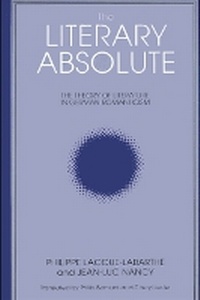
The Literary Absolute
The Theory of Literature in German Romanticism
Published on 15. March 1988
Book
Hardback
194 pages
978-0-88706-660-3 (ISBN)
Description
The Literary Absolute is the first authoritative study of the emergence of the modern concept of literature in German romanticism. The authors trace this concept from the philosophical crisis bequeathed by Kant to his successors, to its development by the central figures of the Athenaeum group: the Schlegel brothers, Schelling, and Novalis.
This study situates the Jena romantics' "fragmentary" model of literature-a model of literature as the production of its own theory-in relation to the development of a post-Kantian conception of philosophy as the total and reflective auto-production of the thinking subject. Analyzing key texts of the period, the authors articulate the characteristics of romantic thought and at the same time show historical and systematic connections with modern literary theory. Thus, The Literary Absolute renews contemporary scholarship, showing the romantic origins of some of the leading issues in current critical theory.
This study situates the Jena romantics' "fragmentary" model of literature-a model of literature as the production of its own theory-in relation to the development of a post-Kantian conception of philosophy as the total and reflective auto-production of the thinking subject. Analyzing key texts of the period, the authors articulate the characteristics of romantic thought and at the same time show historical and systematic connections with modern literary theory. Thus, The Literary Absolute renews contemporary scholarship, showing the romantic origins of some of the leading issues in current critical theory.
Reviews / Votes
"The authors have effectively situated romanticism within its philosophical context in a brilliant way." - Mark C. Taylor, Williams College"It is the most useful historical and theoretical study of its topic that has been published during the last twenty odd years. Everyone concerned with literary criticism and philosophy should have it to read more than once." - Werner Hamacher, The Johns Hopkins University
More details
Series
Language
English
Place of publication
Albany, NY
United States
Target group
Professional and scholarly
US School Grade: College Graduate Student and over
Illustrations
Total Illustrations: 0
Dimensions
Height: 229 mm
Width: 152 mm
Thickness: 25 mm
Weight
227 gr
ISBN-13
978-0-88706-660-3 (9780887066603)
Copyright in bibliographic data and cover images is held by Nielsen Book Services Limited or by the publishers or by their respective licensors: all rights reserved.
Schweitzer Classification
Other editions
Additional editions
Philippe Lacoue-Labarthe | Jean-Luc Nancy
The Literary Absolute
The Theory of Literature in German Romanticism
E-Book
03/1988
State University of New York Press
€34.99
Available for download
Persons
Philippe Lacoue-Labarthe and Jean-Luc Nancy are philosophers who teach at the Universite de Strasbourg. Cheryl Lester is Assistant Professor of English at the University of Kansas. Philip Barnard is Assistant Professor of Literature at American University.
Content
Translators' Introduction: The Presentation of Romantic Literature Note on the Text
Preface: The Literary Absolute
Chronology
Summary of the Athenaeum
Overture: The System-Subject
1. The Fragment: The Fragmentary Exigency
2. The Idea: Religion within the Limits of Art
Appendix: Note on Heinz Widerporst's Epicurean Confession of Faith
3. The Poem: A Nameless Art
4. Criticism: The Formation of Character
Closure: Romantic Equivocity
Notes
Bibliography
Appendix: Topical Index to the Fragments
Index
Preface: The Literary Absolute
Chronology
Summary of the Athenaeum
Overture: The System-Subject
1. The Fragment: The Fragmentary Exigency
2. The Idea: Religion within the Limits of Art
Appendix: Note on Heinz Widerporst's Epicurean Confession of Faith
3. The Poem: A Nameless Art
4. Criticism: The Formation of Character
Closure: Romantic Equivocity
Notes
Bibliography
Appendix: Topical Index to the Fragments
Index