

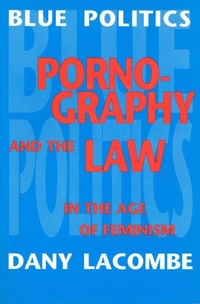
Blue Politics
Pornography and the Law in the Age of Feminism
2nd Edition
Will be published approx. on 7. June 1994
Book
Paperback/Softback
229 pages
978-0-8020-7352-5 (ISBN)
Description
In 1985 the Special Committee on Pornography and Prostitution, the Fraser Committee, recommended the criminalization of violent and degrading sexually explicit material on the ground that it harmed women. On two occasions (in 1986 with Bill C-114 and in 1987 with Bill C-54) the Mulroney government proposed a more restrictive approach to the regulation of pornography. Despite the support of various feminist and religious/family-oriented organizations, the government's attempts at law reform failed. Obscenity provisions were neither repealed nor replaced by a law criminalizing pornography. Blue Politics looks at the social and political mechanisms that initiated, shaped, and finally defeated the controversial legal proposals of the Conservative government in the 1980s.
Dany Lacombe documents the emergence of a feminist definition of pornography, analyses the impact this definition had on the debate between conservative and civil libertarian organizations, and identifies the emergence of groups who strongly resisted the attempt to reform the law: feminists against censorship and sex radicals. Finally, she examines the way in which institutional practices are shaped by and yet shape the power relations between groups. The emphasis is on the way such power relations are embodied in the policy-making process.
Drawing on Michel Foucault's concept of `power/knowledge,' Lacombe reveals how the process to criminalize pornography inaugurated a controversial politics that produced collective identities and transformed power relations. She shows law reform as a strategy that both constrains and enables action.
Dany Lacombe documents the emergence of a feminist definition of pornography, analyses the impact this definition had on the debate between conservative and civil libertarian organizations, and identifies the emergence of groups who strongly resisted the attempt to reform the law: feminists against censorship and sex radicals. Finally, she examines the way in which institutional practices are shaped by and yet shape the power relations between groups. The emphasis is on the way such power relations are embodied in the policy-making process.
Drawing on Michel Foucault's concept of `power/knowledge,' Lacombe reveals how the process to criminalize pornography inaugurated a controversial politics that produced collective identities and transformed power relations. She shows law reform as a strategy that both constrains and enables action.
More details
Edition
2nd edition
Language
English
Place of publication
Toronto
Canada
Target group
College/higher education
Professional and scholarly
Product notice
Paperback (trade)
Dimensions
Height: 233 mm
Width: 152 mm
Thickness: 17 mm
Weight
372 gr
ISBN-13
978-0-8020-7352-5 (9780802073525)
Copyright in bibliographic data and cover images is held by Nielsen Book Services Limited or by the publishers or by their respective licensors: all rights reserved.
Schweitzer Classification
Person
Dany Lacombe is Professor of Sociology at Simon Fraser University