

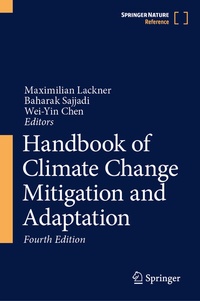
Handbook of Climate Change Mitigation and Adaptation
Description
Prof. (FH) Dr. Maximilian Lackner is study programme director of the Master "Innovation and Technology Management" and "Industrial Engineering & Business" at the University of Applied Sciences Technikum Wien, Vienna, Austria. He earned his PhD in technical chemistry in 2003, and his habilitation in chemical engineering in 2009, both at Vienna University of Technology, Austria. Dr. Lackner teaches at several universities and universities of applied sciences. Having founded seven companies, Dr. Lackner has more than 20 years of professional experience in the polymer industry in various senior leadership positions in Austria and China. His research interests include gas fermentation, biopolymers, particularly poly(hydroxyalkanoates), single-cell protein, in situ brownfield remediation and industrial engineering. His h-index is 36.
Dr. Baharak Sajjadi is an assistant professor of Petroleum and Geological Engineering at the Mewbourne College of Earth and Energy at the University of Oklahoma, USA. She obtained her PhD in chemical engineering from the University of Malaya, Malaysia, in 2015. She has served as a research assistant professor of Chemical Engineering at the University of Mississippi, USA. She has over 10 years of research experience in advanced refinery processes and bioprocesses, carbon conversion and modification technologies, renewable energies, and computational fluid dynamics (CFD simulation). Dr. Sajjadi has published over 60 scientific articles in peer-reviewed journals. She pioneered the use of ultrasound, catalytic non-thermal plasma, and catalytic chemical looping for carbon capture and conversion, natural gas conversion, and other environmental applications. She also serves as the associate editor for the Elsevier Journal FUEL. Her h-index is 31.
Dr. Wei-Yin Chen is a professor emeritus of Chemical Engineering of the University of Mississippi. He has had over 40-years of experience in developing technology-driven, knowledge-based, carbon conversion programs for in-furnace NO reduction, coal liquefaction, and low-temperature carbon modifications for sustainable food, energy, and water nexus. He founded and has been leading the Sustainable Energy and Environmental Group (SEEG) with over 250 collaborators around the globe. The SEEG pioneered the use of ultrasound, light, non-thermal plasma, biological, and chemical methods to modify the material surface for carbon gasification,carbon activation for CO2 capture and wastewater treatment, soil amendment, electrode fabrication, desalination/deionization, biomedical material, fuel cell, etc. He has been awarded by UM and national and international organizations for his contributions to research, teaching, and services. He has served as a reviewer or panelist for institutions around the globe.
More details
Other editions
Previous edition
Persons
Dr. Baharak Sajjadi is an assistant professor of Petroleum and Geological Engineering at the Mewbourne College of Earth and Energy at the University of Oklahoma, USA. She obtained her PhD in chemical engineering from the University of Malaya, Malaysia, in 2015. She has served as a research assistant professor of Chemical Engineering at the University of Mississippi, USA. She has over 10 years of research experience in advanced refinery processes and bioprocesses, carbon conversion and modification technologies, renewable energies, and computational fluid dynamics (CFD simulation). Dr. Sajjadi has published over 60 scientific articles in peer-reviewed journals. She pioneered the use of ultrasound, catalytic non-thermal plasma, and catalytic chemical looping for carbon capture and conversion, natural gas conversion, and other environmental applications. She also serves as the associate editor for the Elsevier Journal FUEL. Her h-index is 31.
Dr. Wei-Yin Chen is a professor emeritus of Chemical Engineering of the University of Mississippi. He has had over 40-years of experience in developing technology-driven, knowledge-based, carbon conversion programs for in-furnace NO reduction, coal liquefaction, and low-temperature carbon modifications for sustainable food, energy, and water nexus. He founded and has been leading the Sustainable Energy and Environmental Group (SEEG) with over 250 collaborators around the globe. The SEEG pioneered the use of ultrasound, light, non-thermal plasma, biological, and chemical methods to modify the material surface for carbon gasification,carbon activation for CO2 capture and wastewater treatment, soil amendment, electrode fabrication, desalination/deionization, biomedical material, fuel cell, etc. He has been awarded by UM and national and international organizations for his contributions to research, teaching, and services. He has served as a reviewer or panelist for institutions around the globe.