

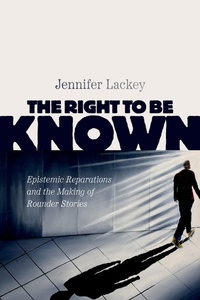
The Right to Be Known
Epistemic Reparations and the Making of Rounder Stories
Published on 10. June 2026
Book
Hardback
280 pages
978-0-19-783395-7 (ISBN)
Description
Stories shape not only how we understand the world-but also how we live in it. The way a narrative sketches the contours of a person's character or presents the unfolding of events can have monumental consequences for those it represents. Yet across historical periods and global spaces, entire peoples, cultures, and communities, as well as the individuals within them, have been robbed of their stories through erasure, vilification, and distortion.
At the heart of this book lies the question: if people are unknown in deep and unjust ways because their stories have been stolen, don't they have the right to be known? Drawing on a framework from the United Nations Commission on Human Rights-which affirms the "right to know" for victims of gross violations or injustices-this book makes a novel and urgent case for its counterpart: the right to be known. Both rights, it is argued, can be understood within a framework of epistemic reparations. The ultimate goal is to illuminate not only the normative demands these reparations generate, but also some of the concrete steps that can be taken to fulfill them, so that each of us might get to work right now in the process of addressing the epistemic wrongs faced by those relegated to the margins of the unknown.
At the heart of this book lies the question: if people are unknown in deep and unjust ways because their stories have been stolen, don't they have the right to be known? Drawing on a framework from the United Nations Commission on Human Rights-which affirms the "right to know" for victims of gross violations or injustices-this book makes a novel and urgent case for its counterpart: the right to be known. Both rights, it is argued, can be understood within a framework of epistemic reparations. The ultimate goal is to illuminate not only the normative demands these reparations generate, but also some of the concrete steps that can be taken to fulfill them, so that each of us might get to work right now in the process of addressing the epistemic wrongs faced by those relegated to the margins of the unknown.
Reviews / Votes
08/12/2025More details
Language
English
Place of publication
New York
United States
Target group
College/higher education
Dimensions
Height: 237 mm
Width: 165 mm
Thickness: 29 mm
Weight
522 gr
ISBN-13
978-0-19-783395-7 (9780197833957)
Copyright in bibliographic data and cover images is held by Nielsen Book Services Limited or by the publishers or by their respective licensors: all rights reserved.
Schweitzer Classification
Person
Jennifer Lackey is the Wayne and Elizabeth Jones Professor of Philosophy and Professor of Law (courtesy) at Northwestern University, Founding Director of the Northwestern Prison Education Program, and a Senior Research Associate at the African Centre for Epistemology and Philosophy of Science at the University of Johannesburg. She is a member of the American Academy of Arts and Sciences and the recipient of a number of honors, including the Humanitas Award, Horace Mann Medal, and the Lebowitz Prize for Philosophical Achievement and Contribution. Her work has been supported by grants and fellowships from the John Simon Guggenheim Memorial Foundation, the Andrew W. Mellon Foundation, the American Council of Learned Societies, and the National Endowment for the Humanities.
Content
Introduction Chapter 1: Epistemic Reparations and the Right to Be Known Chapter 2: Stories That Wrong and Stories That Repair Chapter 3: Talking, Listening, and Learning Chapter 4: Knowing Someone Chapter 5: Duties to Know Someone Conclusion