

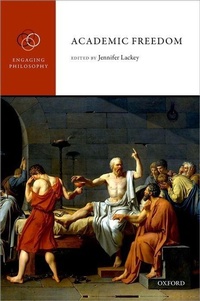
Academic Freedom
Published on 31. October 2018
Book
Hardback
224 pages
978-0-19-879150-8 (ISBN)
Description
Academic freedom allows members of institutions of higher learning to engage in intellectual pursuits without fear of censorship or retaliation, and lies at the heart of the mission of the university. Recent years have seen growing concerns about threats to academic freedom, many brought about from the changing norms of (and demands on) the university. A wide range of new issues - including content warnings, safe spaces, social media controversies, microaggressions, and no platforming - have given rise to loud cries, in both scholarly and popular contexts, that academic freedom is under serious attack. This volume fills both of these gaps in the current literature by bringing together leading philosophers from a wide range of areas of expertise to weigh in on both traditional issues and timely challenges that involve academic freedom. Divided into four main sections, it covers the rationale of academic freedom, its parameters, the new challenges to academic freedom (ranging from content warnings to political correctness), and the conflicts between academic freedom and the enforcement of laws and regulations governing the university.
More details
Series
Language
English
Place of publication
Oxford
United Kingdom
Target group
Professional and scholarly
Product notice
sewn/stitched
Cloth over boards
Dimensions
Height: 238 mm
Width: 158 mm
Thickness: 19 mm
Weight
478 gr
ISBN-13
978-0-19-879150-8 (9780198791508)
Copyright in bibliographic data and cover images is held by Nielsen Book Services Limited or by the publishers or by their respective licensors: all rights reserved.
Schweitzer Classification
Other editions
Additional editions
Person
Jennifer Lackey is the Wayne and Elizabeth Jones Professor in the Department of Philosophy at Northwestern University. She is the author of Learning from Words: Testimony as a Source of Knowledge (OUP 2010), the editor of Essays in Collective Epistemology (OUP 2014), and a co-editor of The Epistemology of Disagreement: New Essays (OUP 2013) and The Epistemology of Testimony (OUP 2006). Jennifer is the winner of the Dr. Martin R. Lebowitz and Eve Lewellis Lebowitz Prize for Philosophical Achievement and Contribution (2015) and the Young Epistemologist Prize (2005). Her work has been supported by the Mellon Foundation, the American Council of Learned Societies, the National Endowment for the Humanities, and the Alice Kaplan Institute for the Humanities.
Content
Part I: Introduction
1: Jennifer Lackey: Academic Freedom
Part II: The Rationale for Academic Freedom
2: Michael P. Lynch: Academic Freedom and the Politics of Truth
3: Michele Moody-Adams: Is There a Safe Space for Academic Freedoma
4: Philip Pettit: Two Concepts of Free Speech
Part III: The Parameters of Academic Freedom
5: John Protevi: Realpolitik of Academic Freedom: The Steven Salaita Case
6: Brian Weatherson: Freedom of Research Area
Part IV: Silencing and Beyond: Microaggressions, Content Warnings, and Political Correctness
7: Jennifer Saul: Beyond Just Silencing: A Call for Complexity in Discussions of Academic Free Speech
8: Mary Kate McGowan: On Political Correctness, Microaggressions, and Silencing in the Academy
Part V: Protests, Civil Disobedience, and No Platforming
9: David Estlund: When Protest and Speech Collide
10: Martha C. Nussbaum: Civil Disobedience and Free Speech in the Academy
11: Robert Mark Simpson and Amia Srinivasan: No Platforming
1: Jennifer Lackey: Academic Freedom
Part II: The Rationale for Academic Freedom
2: Michael P. Lynch: Academic Freedom and the Politics of Truth
3: Michele Moody-Adams: Is There a Safe Space for Academic Freedoma
4: Philip Pettit: Two Concepts of Free Speech
Part III: The Parameters of Academic Freedom
5: John Protevi: Realpolitik of Academic Freedom: The Steven Salaita Case
6: Brian Weatherson: Freedom of Research Area
Part IV: Silencing and Beyond: Microaggressions, Content Warnings, and Political Correctness
7: Jennifer Saul: Beyond Just Silencing: A Call for Complexity in Discussions of Academic Free Speech
8: Mary Kate McGowan: On Political Correctness, Microaggressions, and Silencing in the Academy
Part V: Protests, Civil Disobedience, and No Platforming
9: David Estlund: When Protest and Speech Collide
10: Martha C. Nussbaum: Civil Disobedience and Free Speech in the Academy
11: Robert Mark Simpson and Amia Srinivasan: No Platforming