

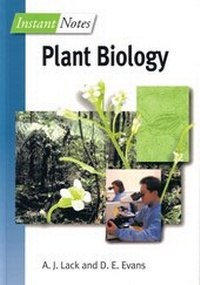
BIOS Instant Notes in Plant Biology
Published on 15. June 2001
Book
Paperback/Softback
344 pages
978-1-85996-197-1 (ISBN)
Description
Instant Notes in Plant Biology covers all aspects of modern plant biology. The scope and depth of this text are suitable for a first and second year undergraduate student of plant biology, including molecular biologists and biotechnologists.
Reviews / Votes
'The style of illustrations will be of value by the stressed undergraduate ... This book is based entirely on excellent line drawings which would be easy for an undergraduate to remember and perhaps even reproduce ... Overall, this is definitely a book I will enjoy to have around for reference and teaching purposes.' - New Phytologist'The contents are comprehensive and cover all areas found in first and second year courses. Agriculture and horticulture students would find this book useful. I would recommend this book to my students.' - Dr Nick Smirnoff, University of Exeter
More details
Series
Language
English
Place of publication
London
United Kingdom
Publishing group
Taylor & Francis Ltd
Target group
College/higher education
Professional and scholarly
Weight
454 gr
ISBN-13
978-1-85996-197-1 (9781859961971)
Copyright in bibliographic data and cover images is held by Nielsen Book Services Limited or by the publishers or by their respective licensors: all rights reserved.
Schweitzer Classification
Other editions
New editions
Andrew Lack | David Evans
BIOS Instant Notes in Plant Biology
Book
09/2005
2nd Edition
Taylor & Francis
€45.10
Shipment within 15-20 days
Persons
Dr Andrew Lack, School of Biological and Molecular Sciences, Oxford Brookes University, UK
Dr David Evans, School of Biological and Molecular Sciences, Oxford Brookes University, UK
Dr David Evans, School of Biological and Molecular Sciences, Oxford Brookes University, UK
Content
Section A - INTRODUCTION. Section B - STRUCTURE. The plant cell. The cell wall. Plastids and mitochondria. Membranes. Nucleus and genome. Cell Division. Section C - VEGETATIVE ANATOMY. Meristems and primary tissues. Roots. Herbaceous stems and primary growth. Woody stems and secondary growth. Leaves. Section D - REPRODUCTIVE ANATOMY. The flower. Pollen and ovlules. The seed. Fruits. Section E - PHYSIOLOGY AND REGULATION. Arabidopsis and other model plants. Methods in experimental plant science. Section F - GROWTH AND DEVELOPMENT. Features of growth and development. Biochemistry of growth regulation. Molecular action of hormones and intracellular messengers. Section G - SENSING AND RESPONDING TO THE ENVIRONMENT. Phytochrome, photoperiodism and photomorphogenesis. Tropisms. Nastic responses. Abscission. Stress avoidance and adaptation. Section H - FLORAL DEVELOPMENT AND REPRODUCTIVE PHYSIOLOGY. Physiology of floral initiation and development. Breeding systems. Self incompatibility. Seed development, dormancy and germination. Section I - PLANTS, WATER AND MINERAL NUTRITION. Plants and water. Water retention and stomata. Movement of nutrient ions across membranes. Uptake of mineral nutrients in the plant. Functions of mineral nutrients. Section J - METABOLISM. Photosynthetic pigments and the nature of light. Major reactions of photosynthesis. C3 and C4 plants and CAM. Respiration and carbohydrate metabolism. Amino acid, lipid, polysaccharide and secondary product metabolism. Section K - PLANT COMMUNITIES AND POPULATIONS. Physical factors and plant distribution. Plant communities. Ecology of different growth forms. Populations. Contributions to carbon balance and atmosphere. Section L - REPRODUCTIVE ECOLOGY. Ecology of flowering and pollination. Seed ecology. Regeneration and establishment. Polymorphisms and population genetics. Section M - INTERACTIONS BETWEEN PLANTS AND OTHER ORGANISMS. Mycorrhiza. Nitrogen fixation. Interactions between plants and animals. Fungal pathogens and endophytes. Bacteria, mycoplasma, viruses and heterokonts. Parasites and saprophytes. Carnivorous plants. Section N - HUMAN USES OF PLANTS. Plants as food. Plants for construction. Plants in medicine. Plants for other uses. Bioremediation. Section O - PLANT GENETIC ENGINEERING AND BIOTECHNOLOGY. Plant breeding. Plant cell and tissue culture. Plant genetic engineering. Section P - PLANT DIVERSITY. Diversity and life cycles. The algae. The bryophytes. Reproduction in bryophytes. Section Q - SPORE-BEARING VASCULAR PLANTS. Early evolution of vascular plants. Clubmosses and horsetails. The ferns. Evolution of the seed. Section R - SEED PLANTS. Early seed plants. Conifers. Cycads, Gingko and Gnetales. Evolution of flowering plants. Mechanisms of evolution. Further reading. Index