

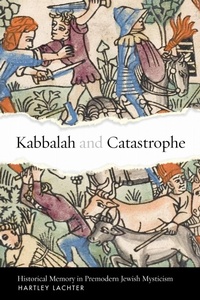
Kabbalah and Catastrophe
Historical Memory in Premodern Jewish Mysticism
Published on 22. October 2024
Book
Hardback
362 pages
978-1-5036-4021-4 (ISBN)
Description
While premodern kabbalistic texts were not chronicles of historical events, they provided elaborate models for understanding the secret divine plan guiding human affairs. Hartley Lachter analyzes innovative kabbalistic doctrines, such as the idea of reincarnation and the notion of multiple successive universes, through which Jewish mystics sought to demonstrate that the misfortunes of Jewish history were in fact necessary steps toward redemption.
Lachter argues that these works, mostly composed between the early 14th century and the generation affected by the Spanish expulsion in the early 16th century, enabled Jewish readers to make sense of the troubling misfortunes of their own time. Kabbalah and Catastrophe uncovers the remarkable variety of ways that kabbalists deployed esoteric tradition to argue that God had not abandoned the Jews to the inscrutable forces of history. Instead, they suggested to readers that Jews are history's primary actors, and that despite their small numbers and lack of military power, Jews nonetheless secretly push history forward. For scholars of Jewish mysticism and medieval Jewish history, Lachter articulates how premodern mystical texts can be crucial sources of insight into how Jews understood the meaning of history.
Lachter argues that these works, mostly composed between the early 14th century and the generation affected by the Spanish expulsion in the early 16th century, enabled Jewish readers to make sense of the troubling misfortunes of their own time. Kabbalah and Catastrophe uncovers the remarkable variety of ways that kabbalists deployed esoteric tradition to argue that God had not abandoned the Jews to the inscrutable forces of history. Instead, they suggested to readers that Jews are history's primary actors, and that despite their small numbers and lack of military power, Jews nonetheless secretly push history forward. For scholars of Jewish mysticism and medieval Jewish history, Lachter articulates how premodern mystical texts can be crucial sources of insight into how Jews understood the meaning of history.
Reviews / Votes
"It is a pleasure to read such an erudite work that is written in such an accessible manner. Lachter distills a great deal of information from notoriously complex texts to illuminate the kabbalistic tradition on history and suffering."-Jonathan Ray, Georgetown University "This is a truly innovative work, offering rare insight into the kabbalists as agents of history. Lachter shines as a scholar of medieval texts, and the many understudied works he includes make for a significant contribution to the field."
-Ellen Haskell, University of North Carolina at Greensboro "Drawing on a wide range of less well-known kabbalistic texts-for example, the Sefer ha-pelt'ah and Sefer ha-temunah, composed between the late 14th to the early 16th century, Lachter explains, with erudition and sensitivity, how Jews of a mystical persuasion explained the difficult shape of exilic existence.... Highly recommended."-S. T. Katz, CHOICE
More details
Series
Edition
New edition
Language
English
Place of publication
Palo Alto
United States
Target group
College/higher education
Edition type
New edition
Product notice
Cloth
Dimensions
Height: 229 mm
Width: 152 mm
Thickness: 27 mm
Weight
689 gr
ISBN-13
978-1-5036-4021-4 (9781503640214)
Copyright in bibliographic data and cover images is held by Nielsen Book Services Limited or by the publishers or by their respective licensors: all rights reserved.
Schweitzer Classification
Other editions
Additional editions
E-Book
10/2024
Stanford University Press
€142.99
Available for download
Person
Hartley Lachter is Philip and Muriel Berman Chair in Jewish Studies and Associate Professor of Religion Studies at Lehigh University. He is the author of Kabbalistic Revolution: Reimagining Judaism in Medieval Spain (2014).
Content
Acknowledgments
Introduction
1. Terrors of History: Finding Order in a World of Chaos
2. Meaning in Exile: Kabbalistic Readings of History Gone Awry
3. The Shape of Time: History and Cosmic Cycles
4. Living across Time: Reincarnation and the Course of History
5. History's Ends: Apocalyptic Secrets in the Present Tense
6. Shaping History: Kabbalistic Writing and Historical Agency
Conclusion
Notes
Bibliography
Index
Introduction
1. Terrors of History: Finding Order in a World of Chaos
2. Meaning in Exile: Kabbalistic Readings of History Gone Awry
3. The Shape of Time: History and Cosmic Cycles
4. Living across Time: Reincarnation and the Course of History
5. History's Ends: Apocalyptic Secrets in the Present Tense
6. Shaping History: Kabbalistic Writing and Historical Agency
Conclusion
Notes
Bibliography
Index