

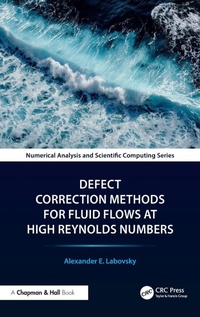
Defect Correction Methods for Fluid Flows at High Reynolds Numbers
1st Edition
Published on 16. July 2025
Book
Hardback
152 pages
978-1-032-41043-2 (ISBN)
Description
Defect Correction Methods for Fluid Flows at High Reynold's Numbers presents the mathematical development of defect correction methods (DCM) in application to fluid flow problems in various settings. We will show several approaches to applying the DCM ideas in computational fluid dynamics (CFD) - from a basic idea of controlling the flow by the means of increased diffusion, to the state-of-the-art family of novel, DCM-based turbulence models. The main idea of the methods presented in this book, is to use defect correction in turbulence modelling; additionally, several methods will also be presented, that aim at reducing the time discretization error.
Features
? Provides a road map, starting from the ideas of minimally invasive controlling of turbulent flows, to the ways of improving the existing regularization techniques with DCM, to the ideas of 'full defect correction' in both space and time and, finally, to the more complex embedding of the DCM into turbulence modelling by the 'correction' of the whole turbulence model
? Can be used for teaching a topics course on a Masters or Ph.D. level. It is even more suitable as a reference for CFD theorists and practitioners, with most of the methods being minimally invasive and, therefore, easy to implement in the existing/legacy codes
? Discusses the current challenges in turbulence modelling with defect correction, showing several possible directions for future developments. Two source codes are provided - one for a regularization technique and another for a novel turbulence model - in order to give an interested researcher a quick start to the topic of DCM in CFD.
Features
? Provides a road map, starting from the ideas of minimally invasive controlling of turbulent flows, to the ways of improving the existing regularization techniques with DCM, to the ideas of 'full defect correction' in both space and time and, finally, to the more complex embedding of the DCM into turbulence modelling by the 'correction' of the whole turbulence model
? Can be used for teaching a topics course on a Masters or Ph.D. level. It is even more suitable as a reference for CFD theorists and practitioners, with most of the methods being minimally invasive and, therefore, easy to implement in the existing/legacy codes
? Discusses the current challenges in turbulence modelling with defect correction, showing several possible directions for future developments. Two source codes are provided - one for a regularization technique and another for a novel turbulence model - in order to give an interested researcher a quick start to the topic of DCM in CFD.
More details
Series
Language
English
Place of publication
United Kingdom
Publishing group
Taylor & Francis Ltd
Target group
College/higher education
Postgraduate
Illustrations
18 farbige Zeichnungen, 17 s/w Tabellen, 18 farbige Abbildungen
17 Tables, black and white; 18 Line drawings, color; 18 Illustrations, color
Dimensions
Height: 240 mm
Width: 161 mm
Thickness: 12 mm
Weight
379 gr
ISBN-13
978-1-032-41043-2 (9781032410432)
Copyright in bibliographic data and cover images is held by Nielsen Book Services Limited or by the publishers or by their respective licensors: all rights reserved.
Schweitzer Classification
Other editions
Additional editions

Alexander E. Labovsky
Defect Correction Methods for Fluid Flows at High Reynolds Numbers
E-Book
07/2025
1st Edition
Chapman and Hall
€73.99
Available for download

Alexander E. Labovsky
Defect Correction Methods for Fluid Flows at High Reynolds Numbers
E-Book
07/2025
1st Edition
Chapman and Hall
€73.99
Available for download
Person
Alexander Labovsky is an Associate Professor of Mathematical Sciences at Michigan Technological University. His research interests include high accuracy methods for PDEs, multiscale modelling and numerical analysis of turbulence models for Navier-Stokes and coupled Navier-Stokes systems (fluid-fluid interaction, magnetohydrodynamics). He also has ongoing projects in Uncertainty Quantification and modelling of compressible flows.
Content
1 Introduction 2 Artificial viscosity and defect correction 3 Deferred Correction in MagnetoHydroDynamics 4 Deferred Correction with a Turbulence Model 5 Can defect correction replace a turbulence model? 6 Deferred Correction for a Fluid-Fluid Interaction Problem 7 Large Eddy Simulation with Correction (LES-C): a New Class of Turbulence Models 8 Scale Truncation and the Energy Balance of the ADC 9 Defect-Deferred Correction: the Full ADC Model for the NSE 10 The Full ADC Model for Magnetohydrodynamics 11 Another LES-C Model for a Fluid-Fluid Interaction Problem Bibliography Index