

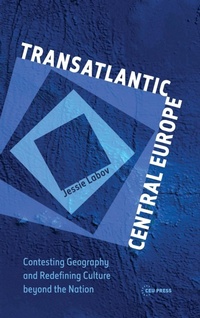
Transatlantic Central Europe
Contesting Geography and Redifining Culture beyond the Nation
Published on 10. April 2019
Book
Hardback
246 pages
978-615-5053-29-0 (ISBN)
Description
While there are still occasional uses of it today, the term Central Europe carries little of the charge that it did in the 1980s and early 1990s, and as a political and intellectual project it has receded from the horizon. Proponents of a distinct cultural profile of these countries-all involved now in the process of Transatlantic integration-used Central European, as a contestation with the geo-political label of Eastern Europe. This book discusses the transnational set of practices connecting journals with other media in the mid-1980s, disseminating the idea of Central Europe simultaneously in East and West. A range of new methodologies, including GIS-mapping visualization, is used, repositing the political-cultural journal as one central node of a much larger cultural system. What has happened to the liberal humanist philosophy that Central Europe once evoked? In the early years of the transition era, the liberal humanist perspective shared by Havel, Konrad, Kundera, and Michnik was quickly replaced by an economic liberalism that evolved into neoliberal policies and practices. The author follows the trajectories of the concept into the present day, reading its material and intellectual traces in the postcommunist landscape. She explores how the current use of transnational, web-based media follows the logic and practice of an earlier, 'dissident' generation of writers.
Reviews / Votes
"Labovs Studie leistet einen wichtigen Beitrag, indem sie die bisweilen eher kleinteilig und nationalhistorisch ausgerichtete Erforschung des ostmitteleuropaeischen Exils waehrend des Kalten Krieges in groessere zeitliche und raeumliche Kontexte einbettet sowie fuer Fragen der Mediengeschichte und der postcolonial studies anschlussfaehig macht. Mit ihrer These, dass das Identitaetskonzept eines zum Westen gehoerenden "Mitteleuropas" das Produkt transatlantischer Kommunikationsnetzwerke sei, macht Labov das Potenzial deutlich, das die Exilforschung gerade fuer die Historisierung kulturraeumlicher Imaginationen birgt. Denn waehrend die Rezeption postkolonialer Theorien in der Osteuropaforschung der 1990er-Jahre dazu fuehrte, sich kritisch mit "westlichen" Perspektiven auf die Region auseinanderzusetzen, bietet die Erforschung des Exils die Moeglichkeit, nach den Handlungsspielraeumen nichtwestlicher Akteure im Angesicht internationaler Machtasymmetrien zu fragen." -- Kai Johann Willms * H-Soz-Kult * "Transatlantic Central Europe is a thought-provoking volume that employs theoretical and methodological innovations to a seemingly passe idea, and thereby not only improves on the intellectual historical record, but also demonstrates its enduring relevance for cultural politics in the present. The book is clearly written, and is thus accessible even to those with no prior exposure to the literary figures discussed." * Slavic Review * "Labov leistet mit ihrer akribischen Studie einen wichtigen Beitrag zur Exil- und Ostmitteleuropaforschung und beleuchtet diesen Themenkomplex mit Methoden der digitalen Geisteswissenschaft. Das Buch zeichnet sich durch seine gute Lesbarkeit aus und ueberrascht mit einem innovativen Blick auf einen Themenbereich, der zwar vielseitig erforscht, aber von einer digital und GIS-basierten Analyse noch nicht erfasst wurde. Labov hat gewiss eine Bruecke zwischen der Vergangenheit und der Gegenwart geschlagen und auf diese Weise zur Heilung von ostmitteleuropaeischen Minderwertigkeitskomplexen beigetragen." * Shepunkte * "Labov's book offers a welcome combination of traditional and innovative methodologies, and brings together analysis of both well-known and unjustly neglected publications, primarily periodicals. While in Slavic literary history the prominent role of periodicals has long been recognized, recent years have also seen the rise of periodical studies as a specialized subfield of literary scholarship in the US and elsewhere, which is an additional factor that should garner Labov's study wider attention beyond Slavic and East European Studies." -- Vitaly Chernetsky * Polish Review *More details
Language
English
Place of publication
Budapest
Hungary
Target group
Professional and scholarly
Academic
Product notice
sewn/stitched
Cloth over boards
Dimensions
Height: 235 mm
Width: 157 mm
Thickness: 18 mm
Weight
512 gr
ISBN-13
978-615-5053-29-0 (9786155053290)
Copyright in bibliographic data and cover images is held by Nielsen Book Services Limited or by the publishers or by their respective licensors: all rights reserved.
Schweitzer Classification
Other editions
Additional editions
Jessie Labov
Transatlantic Central Europe
Contesting Geography and Redifining Culture beyond the Nation
E-Book
04/2019
Central European University Press
€61.99
Available for download
Person
Jessie Labov is a Resident Fellow at the Center for Media, Data, and Society at Central European University, Budapest.
Content
List of Figures, List of Maps, Introduction: Movements of Texts across Borders PART I: Cross Currents and Its Transatlantic Central European Imaginary Chapter One: The Political-Cultural Journal: The Case of Cross Currents Cross Currents: A Yearbook of Central European Culture Distribution and Diaspora Why The New York Review of Books? The Postcolonial Intersection Cross Currents as Essay and Encyclopedia Chapter Two: The Debate over Central Europe-from Jews to Yugoslavia The Domains of Central Europe Divergent Definitions of Central Europe: Mi?osz and Kundera Flight from Byzantium: Kundera vs. Brodsky on Dostoyevsky The Lisbon Conference: May 7-8, 1988 The North-South Axis Returns: Central and Southeastern Europe Two Yugoslav Entries: Vladimir Dedijer and Danilo KiS PART II: Further Essays in Contesting Geography and Redefining Culture Chapter Three: Borders, Editors, and Readers in Motion The Need for New Geographies Interwar Hungary beyond Its Borders Parallel Routes from Independence through War: Giedroyc and Grydzewski, Part I Polish Emigre Publishing after the Second World War: Giedroyc and Grydzewski, Part II Reading Kultura from a Distance Towards an Extra-Territorial Literature Chapter Four: Transmedial Work-Arounds after 1989 Moving beyond Text and Context Abuses of the Helsinki Charter in Yugoslavia (1989) The Case of Radio B92/B2-92: From Analog to Digital Practices (1990s) Ukraine, Belarus, and beyond Central Europe (2000s): From Online to Offline Work-Arounds, Conclusion: Redefining Transatlantic Central Europe Today Bibliography, Index