

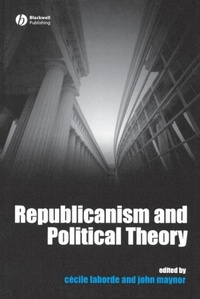
Republicanism and Political Theory
1st Edition
Published on 4. January 2008
Book
Paperback/Softback
296 pages
978-1-4051-5580-9 (ISBN)
Description
Republicanism and Political Theory is the first book to offer a comprehensive and critical survey of republican political theory.
Critically assesses its historical credentials, conceptual coherence, and normative proposals
Brings together original contributions from leading international scholars in an interactive way
Provides the reader with valuable insight into new debates taking place in republican political theory
Critically assesses its historical credentials, conceptual coherence, and normative proposals
Brings together original contributions from leading international scholars in an interactive way
Provides the reader with valuable insight into new debates taking place in republican political theory
Reviews / Votes
"This collection, which brings together ten major figures in contemporary political theory, represents an important contribution to the elaboration of the republican paradigm. It furthers investigation into the republican's core theoretical commitment to a distinctive conception of liberty, and extends the theory's reach into new areas, to do with transnationalism, gender relations, and constitutionalism, to name just these. The essays are all first-rate, and should become reference points for future debate."Daniel Weinstock, Universite de Montreal
More details
Language
English
Place of publication
Hoboken
United Kingdom
Publishing group
John Wiley and Sons Ltd
Target group
Professional and scholarly
Product notice
Paperback (trade)
Dimensions
Height: 230 mm
Width: 163 mm
Thickness: 17 mm
Weight
435 gr
ISBN-13
978-1-4051-5580-9 (9781405155809)
Copyright in bibliographic data and cover images is held by Nielsen Book Services Limited or by the publishers or by their respective licensors: all rights reserved.
Schweitzer Classification
Persons
Cecile Laborde is Reader in Political Theory at University College London. She is the author of La Confrerie Layenne et les Lebous du Senegal (1995), Pluralist Thought and the State in Britain and France (2000), and Critical Republicanism. The Hijab Controversy, Republican Theory and the Left (2008). Her work on secularism, multiculturalism, patriotism, and republicanism has recently been published in Journal of Political Philosophy, Political Theory, British Journal of Political Science, Political Studies, and Constellations. Current projects include the political philosophy of religion, and republicanism and global justice.
John Maynor is an Associate Professor in Political Philosophy at Middle Tennessee State University. He is the author of Republicanism in the Modern World (2003) and has published a number of articles on republican theory. His current research focuses on how new media is affecting political engagement and on republican responses to the forces of globalization.
John Maynor is an Associate Professor in Political Philosophy at Middle Tennessee State University. He is the author of Republicanism in the Modern World (2003) and has published a number of articles on republican theory. His current research focuses on how new media is affecting political engagement and on republican responses to the forces of globalization.
Content
Notes on Contributors. The Republican Contribution to Contemporary Political Theory: Cecile Laborde (University College London) and John Maynor (Middle Tennessee State University).
Part I: Republican Freedom and its Critics:.
1. Liberty and Domination: Matthew Kramer (University of Cambridge).
2. How are Power and Unfreedom Related?: Ian Carter (University of Pavia).
3. Freedom as the Absence of Arbitrary Power: Quentin Skinner (University of Cambridge).
4. Republican Freedom: Three Axioms, Four Theorems: Philip Pettit (Princeton University).
Part II: Republicanism, Democracy and Citizenship:.
5. Republican Citizenship, Nationality and Europe: David Miller (University of Oxford).
6. Republicanism and Constitutionalism: Richard Bellamy (University College London).
7. Non-Domination and Transnational Democracy: James Bohman (St Louis University).
Part III: Republicanism, Rights and Domination:.
8. Republican Punishment, Consequentialist or Retributive?: Richard Dagger (Arizona State University).
9. Pettit's Civic Republicanism and Male Domination: Marilyn Friedman (Washington University, St Louis, Missouri).
Index
Part I: Republican Freedom and its Critics:.
1. Liberty and Domination: Matthew Kramer (University of Cambridge).
2. How are Power and Unfreedom Related?: Ian Carter (University of Pavia).
3. Freedom as the Absence of Arbitrary Power: Quentin Skinner (University of Cambridge).
4. Republican Freedom: Three Axioms, Four Theorems: Philip Pettit (Princeton University).
Part II: Republicanism, Democracy and Citizenship:.
5. Republican Citizenship, Nationality and Europe: David Miller (University of Oxford).
6. Republicanism and Constitutionalism: Richard Bellamy (University College London).
7. Non-Domination and Transnational Democracy: James Bohman (St Louis University).
Part III: Republicanism, Rights and Domination:.
8. Republican Punishment, Consequentialist or Retributive?: Richard Dagger (Arizona State University).
9. Pettit's Civic Republicanism and Male Domination: Marilyn Friedman (Washington University, St Louis, Missouri).
Index