

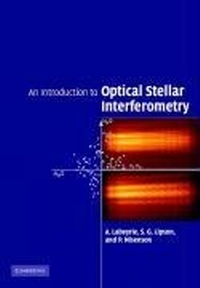
An Introduction to Optical Stellar Interferometry
Will be published approx. on 29. June 2006
Book
Hardback
360 pages
978-0-521-82872-7 (ISBN)
Description
During the last two decades, optical stellar interferometry has become an important tool in astronomical investigations requiring spatial resolution well beyond that of traditional telescopes. This book, first published in 2006, was the first to be written on the subject. The authors provide an extended introduction discussing basic physical and atmospheric optics, which establishes the framework necessary to present the ideas and practice of interferometry as applied to the astronomical scene. They follow with an overview of historical, operational and planned interferometric observatories, and a selection of important astrophysical discoveries made with them. Finally, they present some as-yet untested ideas for instruments both on the ground and in space which may allow us to image details of planetary systems beyond our own.
Reviews / Votes
'I have no doubt that it will soon be a set book on many third-level courses in astronomy and astrophysics ... [this book] is a scholarly and cogent work.' Astronomy and Space '... wide-ranging, covering both qualitative and quantitative introductions to interferometry and aperture synthesis at optical wavelengths, as well as expositions of parallel areas of interest ... the presentation is excellent and the authors deploy rough order-of-magnitude calculations and physical arguments in amongst the text to very good effect. ... this volume fills a gap that has for a long time been problematic.' The ObservatoryMore details
Language
English
Place of publication
Cambridge
United Kingdom
Target group
Professional and scholarly
Product notice
Unsewn / adhesive bound
Paper over boards
Dimensions
Height: 256 mm
Width: 179 mm
Thickness: 22 mm
Weight
869 gr
ISBN-13
978-0-521-82872-7 (9780521828727)
Copyright in bibliographic data and cover images is held by Nielsen Book Services Limited or by the publishers or by their respective licensors: all rights reserved.
Schweitzer Classification
Other editions
Additional editions
A. Labeyrie | S. G. Lipson | P. Nisenson
An Introduction to Optical Stellar Interferometry
Book
03/2014
Cambridge University Press
€78.90
Shipment within 15-20 days
A. Labeyrie | S. G. Lipson | P. Nisenson
An Introduction to Optical Stellar Interferometry
E-Book
08/2006
1st Edition
Cambridge University Press
€52.99
Available for download
A. Labeyrie | S. G. Lipson | P. Nisenson
An Introduction to Optical Stellar Interferometry
Book
Cambridge University Press
Unfortunately, price unknown
The article will not be published
Previous edition
A. Labeyrie | S. G. Lipson | P. Nisenson
An Introduction to Optical Stellar Interferometry
Book
Cambridge University Press
Unfortunately, price unknown
The article will not be published
Persons
Antoine Labeyrie is Professor at the College de France. During his distinguished career he has made many fundamental contributions to high resolution optical astronomy. Stephen G. Lipson is Chair of Electro-Optics and Professor of Physics at Technion - Israel Institute of Technology, Haifa. He is co-author of Optical Physics, 3rd edition (Cambridge University Press, 1995). Peter Nisenson studied physics and optics before becoming a professional astronomer at the Harvard Smithsonian Center for Astrophysics. His achievements include developing image detectors that can measure individual photon events.
Content
1. Introduction; 2. Basic concepts: a qualitative introduction; 3. Interference, diffraction and coherence; 4. Aperture synthesis; 5. Optical effects of the atmosphere; 6. Single-aperture techniques; 7. Intensity interferometry; 8. Amplitude interferometry: techniques and instruments; 9. The hypertelescope; 10. Nulling and coronagraphy; 11. A sampling of interferometric science; 12. Future ground and space projects; Appendices.