

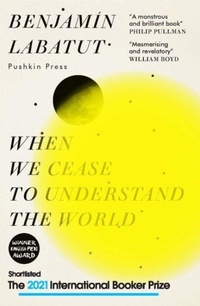
When We Cease to Understand the World
Published on 6. May 2021
Book
Paperback/Softback
192 pages
978-1-78227-614-2 (ISBN)
Description
<b>Shortlisted for the International Booker Prize</b>
<b>'A monstrous and brilliant book' Philip Pullman
'Mesmerising and revelatory' William Boyd</b>
At breakneck pace and with wondrous detail, Benjamin Labatut uses the imaginative resources of fiction to break open the stories of great scientists and mathematicians who expanded our notions of the possible.
As they grapple with the most profound questions of existence, these troubled men have strokes of unparalleled genius, alienate friends and lovers, descend into isolated states of madness. Some of their discoveries revolutionise our world for the better; others pave the way to chaos and unimaginable suffering. For sometimes, discovery brings destruction.
Reviews / Votes
Ingenious, intricate and deeply disturbing... Labatut has written a dystopian nonfiction novel set not in the future but in the present -- John Banville * Guardian * We may be familiar with such things as Schroedinger's cat and Heisenberg's uncertainty principle... but the sheer audacity, the utter insanity of the ideas and the thinkers who discovered these ideas has never, in my experience, been so vividly and terrifyingly conveyed as in this short, monstrous, and brilliant book * Philip Pullman * A deeply researched, exquisitely imagined group portrait of tormented geniuses... In Labatut's hands the story of quantum physics is violent, suspenseful and finally heartbreaking * New York Times, 'The 100 Best Books of the 21st Century' * Absolutely brilliant. I was utterly gripped and wolfed it down. It feels as if he had invented an entirely new genre * Mark Haddon, author of 'The Porpoise' * Labatut uses fiction to crack open the stories of scientists and mathematicians whose expanded our notions of the possible, while also presenting them as human, all too human * Dazed * A wholly mesmerising and revelatory book. A blend of limpid scientific exposition and bravura fictional gloss. Completely fascinating -- William Boyd "Double physics!" Nothing in the school time-table was as unwelcome as those two words. Benjamin Labatut's When We Cease to Understand the World is doubly welcome: as a thrilling account of theories of physics, and as a series of highly-wrought imaginative extrapolations about the physicists who arrived at them -- Geoff Dyer I absolutely loved this. The writing crackles with energy. What a triumph. I hope it does really well and finds multitudinous readers * Cathy Rentzenbrink, author of 'The Last Act of Love' * A dazzling associative caper full of graceful arabesques linking continents and centuries and ideas * Sunday Times * Remind[s] us of fiction's power to take us to another world and expand our understanding of this one... When We Cease to Understand the World showcases the minds seeking to pierce the mysterious heart of mathematics * Guardian * Darkly dazzling... Given a fine, exacting translation from the Spanish by Adrian Nathan West, these pieces possess an insidiously persuasive power... this book-as haunting as it is erudite-stubbornly insists on connecting the wonders of scientific advancement to the atrocities of history * Wall Street Journal * The strangest and most original book I've read for years. It hovers in a state between fiction and non-fiction, or wave and particle, and makes an account of modern mathematics and science into something as eerie as a great ghost story -- Philip Pullman * New Statesman, Books of the Year * A gripping meditation on knowledge and hubris... His prose is masterfully paced and vividly rendered in Adrian Nathan West's magnetic translation... With his slippery hybrid of fact and fiction, Labatut slyly applies the uncertainty principle to the human pursuit of knowledge itself * New York Times * It is a story about nature's fightback against human interference. In other words it is the story of the 21st century. In a literary industry obsessed with genres, it belongs to none -- Paul Mason * New Statesman, Books of the Year * Compelling, startling and utterly original. This book about physics is a work of art * Christie Watson * [A]n exquisitely written and continuously fascinating hybrid work of fiction and history * Irish Times * It may be possible to actually feel your brain getting bigger as you read * Evening Standard * Tantalising... This is a truly thrilling work of imagination and chutzpah * Big Issue * The new Bolano * Revistas Lecturas * Labatut shakes his readers and gifts them thought-provoking images, planting in them the necessity to read everything he's written and everything he writes as quickly as possible * La Tercera * Labatut penetrates into the heart of a reality that only few have seen before him - and no one has yet described. A book of terrifying beauty * Wolfram Eilenberger, author of Time of the Magicians * Remarkable... melodiously poetic, but precise... Due to the increasing space that Labatut grants to fiction, he succeeds in giving an aesthetic answer to the question of the limits of knowledge: where there is uncertainty, literature grows a special power to enable experience. In this way, fiction can preserve the enlightenment of the blind * Die Zeit * He meticulously describes the moods and experiences of his historical protagonists. With this fictional approach, Labatut creates a bewitching closeness and immediacy. And at best a deeper, almost poetic understanding of what Schwarzschild's singularity or Heisenberg's uncertainty principle actually mean for our reality * Deutschlandfunk Kultur * The limits of human knowledge: this is the territory in which Labatut, with great vigour and extraordinary intellectual rigour, enters in this admirable book * Expresso (Portugal) *More details
Language
English
Place of publication
London
United Kingdom
Product notice
Paperback (UK-B)
Dimensions
Height: 200 mm
Width: 128 mm
Thickness: 19 mm
Weight
180 gr
ISBN-13
978-1-78227-614-2 (9781782276142)
Copyright in bibliographic data and cover images is held by Nielsen Book Services Limited or by the publishers or by their respective licensors: all rights reserved.
Schweitzer Classification
Other editions
Previous edition
Benjamin Labatut
When We Cease to Understand the World
Book
09/2020
Pushkin Press
€38.56
Article exhausted; check for reprint
Persons
Benjamin Labatut was born in Rotterdam in 1980 and grew up in The Hague, Buenos Aires and Lima. He has published two award-winning works of fiction prior to When We Cease to Understand the World, which is his first book to be translated into English. Labatut lives with his family in Santiago, Chile.