

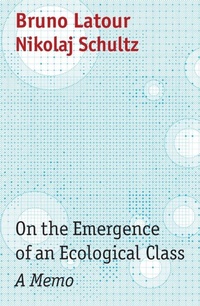
On the Emergence of an Ecological Class - a Memo
A Memo
1st Edition
Will be published approx. on 15. December 2022
Book
Hardback
80 pages
978-1-5095-5505-5 (ISBN)
Description
Under what conditions could ecology, instead of being a set of movements among others, organize politics around an agenda and set of beliefs? Can ecology aspire to define the political horizon in the way that liberalism, socialism, conservatism and other political ideologies have done at various times and places? What can ecology learn from history about how new political movements emerge and how they win the struggle for ideas, long before they can translate their ideas into parties and elections?
In this short text, consisting of 76 discussion points, Bruno Latour and Nikolaj Schultz argue that if the ecological movement is to gain ideological consistency and autonomy, it must offer a political narrative that recognizes, embraces and effectively represents its project in terms of social conflicts. Political ecology must accept that it brings along division. It must provide a convincing cartography of the conflicts it generates and, based on this, it must try to define a common horizon of collective action. In order to represent and describe these conflicts, Latour and Schultz propose to re-use the old notion of 'class' and 'class struggle', albeit infused with a new meaning in line with the ecological concerns of our New Climatic Regime. Advancing the idea of a new ecological class, assembled by its collective interests in fighting the logic of production and safeguarding our planet's conditions of habitability, they ask: how can a proud and conscious ecological class emerge and take effective action to shape our collective future?
In this short text, consisting of 76 discussion points, Bruno Latour and Nikolaj Schultz argue that if the ecological movement is to gain ideological consistency and autonomy, it must offer a political narrative that recognizes, embraces and effectively represents its project in terms of social conflicts. Political ecology must accept that it brings along division. It must provide a convincing cartography of the conflicts it generates and, based on this, it must try to define a common horizon of collective action. In order to represent and describe these conflicts, Latour and Schultz propose to re-use the old notion of 'class' and 'class struggle', albeit infused with a new meaning in line with the ecological concerns of our New Climatic Regime. Advancing the idea of a new ecological class, assembled by its collective interests in fighting the logic of production and safeguarding our planet's conditions of habitability, they ask: how can a proud and conscious ecological class emerge and take effective action to shape our collective future?
More details
Language
English
Place of publication
Oxford
United Kingdom
Target group
Professional and scholarly
Dimensions
Height: 192 mm
Width: 124 mm
Thickness: 14 mm
Weight
206 gr
ISBN-13
978-1-5095-5505-5 (9781509555055)
Copyright in bibliographic data and cover images is held by Nielsen Book Services Limited or by the publishers or by their respective licensors: all rights reserved.
Schweitzer Classification
Other editions
Additional editions
Book
12/2022
1st Edition
Polity Press
€13.00
Available immediately
E-Book
11/2022
1st Edition
Wiley
€8.99
Available for download
Person
Bruno Latour's transdisciplinary work, ranging across philosophy, history, anthropology and sociology, has positioned him as one of the world's most influential thinkers. After teaching at the Ecole des Mines in Paris from 1982 to 2006, he was appointed Professor at the Institut d'etudes politiques (Sciences Po), where he served as vice-president for research from 2007 to 2013. His many books include Laboratory Life, We Have Never Been Modern, Facing Gaia, Down to Earth and After Lockdown.
Nikolaj Schultz is a sociologist and PhD candidate at the University of Copenhagen.
Nikolaj Schultz is a sociologist and PhD candidate at the University of Copenhagen.
Content
Table of contents:I: Class struggles and classification struggles
II: A prodigious extension of materialism
III: The great turnaround
IV: A class that's legitimate again
V: A misalignment of affects
VI: A different sense of history in a different cosmos
VII: The ecological class is potentially in the majority
VIII: The indispensable and too often abandoned battle of ideas
IX: Winning power, but what kind?
X: Filling the emptiness of the public space from below
II: A prodigious extension of materialism
III: The great turnaround
IV: A class that's legitimate again
V: A misalignment of affects
VI: A different sense of history in a different cosmos
VII: The ecological class is potentially in the majority
VIII: The indispensable and too often abandoned battle of ideas
IX: Winning power, but what kind?
X: Filling the emptiness of the public space from below