

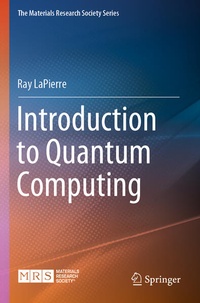
Introduction to Quantum Computing
Published on 29. September 2022
Book
Paperback/Softback
XVI, 366 pages
978-3-030-69320-6 (ISBN)
Description
This book provides a self-contained undergraduate course on quantum computing based on classroom-tested lecture notes. It reviews the fundamentals of quantum mechanics from the double-slit experiment to entanglement, before progressing to the basics of qubits, quantum gates, quantum circuits, quantum key distribution, and some of the famous quantum algorithms. As well as covering quantum gates in depth, it also describes promising platforms for their physical implementation, along with error correction, and topological quantum computing. With quantum computing expanding rapidly in the private sector, understanding quantum computing has never been so important for graduates entering the workplace or PhD programs. Assuming minimal background knowledge, this book is highly accessible, with rigorous step-by-step explanations of the principles behind quantum computation, further reading, and end-of-chapter exercises, ensuring that undergraduate students in physics and engineering emerge well prepared for the future.
More details
Product info
Book
Series
Edition
1st ed. 2021
Language
English
Place of publication
Cham
Switzerland
Publishing group
Springer International Publishing
Target group
College/higher education
Illustrations
38
240 s/w Abbildungen, 38 farbige Abbildungen
XVI, 366 p. 278 illus., 38 illus. in color.
Dimensions
Height: 235 mm
Width: 155 mm
Thickness: 21 mm
Weight
581 gr
ISBN-13
978-3-030-69320-6 (9783030693206)
DOI
10.1007/978-3-030-69318-3
Schweitzer Classification
Other editions
Additional editions
Ray LaPierre
Introduction to Quantum Computing
Book
09/2021
Springer
€53.49
Article exhausted; check for reprint
Person
Ray LaPierre attended Dalhousie University, Canada, where he obtained a B.Sc. degree in Physics in 1992. He then completed his M.Eng. degree in 1994 and Ph.D. degree in 1997 in the Engineering Physics Department at McMaster University, Canada. His graduate work involved development of molecular beam epitaxy of compound semiconductor alloys for laser diodes in telecom applications. Upon completion of his graduate work in 1997, he joined JDS Uniphase, Canada, where he developed dielectric coatings for wavelength division multiplexing devices. In 2004, he rejoined McMaster University as an Assistant Professor in the Engineering Physics Department. He is currently Professor in the Engineering Physics Department at McMaster with interests in III-V nanowires, molecular beam epitaxy, and applications in photovoltaics, photodetectors and quantum information processing.
Content
Chapter 1: Superposition.- Chapter 2: Quantization.- Chapter 3: Spin.- Chapter 4: Qubits.- Chapter 5: Entanglement.- Chapter 6: Quantum Key Distribution.- Chapter 7: Quantum Gates.- Chapter 8: Teleportation.- Chapter 10: Computational Complexity.- Chapter 11: Deutsch Algorithm.- Chapter 12: Grover Algorithm.- Chapter 13: Shor Algorithm.- Chapter 14: Physical Implementation of Single-Qubit Gates.- Chapter 15: Electron Spin Resonance.- Chapter 16: Two-state Dynamics.- Chapter 17: Physical Implementation of Two-qubit Gates.- Chapter 18: DiVincenzo Criteria.- Chapter 19: Nuclear Magnetic Resonance.- Chapter 20: Solid-state Spin Qubits.- Chapter 21: Trapped Ion Quantum Computing.- Chapter 22: Superconducting Qubits.- Chapter 23: Adiabatic Quantum Computing.- Chapter 24: Optical Quantum Computing.- Chapter 25: Quantum Error Correction.- Chapter 26: Topological Quantum Computing.