

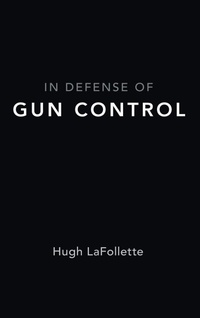
In Defense of Gun Control
Published on 30. August 2018
Book
Hardback
256 pages
978-0-19-087336-3 (ISBN)
Description
Nearly half of all privately owned firearms in the world are in American hands. The U.S. homicide rate is 6 times higher than the average of all developed countries, and more than three times higher than any individual country. Half of all homicides are committed with a firearm. Gun advocates claim that the high rate of private gun ownership does not contribute to this; some even argue that murder rates would be lower if only more people carried guns to defend themselves. Pro gun control advocates find the correlation between number of guns and gun violence an obvious one -- and that it should be the starting point for discussion about gun control. Both sides think their cases are strong, and have created a political stalemate. Can the truth of these views be evaluated rationally and dispassionately?
Hugh Lafollette argues the gun control debate is more complex than advocates on either side acknowledge. It requires resolving moral and legal questions about the nature of and limitations on rights, as well as the responsibility of government to protect citizens from risk. It requires assessing claims about the right to bear arms, as well as the right to be secure from harm caused by guns. Empirical findings must be considered--about the role of guns in causing harm, the degree to which private ownership of guns can protect innocent civilians from attacks by criminals, whether the government should be constrained by a well-armed citizenry, and the degree to which laws seriously limiting access to guns can be effectively enforced. Lafollette carefully sorts through all these conceptual, moral, and empirical claims. He concludes that all things considered, the U.S. does need more gun control than we have. He then proposes an indirect strategy for decreasing harm from firearms--requiring all gun owners to have liability insurance (something the NRA actually encourages) similar to that of car owners. Lafollette argues that this approach could reduce gun violence without the problem of government intrusion.
Painstakingly fair and historically informed, the book is mainly designed for use in applied ethics and public policy courses, showcasing how one might approach a difficult topic with care and even-handedness in order to construct a rational argument. In Defense of Gun Control sorts through the conceptual, moral, and empirical claims to fairly assess arguments for and against serious gun control.
Hugh Lafollette argues the gun control debate is more complex than advocates on either side acknowledge. It requires resolving moral and legal questions about the nature of and limitations on rights, as well as the responsibility of government to protect citizens from risk. It requires assessing claims about the right to bear arms, as well as the right to be secure from harm caused by guns. Empirical findings must be considered--about the role of guns in causing harm, the degree to which private ownership of guns can protect innocent civilians from attacks by criminals, whether the government should be constrained by a well-armed citizenry, and the degree to which laws seriously limiting access to guns can be effectively enforced. Lafollette carefully sorts through all these conceptual, moral, and empirical claims. He concludes that all things considered, the U.S. does need more gun control than we have. He then proposes an indirect strategy for decreasing harm from firearms--requiring all gun owners to have liability insurance (something the NRA actually encourages) similar to that of car owners. Lafollette argues that this approach could reduce gun violence without the problem of government intrusion.
Painstakingly fair and historically informed, the book is mainly designed for use in applied ethics and public policy courses, showcasing how one might approach a difficult topic with care and even-handedness in order to construct a rational argument. In Defense of Gun Control sorts through the conceptual, moral, and empirical claims to fairly assess arguments for and against serious gun control.
Reviews / Votes
[The book] brings new clarity and philosophical rigor to the gun control debate ... What In Defense of Gun Control most brings out, through an in-depth treatment of the arguments, is a movement away from the polarities by showing the genuine complexity of the issue. While some arguments can be (and are rightfully) summarily dismissed, a reader is likely to find something compelling in both sets of arguments as presented. This is a great strength of the book, for it can hopefully lead us to a shift away from polarized positions and into a more nuanced dialogue about what is at stake and the positions that are actually being held. It is a strong effort in this space-one of only a few such rigorously argued works in philosophy on the topic-and we recommend it to all thoughtful readers. * Bradley Jay Strawser and Bart Kennedy, Naval Postgraduate School, Monterey, CA, USA, Criminal Law and Philosophy * Makes a valuable contribution to the public debate by identifying and destroying inadequate empirical claims popular among gun rights advocates. It is also admirable for its conscientiousness and intellectual humility, for example in explaining the empirical limitations of the public health argument for gun control. It is a model for how this debate should be conducted. * Bioethics * Recommended. * CHOICE * Hugh LaFollette has offered an informative, compelling and readable contribution to the philosophical literature on America's gun debate, which, as of yet, is still relatively small. He gives an overview of three major sets of arguments for and against gun control: armchair arguments, rights based arguments, and empirical arguments. He appraises each in turn, and ultimately points out how and where the gun rights position is wanting, and why the case for gun control is stronger. He concludes by detailing several proposals for gun control. These include some well-known (and much debated) regulations, like gun registration and background checks on gun purchases, but one idea that is rather novel and little discussed, mandatory liability insurance for gun owners. * Notre Dame Philosophical Reviews *More details
Language
English
Place of publication
New York
United States
Target group
Professional and scholarly
Dimensions
Height: 235 mm
Width: 157 mm
Thickness: 18 mm
Weight
521 gr
ISBN-13
978-0-19-087336-3 (9780190873363)
Copyright in bibliographic data and cover images is held by Nielsen Book Services Limited or by the publishers or by their respective licensors: all rights reserved.
Schweitzer Classification
Other editions
Additional editions
Hugh LaFollette
In Defense of Gun Control
Book
07/2018
Oxford University Press Inc
€49.50
Shipment within 15-20 days
Hugh LaFollette
In Defense of Gun Control
E-Book
05/2018
1st Edition
OUP eBook
€19.99
Available for download
Hugh LaFollette
In Defense of Gun Control
E-Book
05/2018
1st Edition
OUP eBook
€19.99
Available for download
Person
Hugh LaFollette is Cole Chair in Ethics at the University of South Florida St Petersburg and the editor-in-chief of the International Encyclopedia of Ethics (Blackwell 2013).
Content
Acknowledgements
Preface
Chapter 1: Understanding the Issues
Chapter 2: Armchair Arguments
Chapter 3: A Framework for Rights
Chapter 4: The Right to Bear Arms
Chapter 5: Looking for Empirical Evidence
Chapter 6: The Empirical Evidence
Chapter 7: Evaluating the Empirical Evidence
Chapter 8: Why We Need Gun Control
Bibliography
Index
Preface
Chapter 1: Understanding the Issues
Chapter 2: Armchair Arguments
Chapter 3: A Framework for Rights
Chapter 4: The Right to Bear Arms
Chapter 5: Looking for Empirical Evidence
Chapter 6: The Empirical Evidence
Chapter 7: Evaluating the Empirical Evidence
Chapter 8: Why We Need Gun Control
Bibliography
Index