

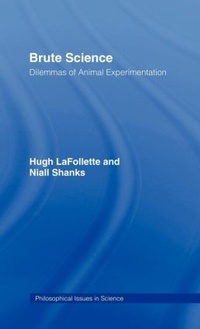
Brute Science
Dilemmas of Animal Experimentation
1st Edition
Published on 2. January 1997
Book
Hardback
298 pages
978-0-415-13113-1 (ISBN)
Description
Brute Science investigates whether biomedical research using animals is, in fact, scientifically justified.
Hugh LaFollette and Niall Shanks examine the issues in scientific terms using the models that scientists themselves use. They argue that we need to reassess our use of animals and, indeed, rethink the standard positions in the debate.
Hugh LaFollette and Niall Shanks examine the issues in scientific terms using the models that scientists themselves use. They argue that we need to reassess our use of animals and, indeed, rethink the standard positions in the debate.
Reviews / Votes
'Innovative and ambitious ... it offers a good model of how philosophy can inform ethical and scientific controversies.' - The British Journal for the Philosophy of Science'Not only compelling, but exciting. The clarity with which the debate was outlined, the diagnosis of the problem ... and the role of models in science were masterly. Brute Science is a fine example of applied philosophy. It is well written and organised and should prove of immense value to those who sit on animal and ethics committees, as well as to teachers of applied ethics and to animal welfarists.' - Jane Azevedo, Sunshine Coast University College (review symposium Metascience)
'This book is a tour di force of the issue, and should be on the required reading list of every animal experimenter, bio-ethicist and animal liberationist, each of whom will learn something for their effort.' - john Forge, University of California (review symposium Metascience)
'Brute Science is an important book. It should be read by every medical student, the members of all Institutional animal Use and Care Committees, everyone involved in the administration of research grants in the biomedical sciences, everyone at the Food and Drugs Administration and the Environmental Protection Agency, everyone in Congress involved in making legislation that concerns drug research, and even chemical and biological weapons. This is an unsettling book, a book that should force the defenders of animal experimentation to re-examine the assumptions upon which a century-old rationalisation of the experimental practice is based.' - Don Howard, University of Notre Dame Diego (review symposium Metascience)
More details
Series
Language
English
Place of publication
London
United Kingdom
Publishing group
Taylor & Francis Ltd
Target group
College/higher education
Postgraduate
Dimensions
Height: 216 mm
Width: 138 mm
Weight
476 gr
ISBN-13
978-0-415-13113-1 (9780415131131)
Copyright in bibliographic data and cover images is held by Nielsen Book Services Limited or by the publishers or by their respective licensors: all rights reserved.
Schweitzer Classification
Other editions
Additional editions
Book
08/2016
1st Edition
Routledge
€78.27
Article exhausted; check different version
Persons
Hugh LaFollette is Professor of Philosophy at East Tennessee State University; he is the author of Personal Relationships: Love, Identity, and Morality (1995) and editor of Ethics in Practice: An Anthology ( 1996). Niall Shanks is Associate Professor of Philosophy and Adjunct Professor of Biological Sciences at East Tennessee State University.
Content
Preface -- Acknowledgments -- Part I Understanding the debate -- 1 A FIRST LOOK: THE PRIMA-FACIE CASES -- 2 THE PROBLEMS OF RELEVANCE -- 3 CLAUDE BERNARD: THE FOUNDER OF THE PARADIGM -- 4 THE CURRENT PARADIGM -- 5 EVOLUTION I: SPECIES AND SPECIES DIFFERENCES -- 6 EVOLUTION II: THE WIDENING SYNTHESIS -- Part II Evaluating animal experimentation: the scientific issues -- 7 CAUSAL DISANALOGY I: STRONG MODELS -- AND THEORETICAL EXPECTATIONS -- 8 CAUSAL DISANALOGY II: THE EMPIRICAL EVIDENCE -- 9 CAUSAL DISANALOGY III: WEAK MODELS -- 10 EVADING CAUSAL DISANALOGY: IT JUST WORKS -- 11 AVOIDING CAUSAL DISANALOGY: TRANSGENIC ANIMALS -- 12 BASIC RESEARCH -- Part ill Evaluating animal experimentation: the moral issues -- 13 THE MORAL DEBATE IN HISTORICAL CONTEXT -- 14 SPECIESISM: THE DEONTOLOGICAL DEFENSE -- 15 INCALCULABLE BENEFITS: THE CONSEQUENTIALIST DEFENSE -- 16 CONCLUSION -- Bibliography -- Index.